SCOTCAT.COM
your internet guide to all things catfish
FACTSHEETS: January 2009 - no. 151
Mystus bimaculatus (Volz, 1904) |
Mystus bimaculatus
Mystus bimaculatus belongs to the family Bagridae from Asia namely Sumatra Indonesia and Malaysia. This catfish is documented as being found in the peat swamps of Sumatra. Mystus bimaculatus is sometimes thought of as being a member of the family Pimelodidae from South America, which clearly it is not due to the fact that this fish has nasal barbels, which is something that pimelodids lack, also coupled with the fact that this fish is Asian in origin. This particular species is not commonly available, but is well worth looking out for and is ideal for smaller aquariums.
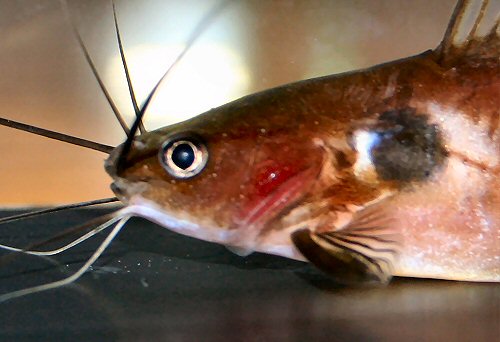
Mystus bimaculatus - head view
Mystus bimaculatus prefer to be kept in water which has a pH in the range of 6.0-7.0. This catfish is ideally suited to temperatures in the range of 22-27ºC or 71-81ºF. I would suggest an Aquarium size of minimum, 48” x 18” X 18” for a small shoal of these catfish, with plenty of hiding places amongst bogwood and rocks. The ideal aquarium substrate to use with these catfish is aquarium sand such as BD Aquarium Sand. As with all other species of fish, water quality and general husbandry is very important, and I would recommend that a minimum of 25% water is changed on a weekly basis. The natural habitat for this catfish is under serious threat from human activity in the region.
|
 or our first Factsheet of 2009
we welcome back regular contributor Chris Ralph
and a look at a member of the Bagridae family,
the two-spot catfish, Mystus bimaculatus.
I will now hand you over to Chris
for the lowdown on this pretty species.
or our first Factsheet of 2009
we welcome back regular contributor Chris Ralph
and a look at a member of the Bagridae family,
the two-spot catfish, Mystus bimaculatus.
I will now hand you over to Chris
for the lowdown on this pretty species.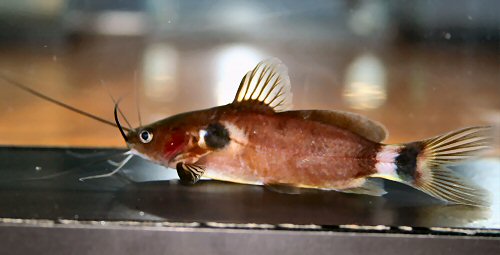
Common Name |
Two Spot Catfish, Two Spot Pink Pim |
Synonyms |
Macrones bimaculatus |
Family |
Bagridae |
Subfamily |
Bagrinae |
Distribution |
Asia: Sumatra, Indonesia and Malaysia. |
Size |
125mm s.l. (standard length – this is the measurement of the fish from the tip of the snout to the base of the caudal peduncle). |
Temp. |
22-27°C (71-81°F) |
p.H. |
6.0-7.0 |
Characteristics |
The body of Mystus bimaculatus is generally described as being torpedo, cigar shaped or moderately elongated. The nostrils are described as being well separated. There are four pairs of barbels, two pairs of mandibular barbels, one pair of maxillary barbels and one pair of nasal barbels. All of the barbels are described as being long with the nasal barbels extending beyond the eyes and the maxillary barbels extending beyond the base of the anal fin. The adipose fin is described as being much longer than the base of the anal fin starting directly behind the dorsal fin and extending almost to the base of the caudal fin. |
Colouration |
The base colour of the body and head is described as being uniform pale brown to almost pale pink in juvenile specimens. The colour tends to pale towards the belly region. This catfish is described as having two dark spots along the body with one being situated behind the head, and the other on the caudal peduncle, both of which are bordered with white colouration. As the fish matures these spots especially the one at the base of the caudal fin tend to fade. The remaining fins are described as being clear to yellowish in colour. |
Aquarium Care & Compatibility |
| Wherever possible I would recommend that the aquarist keep these catfish in a community aquarium in small groups of six or more, but as the absolute minimum I would suggest three specimens assuming that they are available in these numbers. These catfish should not be kept with fish small enough to fit inside their mouths as they would soon form part of their diet. Ideal tank mates would include fish such as pearl gourami’s, golden barbs and Odessa barbs to name but a few. In their natural habitat Mystus bimaculatus would be found in relatively large shoals. |
Reproduction |
There are no documented reports of aquarium spawnings of Mystus bimaculatus. |
Sexual Differences |
As with most other species of catfish the males tend to be more slender than the females. It is documented that the males have small fleshy appendages just prior to the anal fin which have a sexual function. |
Diet |
| As with all the other catfish that I have had the pleasure to keep over the years, Mystus bimaculatus readily accepts a mixed and varied diet which includes granular foods, frozen bloodworm and good quality flake to name but a few. |
Glossary of Terms |
Adipose
is defined as a second dorsal fin. |
Etymology |
| Mystus
from “mystax”
meaning whiskered or moustache (hair on the upper
lip). Mystus was first used by Belon in 1553 to describe
all fish with whiskers. |
Photo Credits |
By Author. |
|

If you would like to contribute to the monthly factsheets with an
article, information or photos, please e-mail
me. You will of course be credited for your work.
If you would like to donate any denomination of money to the site just click the above link button. All proceeds will go to running the site and hopefully to keep it going for a few years yet.
ScotCat Sources
 Etymology-genera
Etymology-specific name
Online Sources
 Search
 Fishbase
 Catalog of Fishes
 GBIF
GBIF
 Fishnet2
 iNaturalist

