SCOTCAT.COM  

your internet guide to all things catfish
≡
  • HOME
  • FACTSHEETS
    • By Month/Year
    • By Family
    • by Genus
    • by Common Names
    • By Specific Names
    • By Continent
      • Index
      • Africa
      • Asia
      • Australasia
      • Europe
      • North America
      • South America
  • GALLERIES
    • Photo Gallery
    • Art Gallery
    • Movie Gallery
    • Stamps Gallery
  • FAMILIES
    • A-B
      • Ailiidae
      • Akysidae
      • Amblycipitidae
      • Amphiliidae
      • Anchariidae
      • † Andinichthyidae
      • Ariidae
      • Aspredinidae
      • Astroblepidae
      • Auchenipteridae
      • Auchenoglanididae
      • Austroglanididae
      • Bagridae
    • C-D
      • Callichthyidae
      • Cetopsidae
      • Chacidae
      • Clariidae
      • Claroteidae
      • Cranoglanididae
      • Diplomystidae
      • Doradidae
    • H-I
      • Heptapteridae
      • Heteropneustidae
      • Horabagridae
      • Ictaluridae
    • K-L-M
      • Kryptoglanidae
      • Lacantuniidae
      • Loricariidae
      • Malapteruridae
      • Mochokidae
    • N-P
      • Nematogenyidae
      • Pangasiidae
      • Phreatobiidae
      • Pimelodidae
      • Plotosidae
      • Pseudopimelodidae
    • R-S-T
      • Ritidae
      • Schilbeidae
      • Scoloplacidae
      • Siluridae
      • Sisoridae
      • Trichomycteridae
  • ARTICLES
    • Index
    • Breeding
    • By Author
    • Cat-Articles
    • General
    • Numbered List
    • Ichthyology
    • Travel/Collecting
  • IDENT-A-CAT
  • RESOURCES
    • Citation
    • Etymology
    • Fishhouse
    • Glossary
    • Scientific Papers
    • ScotShop
  • SITE MAP
  • FB GROUP
  • HELP
    • Index
    • Catfish Anatomy
    • Convertors
    • FAQ
    • Ident-A-Cat
    • Water Chemistry

FACTSHEETS: November 2025 - no. 353

 Noturus flavipinnis Taylor, 1969


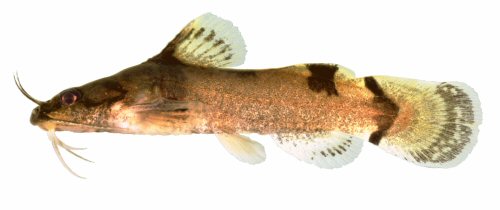
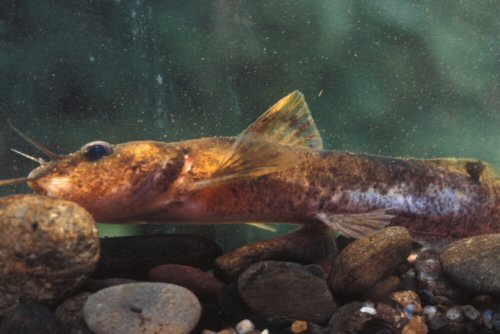
ne of my favourite genera from the North American continent is the the Noturus genus and as a U.K. resident it is quite frustrating that we cannot see them here due to the ban by the U. K. Government through the Ministry of Agriculture, Fisheries and Food (MAAF) to impose restrictions on some coldwater species like the above mentioned "Yellowfin madtom", due to the dangers of introduction to native waters and the threat to its occupants through disease and predation. As you can see with the image below, the "Yellowfin Madtom" has a stout body with the deepest point located in front of the dorsal fin.
 

Noturus flavipinnis

    Noturus flavipinnis


There are about 25 species or so of the genus Noturus, commonly called madtoms, and they, of course, belong to the same family as the bullheads and channel catfish, the Ictaluridae. The name Noturus means "back tail" and refers to the fusion of the adipose and caudal fins (in some species), which tends to give them a tadpole-like appearance.

This species is generally regarded as rare, but it is difficult to inventory due to its secretive and nocturnal habits. A tiny population exists in Copper Creek (Burkhead and Jenkins 1991, Jenkins and Burkhead 1994; Conservation Fisheries, Inc.). Data from the 1980s indicated a population of about 500 adults in Citico Creek (Shute 1984); surveys there in the early 2000s found record numbers of Yellowfin Madtoms (Conservation Fisheries, Inc.). Surveys in 2004 found numerous Yellowfin Madtoms in the upper Clinch River (Conservation Fisheries, Inc., newsletter, December 2004). Recent surveys indicate that the Powell River population is more widespread and larger than formerly known (IUCN 2013).

Old records of Yellowfin Madtom from Lyons Creek at the Tennessee River in Tennessee may actually pertain to Noturus eleutherus (see Jenkins and Burkhead 1994).


Noturus flavipinnis

 Noturus flavipinnis - head view


The madtoms, genus Noturus, are equipped with a venom gland at the base of the pectoral spine, which is often grooved, enabling them to inflict a painful, although not serious sting. As such, you must be very aware that it can give you a very sore hand, so you will have to be careful when catching or moving these fish. It is a venomous toxin that forms part of the mucus coating on these spines. In some cases, this can last a few hours with swelling of the infected area. This, of course, is a deterrent to large predators to keep well away and is an excellent defence mechanism.

Jason Leaman from Pennsylvania talks about a close species in N. insignis, and he states that "if you get stung by the Stonecat, the best relief right away, ironically, is to rub the wound onto the fish (anywhere you won't get stung again). I have never had the sting last more than about 30 seconds. It's really not too painful; however, it throbs a bit briefly. I don't know how long it would actually last if I didn't use the Stonecats' own medicinal value of its oily flesh"


North America: USA in upper Tennessee River drainage in Virginia, Tennessee and Georgia. Populations extant in Copper Creek in Virginia, Powell River in Tennessee and Citico Creek in Tennessee; extirpated from North Fork Holston River in Virginia, Chickamauga Creek in Georgia and Hines Creek in Tennessee.


The upper Tennessee River drainage in Virginia consists of the Clinch, Holston, and Powell rivers, which flow southwest through 11 southwestern counties and drain about 8% of the state. The Holston is actually a system of three forks (North, Middle, and South), and the Powell River is a major tributary of the Clinch. This region is known for its karst topography, created by the dissolution of carbonate rocks like limestone, which results in features like sinkholes, caves, and disappearing streams.

Major threats to this species are impoundments, chemical spills, mining, dredging, and pollution (USFWS, Virginia Field Office). Some historical populations were lost due to water impoundment and pollution. Powell River population is threatened by coal- and gravel-mining operations in and near the upper Powell River (Etnier and Starnes 1993). Citico Creek population potentially is threatened by acid contamination related to the shale chemistry in the region. Some reaches of Copper Creek, Virginia, have been impacted by heavy cutting of riparian brush and trees (Burkhead and Jenkins 1991) and by agricultural run-off (Conservation Fisheries, Inc.).

Update: As of November 1998, in the U.K., you must have a licence to keep the above species. This licence may be free (check the website below), but it does take a few months to process. There have been numerous updates since 1998, so it would be better to check this out. For more information, log on to the DEFRA site and also get a phone number if needed.


Common Name

Yellowfin madtom

Synonyms

None

Family

Ictaluridae

Subfamily

-

Habitat

Inhabits pools and backwaters around slab rocks, bedrock ledges and tree roots in clear creeks and small rivers. Habitat includes medium-sized and large creeks and small rivers that are unpolluted, warm or warm to cool, usually relatively unsilted (Powell River may be very silty), and of moderate to gentle gradient. This species generally occurs in slow pools and occasionally small backwaters off runs and riffles, rarely in runs. It is generally under cover (sticks, logs, leaf litter, undercut banks, tree roots, rocks, trash) during daylight hours. At night, it is often on the streambed in open, clean gravel and rubble areas away from banks and riffles. It may occur in slightly to moderately silted bank areas during the day or night.

Distribution

North America: USA in upper Tennessee River drainage in Virginia, Tennessee and Georgia. Populations extant in Copper Creek in Virginia, Powell River in Tennessee and Citico Creek in Tennessee; extirpated from North Fork Holston River in Virginia, Chickamauga Creek in Georgia and Hines Creek in Tennessee.

Size

13.0cm. (5¼ins)

Temp.

16-23°C (59-73°F)

p.H.

6.5-7.0.

Characteristics

The adipose fin is nearly free from the caudal fin. The caudal fin is straight or slightly rounded. The pectoral spine has 4-10 large teeth on the rear edge and several large teeth on the front edge. The anal fin has 14-16 rays.

Colouration

The body is yellow with dark mottling, specks and 4 dark saddles above, and is yellow to white below. A brown saddle in front of the dorsal fin usually encloses 2 light spots. The fins are yellow with dark bands or mottling at the middle and near the edges. A bold black bar on the base of the caudal fin extends from the top to the bottom of the fin. The dark saddle under the adipose fin extends to the edge of the fin. The caudal fin has a pale edge.

Aquarium Care & Compatibility

The Madtoms are well suited to aquarium life. Provide river gravel and smooth rounded stones for hiding places during the day. A power filter at one end of the tank will provide the conditions of a flowing stream for these catfish. Can be housed with other North American fishes such as minnows, darters and shiners.

Reproduction

Madtoms have very rarely been produced in home aquaria. As far as I am aware, no madtoms have been bred in the U.K., but some successes have been recorded in the U.S. and Canada. Spawning can take place in Spring or Summer, with higher temperatures to trigger the spawning. They exhibit parental care, with the male or both sexes guarding the clutch. The life expectancy is three to four years, and they will be sexually mature in two years. Eggs are laid in cavities beneath flat rocks in pools at depths of usually less than 1m. For further information, see Burkhead and Jenkins (1991), Jenkins and Burkhead (1994), and Dinkins and Shute (1996).

Sexual differences

Not recorded but usually the females are more rotund.

Diet

They like most meaty food, such as cut-up earth worms, frozen blood worm and prawns. They will also take tablet and pellet foods. A varied diet will keep them in optimum health.

Glossary of Terms

Adipose fin: Fleshy finlike projection without rays, behind the rayed dorsal fin.
Anal fin: The median, unpaired, ventrally located fin that lies behind the anus, usually on the posterior half of the fish.
Caudal fin: The tail.
Dorsal fin: The primary rayed fin(s) on top of the body.
Pectoral fin: The paired fins just behind the head.

Etymology

Noturus: Meaning "Back Tail" referring to the fusion of the adipose and caudal fins.
flavipinnis: flavus (L.), yellow; pinnis, Neo-Latin adjective of pinna (L.), fin, i.e., finned, referring to its yellowish dorsal fin.

IUCN Red List

This species is listed as Vulnerable because the estimated number of locations (based on well-established populations) is not more than five. Extent of occurrence and area of occupancy are small, but distribution, abundance, and habitat quality do not appear to be declining (needs updating IUCN 2013).

References

Florida Museum of Natural History
IUCN, International Union for Conservation of Nature and Natural Resources 1990 1990 IUCN red list of threatened animals.
IUCN, Gland, Switzerland and Cambridge, U.K. 288 p.

Knopf
, The Audubon Society Field guide to North America Fishes, Whales & Dolphins, 1986.
Leaman, Jason
. pers comm.
NatureServe. 2013. Noturus flavipinnis. The IUCN Red List of Threatened Species 2013.

Schleser David M.;
North American Native Fishes for the Home Aquarium. Barron's Educational Series. Inc. 1998. 169 p.
The ETYFish Project Fish Name Etymology Database © Christopher Scharpf.

Photo Credits

© Noel Burkhead / Creative Commons

© Dick Biggins @ UFWS
© Map: Google Maps 2025.

Donate towards my web hosting bill!


If you would like to contribute to the monthly factsheets with an article, information or photos, please e-mail me. You will, of course, be credited for your work.


If you would like to donate any amount of money to the site, simply click the link above. All proceeds will go to running the site and hopefully to keep it going for a few years yet.


ScotCat Sources

Etymology = Genus Etymology-genus name

Etymology = Species Etymology-specific name


Other Sources

Search  Search

Fishbase Fishbase

Wikipedia WikiPedia

Catalog of Fishes Catalog of Fishes

Global Biodiversity Information Facility GBIF

FishNet2 FishNet2

iNaturalist iNaturalist

IUCN IUCN

  • Facebook about us + contact us + citation + translate + site map + scotshop + glossary + etymology +
  • help YouTube

©2025 SCOTCAT.COM