SCOTCAT.COM
your internet guide to all things catfish
FACTSHEETS: December 1999 - no. 042
Noturus flavus Rafinesque, 1818 |
Noturus flavus
Noturus flavus is commonly called the 'Stonecat' because of its tendency to hide beneath flat rocks in fast flowing riffles and runs among stones on the river bed, where it resides in moderate to large streams..
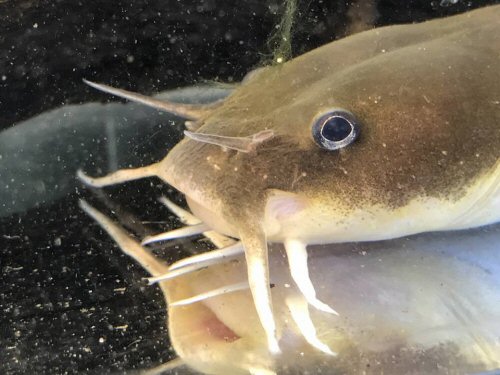
Noturus flavus - head view
I have never seen any madtom species in the U.K. for sale in the retail shops, and it is one genus that I would dearly love to have had, at one time or another ( hint, hint, to our American aquarist friends). The nearest I got to them was when the first coldwater darters where brought into this country from the U.S. about 10 years ago (1989) and I purchased the beautiful Rainbow Darter, Etheostoma caeruleum. At the time there were rumours that madtoms had also been imported, but alas not one to be seen. In these days there was no restrictions on keeping the more exotic coldwater species but now echoing that great song of the past, "Times they are a changing " (*see below). The main talking point of N. flavus and other madtoms is the venom contained in the dorsal and pectoral spines of this genus which can give a very nasty sting, it is a venomous toxin that forms part of the mucus coating on these spines. In some cases this can last a few hours with swelling of the infected area. This of course is a deterrent to large predators to keep well away and is an excellent defence mechanism. *Jason Leaman from Pennsylvania talks about a close species in N.insignis and he states that "if you get stung by the Stonecat, the best relief right away ironically is to rub the wound onto the fish (anywhere you won't get stung again). I have never had the sting last more than about 30 seconds. Its really not too painful, however throbs a bit briefly. I don't know how long it would actually last if I didn't use the Stonecats own medicinal value of its oily flesh" This madtom and others in the same genus have been an ambition to a lot of U.K. catfish keepers to own (myself included) but with a few of them being in the endangered list in their own habitat, and with the U.S. Government and our own Government restrictions, it looks like we will just have the pictures to drool over. There is now
moves afoot by the Government ( U.K.) through the
Ministry of Agriculture, Fisheries and Food (MAAF)
to impose restrictions on some coldwater species like
the above mentioned 'Stonecat', due to the dangers
of introduction to native waters and the threat to
its occupants through disease and predation. In other
words you could be paying up to £30 for a license
to keep them. In the future due to the exporters having
to implement new guidelines on matters such as health
records for each fish, they could become quite rare
in the U.K.
|
 here
is about 25 species or so of the genus Noturus,
commonly called, madtoms, and they of course belong
to the same family as the bullheads and channel catfish,
the Ictaluridae. The name Noturus means
"back tail" and refers to the fusion of
the adipose and caudal fins (in some species) which
tends to give them a tadpole-like appearance.
here
is about 25 species or so of the genus Noturus,
commonly called, madtoms, and they of course belong
to the same family as the bullheads and channel catfish,
the Ictaluridae. The name Noturus means
"back tail" and refers to the fusion of
the adipose and caudal fins (in some species) which
tends to give them a tadpole-like appearance. 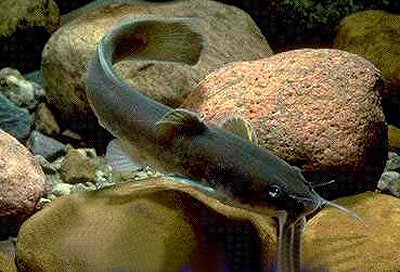
Common Name |
Stonecat Madtom |
Synonyms |
None |
Family |
Ictaluridae |
Subfamily |
- |
Distribution |
North America: St. Lawrence-Great Lakes, Hudson Bay (Red River) and Mississippi River basins from Quebec to Alberta in Canada, and south to northern Alabama, northern Mississippi, and northeastern Oklahoma, USA; Hudson River drainage in New York, USA. |
Size |
22.5cm. (9ins) |
Temp. |
05-23°C (37-73°F) |
p.H. |
6.0-7.0 |
Characteristics |
The body is slender, and compressed posteriorly; the head and nape are broad and depressed; the mouth is subterminal; eye small to moderate. The pectoral spine is straight; the surface usually only roughened, and lacking prominent serrae. The genital papilla is conical and a ventral apical notch is present. The upper jaw projects beyond the lower jaw. The tooth pad on the upper jaw has a narrow, crescent-shaped extension on each side. The notch between adipose and tail fins are closer to tip of tail fin than to the dorsal fin base. The dorsal fin has 1 spine, (5)6 rays. The upper caudal rays number (27) 29-33(36) and the lower caudal rays (26)27-31(33). Anal rays 15-18(19); pelvic rays (8)9-10; the pectoral has 1 spine and 9-11 rays. |
Colouration |
Back and side gray, olive, or brown, often with a yellowish cast; postdorsal spot yellow; fins with a pale yellow cast, blotches gray to blackish. |
Aquarium Care & Compatibility |
| This is one of the bigger madtoms growing to a foot in length in the wild, (smaller in the aquarium) compared to most of the other species which grow to between 4 and 5 inches. Not having kept this species myself the data that I have collated points to a large tank ( 4' 0") with a gravel bottom with no heater of course with an external filter and good water movement. They are very nocturnal so plenty of hiding places, large rocks or slate would suffice, they would then venture out at night for feeding, and would be able to be seen with the tank lights off and with one small light on in the viewing room. |
Reproduction |
As far as I am aware, no madtoms have been bred in the U.K.but some successes have been recorded in the U.S. and Canada. Spawnings in the wild for Noturus flavus takes place in Spring or Summer with higher temperatures to trigger spawning. According to Scott and Crossman (1979) the eggs, which number between 20 and 100 are deposited in a cavity beneath a rock or other structure. The eggs are amber-yellow and are very large, ranging between 3.5 and 4mm diameter, with the whole egg mass enveloped by a gelatinous material. A female stonecat may produce between 200 and 1,200 eggs per year. They exhibit parental care, with the male or both sexes guarding the clutch. |
Diet |
| In their native habitat they will feed on aquatic insects and crustaceans. Aquarium specimens do prefer live feeding including glass shrimp, whiteworm, earthworms and bloodworms, but you might be able wean them on to frozen food, shrimp pellets and carnivore flake. |
Etymology |
| Noturus:
Meaning "Back Tail" referring to the fusion
of the adipose and caudal fins. |
IUCN Red List |
Listed as Least Concern in view of the large extent of occurrence, large number of subpopulations, large population size, and lack of major threats. Trend over the past ten years or three generations is uncertain but lilely relatively stable, or the species may be decling but not fast enough to qualify for any of the thretened categories under Criterion A (reduction in population size), (needs updating IUCN 2013). |
References |
Burgess,
Peter Dr. The Madtoms N.A.C.G.Sept.1997. |
Photo Credits |
©
|

|

If you would like to contribute to the monthly factsheets with an
article, information or photos, please e-mail
me. You will of course be credited for your work.
If you would like to donate any denomination of money to the site just click the above link button. All proceeds will go to running the site and hopefully to keep it going for a few years yet.
ScotCat Sources
 Etymology-genera
Etymology-specific name
Online Sources
 Search
 Fishbase
 Wikipedia
 Catalog of Fishes
 GBIF
GBIF
 Fishnet2
 iNaturalist
 IUCN
IUCN

