SCOTCAT.COM
your internet guide to all things catfish
FACTSHEETS: November 2007 - no. 137
Otocinclus cocama Reis, R.E, 2004 |
|
Otocinclus cocama
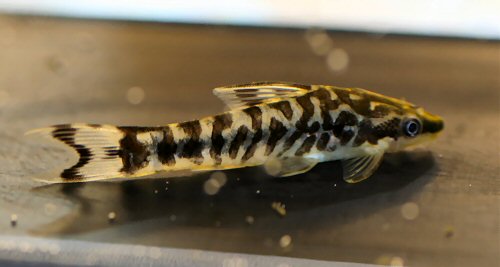
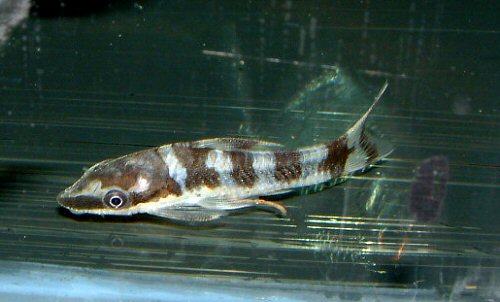
This Otocinclus is of course very distinctive and as such can be identified from all other members of this genus by the vertically elongated blotches spanning from the dorsal midline to the ventral border of flanks, and by a complete lateral line. There seems to be a wide diversity of markings on individual species but they all seem to have the same distinctive blotch shape on the caudal peduncle and the "W" shape band in the caudal fin. The Otocinclus genus on its own has 15 recognised species and a few others that have still to be described and was revised in 1997 by Schaefer with 13 species as valid. A gap of 55 years had occurred between the description of O. macrospilus Eigenmann & Allen, 1942 and Schaefer’s (1997) revision of Otocinclus, where five new species were described. After 1997, four additional species have already been found. O. tapirape Britto & Moreira, 2002, O. mimulus Axenrot & Kullander, 2003, this months subject, Otocinclus cocama Roberto E. Reis, 2004, and another yet undescribed species from Peru and Colombia.
Otocinclus cocama
|
 his
Loracariid, in my personal opinion, rivals the most
revered member of this Family, the "Zebra Plec",
his
Loracariid, in my personal opinion, rivals the most
revered member of this Family, the "Zebra Plec",
Common Name |
Zebra Oto |
Synonyms |
None |
Family |
Loricariidae |
Subfamily |
Hypoptopomatinae |
Distribution: |
South America: Peru, Lower Ucayali and Marañon Rivers. Type locality: quebrada Yanayacu (approx. 04º55'S, 073º43'W), tributary to the caño of the cocha Supay in Jenaro Herrera, Provincia Requena, Departamento Loreto, Peru. |
Size |
4.0cm. (1¾ins) |
Temp. |
21-25°c (69-77°f.) |
p.H. |
6.0-7.5. |
Characteristics |
Dorsal spines (total): 2 - 2; Dorsal soft rays (total): 7 - 7; Anal spines: 1; Anal soft rays: 5; Vertebrae: 28. Can be distinguished from all its congeners by the following: unique, distinct color pattern consisting of vertically elongated blotches spanning from the dorsal midline to the ventral border of flanks; complete lateral line, without the gap plates (midbody plates without lateral line perforations) present in other Otocinclus. Can also be differentiated by having a high number of teeth (30-45 in premaxilla and 23-36 in dentary). Differs from Otocinclus huaorani, Otocinclus mura and Otocinclus bororo by having a small metapterygoid channel and one W-shaped mark in the caudal fin. |
Colouration |
Ground colour of head and dorsum bluish white to slightly creamy yellowish. Dorsum of head and snout between nares black. Lateral portions of snout and postorbital region of head also black, leaving narrow, V-shaped white band beginning at snout tip, passing through nares and above orbits, and progressing laterally through compound pterotic (the cranium). Ventral margin of snout darkened but head otherwise white or pale yellowish ventrally. Color pattern of dorsum of body and flanks formed by four black or dark gray, saddle-shaped blotches; one at origin of dorsal fin, second behind dorsal-fin base, third between dorsal and caudal fins, and fourth at base of caudal fin. Caudal fin with W-shaped vertical band in distal half, but leaving narrow hyaline band at margin. Base of two central caudal-fin rays usually black, as prolongation of last caudal peduncle black blotch. |
Aquarium Care & Compatibility |
| Peaceful, a good community fish alongside small upper swimming inhabitants. |
Reproduction |
Not reported. |
Sexual Differences |
Males are usually smaller than females and have a conical urogenital papilla behind the anal tube, which is not present in females. Also, males possess a skinflap on the dorsal surface of the unbranched pelvic-fin ray, which is absent in females. Finally, males have a small contact organ formed by an odontode swirl at ventral margin of the caudal peduncle, near the caudal fin base. |
Diet |
| Algae and vegetable based foods such as cucumber and courgette ( zucchini). Will also accept tablet food and frozen bloodworm and vegetable based flake food. |
Glossary of Terms |
Medial:
Middle or inner. |
Etymology |
| Otocinclus:
Oto = ear; cinclus = a latticework, (an
allusion to the holes in the head in the region of
the ear). |
IUCN Red List |
The species has a very restricted range (its extent of occurrence (EOO) is 1,350 km²), it occurs at a single location, and it is exposed to intense collection for the ornamental trade that may be causing a decline in the number of mature individuals. Hence, it is listed as Endangered. However, if the species is found to occur more widely, the assessment should be revised. Needs updating (IUCN 2016). |
References |
Ferraris,
C.J. Jr., 2007.
Checklist of catfishes, recent and fossil (Osteichthyes:
Siluriformes), and catalogue of siluriform primary
types. Zootaxa 1418:1-628. |
Photo Credits |
© Allan
James @
|

|

If you would like to contribute to the monthly factsheets with an article, information or photos, please e-mail me. You will of course be credited for your work.
If you would like to donate any denomination of money to the site just click the above link button. All proceeds will go to running the site and hopefully to keep it going for a few years yet.
ScotCat Sources
 Etymology-genera
Etymology-specific name
Online Sources
 Search
 Fishbase
 Wikipedia
 Catalog of Fishes
 GBIF
GBIF
 Fishnet2
 iNaturalist
 IUCN
IUCN

