SCOTCAT.COM
your internet guide to all things catfish
FACTSHEETS: April 1998 - no. 022
Peckoltia brevis (La Monte, 1935) |
|
Peckoltia brevis
There are over 50 species (2015) in this genera, described and non described (L-numbers), and most of them are very difficult to put a name to unless you have a location specified. Work is still being done on the Peckoltia genus, plus the genus Hemiancistrus is also very much alike. The colour pattern tends to go from a spotted head to brown bands on a lighter coloured background.
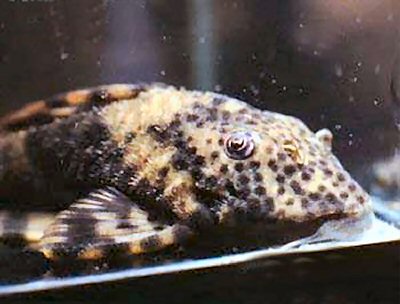
Peckoltia brevis - head view
The fish in question in the above photograph is a male as you can just see the short odontodes (spines) covering the front edge of the pectoral fins and parts of the main body just behind the gill plates, these spines run the full length of the body, they also produce them on the hard rays of the caudal fin. The females are devoid of this character and I find that they are not quite as colourful as the males, being that bit darker. To sum up, Peckoltia brevis is an ideal loricariid catfish as they are quite peaceful with their own kind, easier to keep, and usually cheaper to buy than some of their L- number companions that are around at the present time. The only problem is finding them in the aquatic outlets as all the new L-numbers seem to be more popular (and costlier), so the best bet would be to pick them up, if you are lucky, in one of the fish auctions that abound throughout the U.K. This species was featured in the DATZ magazine of Feb. 1996, pages 74-75 as L205. similar form also to L008.
|
 his
is an ideal community catfish as it is quite a hardy
character living quite happily in different water
conditions as long as they are not too extreme and
they are aclimatised slowly to them. They are not
too happy when the nitrates rise to an unacceptable
level, so keep the water changes up if you experience
high levels, or plant heavily as they don't seem to
harm plants.
his
is an ideal community catfish as it is quite a hardy
character living quite happily in different water
conditions as long as they are not too extreme and
they are aclimatised slowly to them. They are not
too happy when the nitrates rise to an unacceptable
level, so keep the water changes up if you experience
high levels, or plant heavily as they don't seem to
harm plants.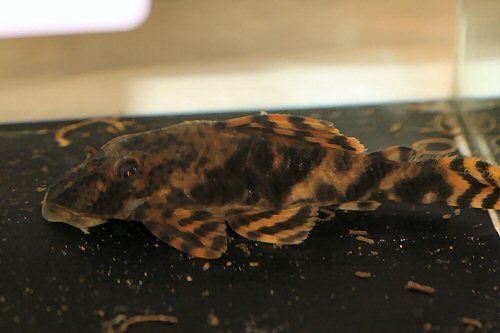
Common Name |
LDA078, Spotted Peckoltia |
Synonyms |
Hemiancistrus brevis |
Family |
Loricariidae |
Subfamily |
Hypostominae |
Distribution |
South America: Brazil, in the Rio Purus and the Rio Jurua. |
Size |
12.0cm. (4¾ins) |
Temp. |
22-26°c (71-77°f) |
p.H. |
6.0-7.2. |
Characteristics |
Elongated, evertible cheek odontodes.Three predorsal plates. Abdomen entirely covered in small plates. Five rows of plates on the caudal peduncle. The teeth are not specialized. |
Colouration |
Colour pattern typically consists of a spotted head and fins and dark saddles or bars on a tan body (the bars may be somewhat broken giving a more mottled appearance). |
Aquarium Care & Compatibility |
| They like their own territory in the aquarium as males will sometimes spar with other males, but usually nothing comes of this confrontation as long as they have their own caves, be it PVC pipes, ceramic pots or even under flat stones that have been built up on the substrate. |
Reproduction |
Not easy. Good water quality and water changing at the right time. They lay their eggs in caves (pipes) and the male guards them for about 10 days. The feeding of courgette (zucchini) and peas taken out of their shell seems to be a precondition for the successful spawning of the Peckoltia genus. |
Sexual Differences |
The males have short odontodes (spines) covering the front edge of the pectoral fins and parts of the main body just behind the gill plates, these spines run the full length of the body, they also produce them on the hard rays of the caudal fin. The females are devoid of this character and I find that they are not quite as colourful as the males, being that bit darker. |
Diet |
| As mentioned above, they love courgette (zucchini), half cook them, sliced, in a pot of water and then frozen for future use. They are also partial to peas now and again. I find they are not a great algae eater like their Chatasoma cousins. I feed also algae wafers and tablet food, they are also keen on frozen bloodworm. Not a hard species to feed as again they are not too fussy. |
Etymology |
| Peckoltia:
Named for Snr. Gustavo Peckolt of the Natural History
Commission of Rondon. |
IUCN Red List |
Despite the little information available on this species, it has a large range (that is likely to be wider than currently known) and no apparent threats. Therefore, it is assessed as Least Concern (IUCN 2023). |
References |
Jon
Armbrusters Loricariid Home Page. |
Photo Credits |
©
Allan James @
|

|

If you would like to contribute to the monthly factsheets with an article, information or photos, please e-mail me. You will of course be credited for your work.
If you would like to donate any denomination of money to the site just click the above link button. All proceeds will go to running the site and hopefully to keep it going for a few years yet.
ScotCat Sources
 Etymology-genera
Etymology-specific name
Other Sources
 Search
 Fishbase
 Wikipedia
 Catalog
of Fishes
Catalog
of Fishes
 GBIF
GBIF
 Fishnet
 iNaturalist
 IUCN
IUCN

