SCOTCAT.COM
your internet guide to all things catfish
FACTSHEETS: August 2016 - no. 242
Peckoltia lujani Armbruster, Werneke & Tan, 2015 |
|
Peckoltia lujani
P. lujani was listed for many years as Ancistrinae sp. (L127) due to the overlaps of traits to different genera. It was given two L-numbers, L127 (DATZ 05/1993) and L207 (DATZ 03/1996) which are one and the same species. As of the paper by Armbruster et al. (2015) this species has now been moved into the Peckoltia genus and described and also the sub-family Hypostominae. There are over 50 species (2015) in this genera, described and non described (L-numbers), and most of them are very difficult to put a name to unless you have a location specified. Work is still being done on the Peckoltia genera, plus the genus Hemiancistrus which are very alike. The colour patterns in Peckoltia tends to go from a spotted head to brown bands on a lighter coloured background.
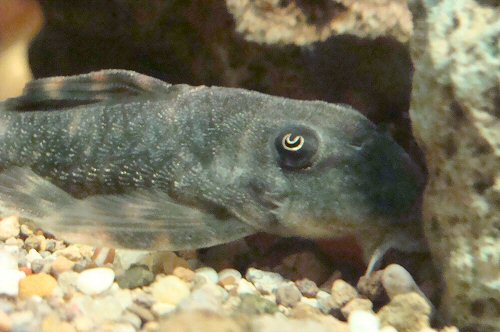
Peckoltia lujani - head view
Not the most colourful of catfish but if you are starting out with a tentative dip into the large and diverse species that makes up the Loricariids you could do no worse than the Peckoltia genera and a start with Peckoltia lujani aka L127/L207. The specific name is in honour of the former graduate student of JWA, Dr. Nathan Lujan. Dr. Lujan who has led expeditions to some of the most remote regions of South America and obtained some of the most important specimens for the study of loricariid systematics specifically as well as South American fish systematics and ecology in general.
|
 his
is an ideal community catfish as it is quite a hardy
character living quite happily in different water
conditions as long as they are not too extreme and
they are aclimatised slowly to them. They are not
too happy when the nitrates rise to an unacceptable
level, so keep the water changes up if you experience
high levels, or plant heavily as they don't seem to
harm plants.
his
is an ideal community catfish as it is quite a hardy
character living quite happily in different water
conditions as long as they are not too extreme and
they are aclimatised slowly to them. They are not
too happy when the nitrates rise to an unacceptable
level, so keep the water changes up if you experience
high levels, or plant heavily as they don't seem to
harm plants.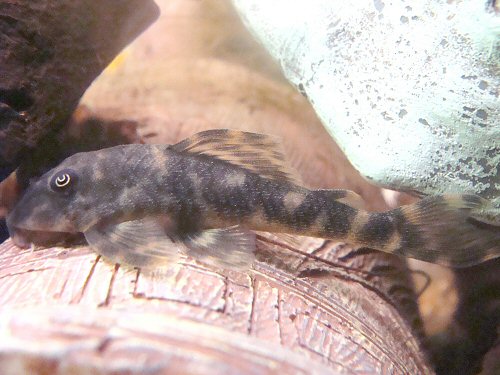
Common Name |
L127, L207 |
Synonyms |
None |
Family |
Loricariidae |
Subfamily |
Hypostominae |
Distribution |
South America: Venezuela, Amazonas. Type Locality: Venezuela, Amazonas, Río Orinoco at Paso Ganado, 38 km NNW of San Fernando de Atabapo, 04.3842°, -067.7747° (Holotype). |
Size |
12.0cm. (4¾ins) |
Temp. |
23-27°c (73-81°f.) |
p.H. |
6.5-7.2. |
Characteristics |
Body moderately elongate. Head and nape forming arc from tip of snout to anterior of parieto-supraoccipital, rising more rapidly to parieto-supraoccipital crest, and then more slowly to dorsal-fin. Dorsal slope decreasing in straight line to insertion of dorsal procurrent caudal rays then ascending to caudal fin. Body depth greatest below insertion of dorsal fin. Ventral profile flat to ventral procurrent caudal-fin rays, and then sloped ventrally. Caudal peduncle oval in cross section with dorsal and ventral surfaces flattened. Body widest at insertion of pectoral fins, narrowest at insertion of caudal fin. Snout rounded. |
Colouration |
Base colour light tan with brown to black markings. Four dorsal saddles on the body, the first below the middle rays of the dorsal fin, the second below the posterior rays of the dorsal fin and slightly posterior, the third below the adipose fin and slightly anterior, and the fourth at the end of the caudal peduncle. |
Aquarium Care & Compatibility |
| They like their own territory in the aquarium as males will sometimes spar with other males, but usually nothing comes of this confrontation as long as they have their own caves, be it PVC pipes, ceramic pots or even under flat stones that have been built up on the substrate. |
Reproduction |
Not easy. Good water quality and water changing at the right time. They lay their eggs in caves (pipes) and the male guards them for about 10 days. The feeding of courgette (zucchini) and peas taken out of their shell seems to be a precondition for the successful spawning of the Peckoltia genus. |
Sexual Differences |
The males have short odontodes (spines) covering the front edge of the pectoral fins and parts of the main body just behind the gill plates, these spines run the full length of the body, they also produce them on the hard rays of the caudal fin. The females are devoid of this character and I find that they are not quite as colourful as the males, being that bit darker. |
Diet |
| Omnivore; Vegetarian food, tablets & pellets, insect larvae, zooplankton and soft wood. As mentioned in the breeding section they love courgette (zucchini), half cook them, sliced, in a pot of water and then frozen for future use. They are also partial to peas now and again. I find they are not a great algae eater like their Chatasoma cousins. I feed also algae wafers and tablet food, they are also keen on frozen bloodworm. Not a hard species to feed as again they are not too fussy. |
Glossary of Terms |
Adipose
fin: Fleshy finlike projection without rays,
behind the rayed dorsal fin. |
Etymology |
| Peckoltia:
Named for Snr. Gustavo Peckolt of the Natural History
Commission of Rondon. |
IUCN Red List |
Peckoltia lujani has a wide range in the Orinoco River system, and is considered Least Concern. However, it is unknown whether the Meta River and Lower Orinoco River subpopulations are conspecific with typical subpopulations in the upper Orinoco. These subpopulations may need to be monitored as this species is rarely collected indicating either small subpopulations or that the species is difficult to capture (IUCN 2023). |
References |
Armbruster,
J.W. 2023. Peckoltia lujani. The
IUCN Red List of Threatened Species 2023. |
Photo Credits |
© BigFrogFeet |
|

If you would like to contribute to the monthly factsheets with an article, information or photos, please e-mail me. You will of course be credited for your work.
If you would like to donate any denomination of money to the site just click the above link button. All proceeds will go to running the site and hopefully to keep it going for a few years yet.
ScotCat Sources
 Etymology-genera
Etymology-specific name
Other Sources
 Search
 Fishbase
 Catalog
of Fishes
Catalog
of Fishes
 GBIF
GBIF
 Fishnet
 iNaturalist
 IUCN
IUCN

