SCOTCAT.COM
your internet guide to all things catfish
FACTSHEETS: July 2012 - no. 193
Pimelodus ornatus Kner, 1858 |
Pimelodus
ornatus As you can see from the image above this is indeed a smart looking catfish which has been imported into the U. K. and Europe on and off since 1979, initially from Paraguay, and has proved a favourite amongst dedicated predatory catfish enthusiasts. Keeping the 'Ornate pim' is not too difficult as long as you stick to a few golden rules such as the size of tank which should be around 100 gall. (500 litres) mark due to its eventual size and the fish constantly on the move as a group, as single specimens are never happy alone and will spend a good amount of time hiding away and sulking in the aquarium. Since the species originates from flowing waters, the water should be clear and with a high oxygen content, good filtration and a substrate of a rounded gravel or sand with plenty of hiding places with pipes or rockwork/stones. If there are plenty of places to hide they will lose their initial shyness and come out more often. Since they roam the aquarium at night with their long feeling barbels they can upset other tank inhabitants so other inmates would have to be chosen carefully. South American Cichlids, L-number cats and other catfish from the Doradidae family are good choices.
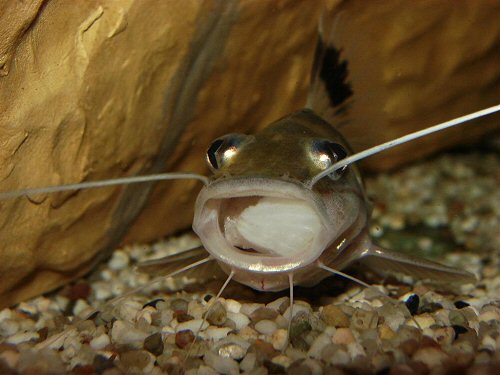
The above image shows the mouth of Pimelodus ornatus and the gape which can take small fish if it needed to so once again careful consideration of tankmates are a must. If at all handled they secrete a toxic mucus and the wounds caused by its pectoral spines are very painful. There spines can also be tangled up in a net if catching so best to do it with an open ended container.
|
 he month of July 2012 brings us back to one of the
prettiest member of the Pimeloidae family, namely
the 'Ornate pim' Pimelodus ornatus.
he month of July 2012 brings us back to one of the
prettiest member of the Pimeloidae family, namely
the 'Ornate pim' Pimelodus ornatus.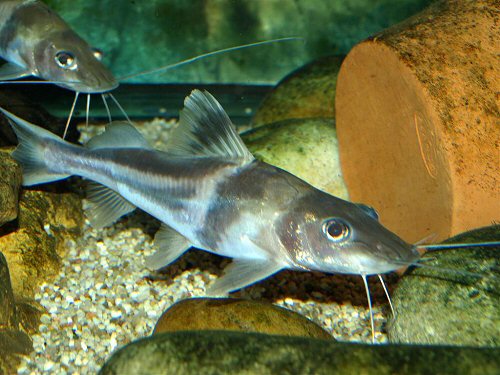
Common Name |
Ornate pim |
Synonyms |
Megalonema rhabdostigma |
Family |
Pimelodidae |
Subfamily |
Pimelodidinae |
Distribution |
South America: Amazon, Corintijns, Essequibo, Orinoco, and Paraná River basins. Also in major rivers of the Guianas. |
Size |
38.5cm. (15½ins) |
Temp. |
24-25°C (75-77°F) |
p.H. |
6.5-7.2. |
Characteristics |
Slender and elongate body and the head is depressed. Upper jaw projects beyond the lower jaw. The maxillary barbels when laid back reach beyond the adipose fin and sometimes reach the tip of the caudal fin. |
Colouration |
Upper part of head and body dark blue/grey, the belly region is whitish. A light horizontal band above the lateral line from below the dorsal fin to the caudal peduncle. Two light vertical bands, one behind the operculum (slightly darker), the second below the dorsal fin spine. The dark horizontal band in the ventral region from the ventral fin to the caudal fin disappears in the adult fish. Dorsal fin with a large black blotch. Caudal fin with a black band in each lobe. Pectoral, ventral and anal fins with dark pigment in the rays (more so on the pectoral fins), whitish on the tips. Adipose fin with light pigment. Maxillary barbels with darker pigment on the top edge, lower half white, mandibular barbels white. |
Aquarium Care & Compatibility |
| Not suited to be housed with smaller species but should fit in with South American Cichlids, L-number cats and members of the Doradidae family. |
Reproduction |
Allegedly the species breeds by internal fertilisation and the female places the fertilised eggs on stones and plants. As this is a migratory breeder you would need to be very lucky to achieve this. |
Sexual Differences |
Not reported but I would imagine that the females would be more rotund. |
Diet |
| Gregarious feeders in the aquarium and are not fussy eaters. Earthworms, white and black worms, Tilapia filets, or trout pieces, tablet and pellet foods and frozen foods such as bloodworm. When adult you do not need to feed this fish every day, every second day would suffice on the diet of the above foods. |
Glossary of Terms |
Adipose fin:
Fleshy finlike projection without rays, behind the
rayed dorsal fin. |
Etymology |
| Pimelodus:
Pimel = fat; odus = tooth. |
References |
Lambourne,
Derek: Catfish Association of Great Britain;
Information Sheet, April 1978. |
Photo Credits |
©
Wolfgang Ros @
|
|

If you would like to contribute to the monthly factsheets with an
article, information or photos, please e-mail
me. You will of course be credited for your work.
If you would like to donate any denomination of money to the site just click the above link button. All proceeds will go to running the site and hopefully to keep it going for a few years yet.
ScotCat Sources
 Article
 Etymology-genera
Etymology-specific name
Online Sources
 Search
 Fishbase
 Catalog of Fishes
 GBIF
GBIF
 Fishnet2
 iNaturalist

