SCOTCAT.COM
your internet guide to all things catfish
FACTSHEETS: May 2007 - no. 131
Plotosus lineatus (Thunberg, 1787) |
This is the first factsheet that does not encompass a freshwater species as the "Coral Catfish" lives in the open ocean and thus in a saltwater situation. The "Look but don't touch" mantle refers to the very venomous spines in their dorsal and pectoral fins and Burgess (1989) and Nelson (1994) state that their stings might be fatal in some circumstances. If you do succumb to a sting from this catfish you need to first thrust your hand into hot water as hot as you can stand it to heat the poison up and so hopefully dilute it, and then you may have to make a trip to your local hospital if things get worse. Best to have someone around when working with this fish.
Plotosus
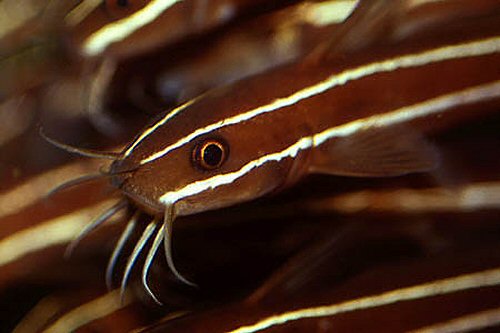
lineatus In their natural habitats they school in a group looking for food so if purchasing you must not buy them singularly but in a group of between 5 and 8. The freshwater species of the Plotosidae family can be bought as individuals but not this saltwater cousin as they will sulk and waste away. When very young they are mostly black and when they start to mature the white to yellow ventral stripes begin to appear gradually to make this catfish a real beauty to the enthusiast. It is only when they get to the adult stage that they lose this trait and revert to a murky brown colour. The close up image below shows the barbel arrangement of this species
Plotosus lineatus - head view
Plotosus lineatus are easy to keep in captivity as long as you can purchase a group free of any parasites as they don't like copper based medications in the aquarium and it is better to drop the salinity of the water gradually if you spot any problems with diseases, to basically give them a freshwater dip. The size of a group of this species necessitates that you house them in a large aquarium, starting of with a 4ft tank for juveniles working your way up to a 8ft x 2ft x 2ft tank for a small group of adults. The life span is reputedly 7 years. A tank set-up for them would comprise of a sand/gravel or coral/rock rubble, which can be aggregated in flanks or balls on sandy bottoms. A good water current is preferred with hiding places in the aquarium. A good quality salt mix (pre-mixed for a day before use) of a constant high or low range salinity is fine. The pH values would need to be monitored with the heavy feeding that is common with these cats.
|
 he theme
for this catfish of the month (May 2007) is "Look,
but don't touch" which tells you a little bit
about this member of the Plotosidae family.
he theme
for this catfish of the month (May 2007) is "Look,
but don't touch" which tells you a little bit
about this member of the Plotosidae family.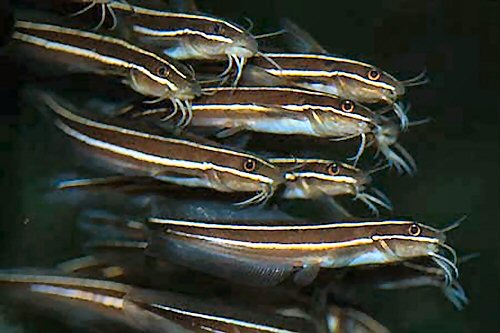
Common Name |
Coral Catfish |
Synonyms |
Silurus arab, Silurus lineatus, Platystacus anguillaris, Plotosus anguillaris, Plotosus thunbergianus, Plotosus marginatus, Plotoseus ikapor, Plotosus vittatus, Plotosus castaneus, Plotosus castaneoides, Plotosus arab, Plotosus flavolineatus |
Family |
Plotosidae |
Subfamily |
- |
Distribution |
Indo-Pacific: Red Sea and East Africa to Samoa, north to southern Japan, southern Korea, and the Ogasawara Islands, south to Australia and Lord Howe Island. Palau and Yap in Micronesia. |
Size |
30.0cm (12ins) |
Temp. |
24-26°C (75-79°F) |
p.H. |
8.0-8.5. |
s.g. |
1-021 |
Ammonia & Nitrite |
Zero |
Nitrates |
Less than 20ppm |
Characteristics |
Dorsal 1/4-5; combined fin 80-100/~10-70-80; Pectoral 1/10-11; Ventral 11-12. Body elongate, torpedo shaped, compressed. Head large. The second dorsal combines with the caudal and anal to form a uniform fringing fin. 4 pairs of short barbels. |
Colouration |
Upperside dark brown to blackish, becoming fawn towards the belly which itself is delicate brown to yellowish. Young fishes with 2 (-3) striking pale, yellowish to bluish-white, longitudinal stripes. Fins brown, the combined fin often dark edged. |
Aquarium Care & Compatibility |
| Can be kept with other Marine fish of compatible size but larger adults would be best kept on their own. Can be kept with invertebrates when young but could pose a problem for them when they get larger. |
Reproduction |
In their natural habitat they lay their eggs in nests constructed by the males in shallow, rocky areas in the summer months. There have been reported spawings in the home aquarium as well as in Public Aquaria. |
Sexual Differences |
Not known. |
Diet |
| No problem in this department as they will greedily feed on pellets, marine flake, frozen and fresh food. Two daily feedings of at least one of defrosted frozen food will suffice. |
Glossary of Terms |
Anal Fin:
The fin forward from the anal cavity. |
Etymology |
| Plotosus
= Plotos
= swimming. |
IUCN Red List |
This widely distributed species is common and abundant and occurs in a variety of nearshore habitats. Exploitation is not suspected to be causing a global decline approaching 30% at this time; therefore, it is listed as Least Concern, (IUCN 2024). |
References |
Bucol,
A. 2024. Plotosus lineatus. The
IUCN Red List of Threatened Species 2024. |
Photo Credits |
© Johnny Jensen
@ |

|

If you would like to contribute to the monthly factsheets with an
article, information or photos, please e-mail
me. You will of course be credited for your work.
If you would like to donate any denomination of money to the site just click the above link button. All proceeds will go to running the site and hopefully to keep it going for a few years yet.
ScotCat Sources
 Etymology-genera
Etymology-specific name
Online Sources
 Search
 Fishbase
 Wikipedia
 Catalog of Fishes
 GBIF
GBIF
 Fishnet2
 iNaturalist
 IUCN
IUCN

