SCOTCAT.COM
your internet guide to all things catfish
FACTSHEETS: June 2024 - no. 336
Pseudobagarius leucorhynchus (Fowler, 1934) |
Pseudobagarius leucorhynchus is a small catfish found in the Mekong river in Thailand. Specimens as small as 3.0cm (1¼ins) have been found to be sexually mature and carrying nearly ripe eggs. This genus corresponds to the “pseudobagarius group” of species of the genus Akysis that was first recognised by Ng & Kottelat (1998). A look-a-Like, Akysis pulvinatus, is thought to mimic this catfish in the same habitat, so called a Müllerian mimic.
Henry Weed Fowler (March 23, 1878 – June 21, 1965) was an American zoologist born in Holmesburg, Pennsylvania. He studied at Stanford University under David Starr Jordan. He joined the Academy of Natural Sciences in Philadelphia and worked as an assistant from 1903 to 1922, associate curator of vertebrates from 1922 to 1934, curator of fish and reptiles from 1934 to 1940 and curator of fish from 1940 to 1965. He published material on numerous topics including crustaceans, birds, reptiles and amphibians, but his most important work was on fish. In 1927 he co-founded the American Society of Ichthyologists and Herpetologists and acted as treasurer until the end of 1927
|
 he month of June 2024 brings us to the Akysidae family
and a small catfish with a very long scientific name.
The
genus name Pseudobagarius means that it is
tautonymous with Akysis pseudobagarius, proposed
for members of the “pseudobagarius group”
of Akysis; pseudo-, false, referring to striking
(but phylogenetically false) resemblance to the sisorid
genus Bagarius. The specific name leucorhynchus:
leuco-,
white; rhynchus, snout, referring to the white end
of the muzzle.
he month of June 2024 brings us to the Akysidae family
and a small catfish with a very long scientific name.
The
genus name Pseudobagarius means that it is
tautonymous with Akysis pseudobagarius, proposed
for members of the “pseudobagarius group”
of Akysis; pseudo-, false, referring to striking
(but phylogenetically false) resemblance to the sisorid
genus Bagarius. The specific name leucorhynchus:
leuco-,
white; rhynchus, snout, referring to the white end
of the muzzle. 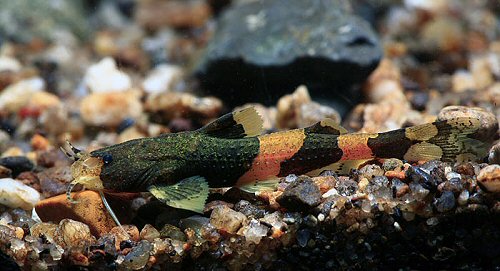
Common Name |
None |
Synonyms |
Akysis leucorhynchus |
Family |
Akysidae |
Subfamily |
- |
Distribution |
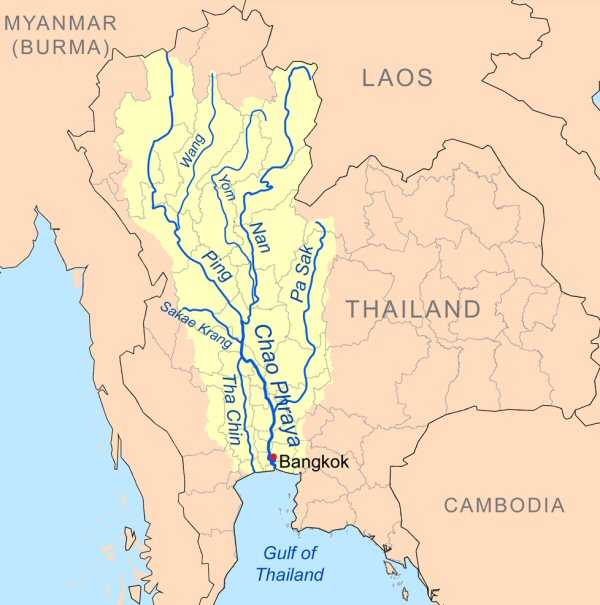
Asia: Thailand; Choa Phraya basin and southern Peninsular. Phitsanulork Province. Type locality: Chieng Mai, North Siam. |
Size |
3.0cm (1¼ins) |
Temp. |
18-24°C (63-75°F) |
p.H. |
6.5-7.5. |
Characteristics |
Pseudobagarius leucorhynchus is slender and has a rather stout dorsal spine, a distinct adipose fin, and longish, broad-based barbels. Akysidae with the following combination of characters: snout extending well anterior of margin of lower jaw, rendering mouth subterminal; narial openings relatively large and closely set; and caudal fin deeply forked. Dorsal soft rays (total): 6 - 6; Anal soft rays: 6 – 8; Vertebrae: 31 – 34. Distinguished from all its congeners by the following combination of characters: light-yellow snout with a sharp, contrasted edge discrete line demarcation; presence of 4-6 small serrae on the posterior edge of pectoral spine; head width 20.3-25.5% SL; depth of caudal peduncle 5.5-7.1% SL; length of anal-fin base 9.7-16.6% SL; length of nasal barbel 16-38% HL; 5 branchiostegal rays; and caudal fin deeply emarginate. |
Colouration |
The body is mostly whitish with three irregular black cross bands; the snout is white and between it and the first black band there is a patch of rich brown. |
Aquarium Care & Compatibility |
| Much like the Akysis genus. They are easy to keep for any decent fishkeeper. You can keep in small tanks (30cm wide x 20cm high x 30cm deep) with a sand bottom, small pipes, and caves. They will either bury themselves in the sand or hide in caves and pipes. They are not usually active during the day but will spring to action and eat voraciously and crazily if food is put in the tank. |
Reproduction |
Not recorded but specimens as small as 3.0cm (1¼ins) have been found to be sexually mature and carrying nearly ripe eggs. |
Sexual differences |
Not recorded |
Diet |
| They will eat bloodworm, chopped earthworms, whiteworm, daphnia, and sinking pellets (although they seem to prefer live or frozen food). |
Glossary of Terms |
Adipose
fin: Fleshy finlike projection
without rays, behind the rayed dorsal fin. |
Etymology |
| Pseudobagarius:
Tautonymous
with Akysis pseudobagarius, proposed for
members of the “pseudobagarius group”
of Akysis; pseudo-, false, referring to striking
(but phylogenetically false) resemblance to the sisorid
genus Bagarius. |
References |
Ferraris, C.J. Jr.
2007 Checklist of catfishes, recent and fossil (Osteichthyes:
Siluriformes), and catalogue of siluriform primary
types. Zootaxa 1418:1-628. |
IUCN Red List |
Pseudobagarius leucorhynchus has most recently been assessed for The IUCN Red List of Threatened Species in 2011. There is insufficient information about the geographic distribution and population size of this species for an accurate assessment and it is assessed as Data Deficient. Despite earlier assessments as Vulnerable for this species by Vidthayanon (2005), there are no empirical data to justify this assessment. |
Photo Credits |
© Nonn
Panitvong |
|

If you would like to contribute to the monthly factsheets with an
article, information or photos, please e-mail
me. You will of course be credited for your work.
If you would like to donate any denomination of money to the site just click the above link button. All proceeds will go to running the site and hopefully to keep it going for a few years yet.
ScotCat Sources
 Etymology-genus name
Etymology-specific name
Other Sources
 Search
 Fishbase
 Catalog
of Fishes
Catalog
of Fishes
 GBIF
GBIF
 FishNet2
 iNaturalist
 IUCN
IUCN

