SCOTCAT.COM
your internet guide to all things catfish
FACTSHEETS: October 2005 - no. 112
Pseudolaguvia shawi (Hora 1921) |
Pseudolaguvia shawi
These little fish are unassuming and do better when kept in the cooler temperatures (21°C) and neutral PH but generally they can cope with higher temperatures and PH values from 6.5-7.4 as long as good water quality is provided and maintained. Hiding places should be provided but if a sand substrate is used they like nothing better than to bury themselves in it leaving nothing but their nasal barbels showing.
Pseudolaguvia shawi
Pseudolaguvia shawi until recently was named as Laguvia shawi. Laguvia is now no longer valid as it has been deemed an objective junior synonym of Hara. (Ng, HH and M Kottelat, 2005).
|
 his
month (October 2005) we welcome a new contributor
in Adrian Taylor of the
his
month (October 2005) we welcome a new contributor
in Adrian Taylor of the 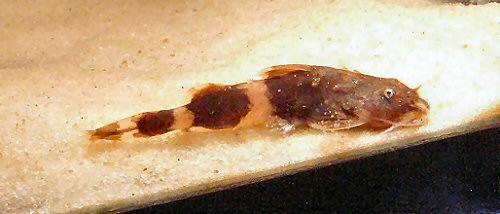
Common Name |
Bee cat, Asian mini bee cat |
Synonyms |
Glyptothorax shawi, Laguvia shawi |
Family |
Sisoridae |
Subfamily |
- |
Distribution |
Asia: Darjeeling, Siliguri Terai and Sikkim in India. Reported from Bangladesh. |
Size |
4.5cm (1¾ins) |
Temp. |
20-24°C (68-75°F) |
p.H. |
6.5-7.4. |
Characteristics |
The body of these fish is short and compressed; the head is semicircular and broad. They have four pairs of barbels, and a broad mouth, the jaws are sub equal, and contain villiform teeth in bands. The ventral surface of the body is corrugated and has a faint V-shaped groove that forms a not easily seen adhesive apparatus. However this is not as well formed as it is in Glyptothorax. The dorsal fin has five to six rays with a strong spine; and is situated midway between the pectoral and ventral fin’s. The adipose fin being small. The pectoral fins have six to eight rays with a strong spine that has five to six serrae on its outer edge and five larger serrae on its inner edge. The caudal fin has a slight crescent shape to it with rounded lobes. The anal fin is short and has nine to ten rays and the ventral fins having six rays to them. |
Colouration |
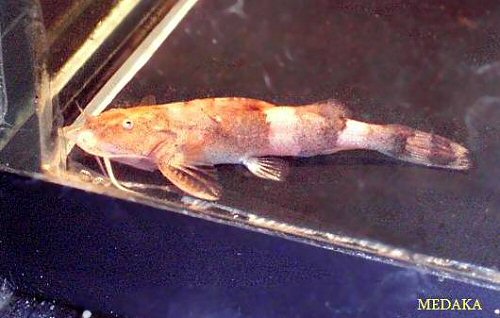
The body is coloured in alternative bands of brown and tan.The first band of brown starts at the snout and continues to just behind the ventral fins, and from that point to an area approximately Just forward or level with the vertical between the start of the adipose fin and the start of the anal fin is a tan coloured band, from that point to the vertical of the trailing edge of the said fins is another band of brown; with another tan coloured band from that point to the caudal peduncle. There is a further band of brown that extends into the first third of the caudal fin, the rest of the caudal fin is tan to opaque in colour except the ends of the fin which has a light brown crescent like marking; although this may vary from specimen to specimen. The other fins are coloured light to dark brown with the tips of the pectoral fins being dotted white to opaque. |
Aquarium Care & Compatibility |
| Keep with small non-aggressive tank mates. |
Reproduction |
Not reported. |
Diet |
| These fish do better when fed with live food, such as grindal worms, bloodworms and daphnia. |
Glossary of Terms |
Nasal
barbels: On
top of the head, by the nostrils (nasal barbels). |
Etymology |
| Pseudolaguvia:
Pseudo-, false; i.e., although this genus may superficially
resemble several “closely allied” genera,
including Laguvia (a junior synonym of Erethistes),
such an appearance is false. |
References |
Jayaram,
K.C. 1999 The freshwater fishes of the Indian
region. Narendra Publishing House, Delhi - 110006,
India. 551 p. |
Photo Credits |
© Adrian Taylor |
|

If you would like to contribute to the monthly factsheets with an article, information or photos, please e-mail me. You will of course be credited for your work.
If you would like to donate any denomination of money to the site just click the above link button. All proceeds will go to running the site and hopefully to keep it going for a few years yet.
Online Sources
 Search
 Fishbase
 Catalog of Fishes
 GBIF
GBIF
 iNaturalist

