SCOTCAT.COM
your internet guide to all things catfish
FACTSHEETS: February 2010 - no. 164
Pseudolithoxus anthrax (Armbruster & Provenzano, 2000) |
Pseudolithoxus anthrax is a species that I have not had the pleasure to keep and in my opinion would be an unusual species to keep. It is documented that Museum records state a maximum size of 10cm/4", although it is suggested that the fish can reach twice this size. Whilst this catfish is best suited to soft and acidic water conditions it is generally recognised that as with most other loricariids it is quite adaptable to harder and slightly more alkaline waters when being kept under aquarium conditions. It is suggested that this can be a tricky species to acclimatize to the aquarium. Close attention therefore, must be given to providing this catfish with good water quality with plenty of oxygenation.
Pseudolithoxus anthrax
I would suggest a minimum size of 48” x 18” X 18” for one or two of these catfish, with plenty of hiding places amongst bogwood and plants. The ideal aquarium substrate to use would be aquarium sand such as BD Aquarium Sand. As with all other species of fish, water quality and general husbandry is very important, and I would recommend that a minimum of 25% water is changed on a weekly basis. This fish has similar requirements to other loricariids, so should do well under normal aquarium conditions.
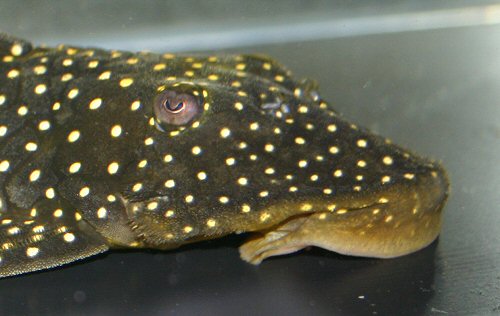
Pseudolithoxus anthrax - head view
Pseudolithoxus anthrax belongs to the family Loricariidae from South America; namely the upper and lower Orinoco tributaries. It is documented that Museum specimens have been collected from the Rio Orinoco drainage in Venezuela, and in the Rio Caura and Rio Aro, which are tributaries of the Orinoco. The type locality is given as Río Orinoco backwater behind sand beach ca. 0.5 hr upstream from Isla Temblador, 3°04'N, 66°28'W. Pseudolithoxus anthrax prefer to be kept in water which has a slightly acidic pH of around 6.0. A ph range of 6.0-7.2 is documented as being acceptable for this catfish. It is ideally suited to temperatures in the range of 22-25ºC or 71-77ºF. There are three other species of Pseudolithoxus from Venezuela which were described at the same time as P. anthrax – Pseudolithoxus dumus, Pseudolithoxus tigris and Pseudolithoxus nicoi.
|
 he
second month of the new decade (2010) brings us to
another indepth look from the catfish world from regular
contributor, aquarist and author, Chris Ralph. His
subject is the Flyer Cat and certainly one of the
more impresive members of the Loricariidae. I now
hand you over to Chris.
he
second month of the new decade (2010) brings us to
another indepth look from the catfish world from regular
contributor, aquarist and author, Chris Ralph. His
subject is the Flyer Cat and certainly one of the
more impresive members of the Loricariidae. I now
hand you over to Chris.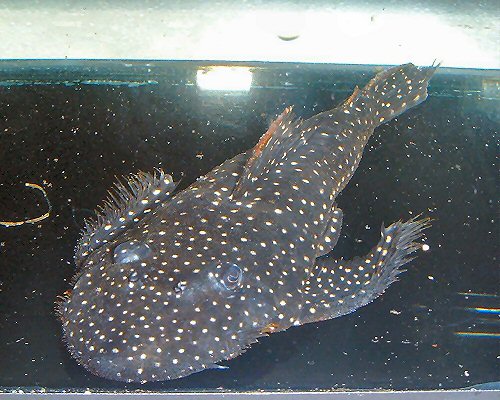
Common Name |
Flyer cat, L235 |
Synonyms |
Lasiancistrus anthrax |
Family |
Loricariidae |
Subfamily |
Ancistrinae |
Distribution |
South America: Venezuela, Upper and lower Orinoco tributaries, Caura and Aro rivers. Type locality: Venezuela, Estado Amazonas, Río Orinoco backwater behind sand beach ca. 0.5 hr. upstream from Isla Temblador, 03º04'N 66º28'W. |
Size |
20.0cm. (8ins) s.l. (standard length – this is the measurement of the fish from the tip of the snout to the base of the caudal peduncle). |
Temp. |
25-29°c (77-85°f.) |
p.H. |
6.0-7.2. |
Characteristics |
The body of Pseudolithoxus is generally described as being flattened or compressed. It is described as having two dorsal spines and seven to eight branched dorsal rays. It is described as having one anal spine and four branched anal raysand there are 24-26 lateral line plates; seven to eight dorsal plates; seven to eight adipose-caudal plates and 12-14 post-anal plates. |
Colouration |
The base colour of the body is described as being charcoal grey to black with white spots covering the entire length of the fish. |
Aquarium Care & Compatibility |
| Wherever possible I would recommend that the aquarist keep these catfish in a community aquarium as single specimens or as sexed pairs due to their aggressive and territorial nature. These catfish should be kept with other small species of fish which are peaceful and tolerant of fast moving water. |
Reproduction |
There are no documented reports of aquarium spawnings of Pseudolithoxus anthrax as far as I am aware, most likely due to the rarity of this catfish amongst imports. |
Sexual Differences |
As with most other species of catfish the males tend to be more slender than the females. It is suggested that females are fatter and have smaller odontodes than males. Adult males have much longer cheek bristles and bristles to their pectoral fins. |
Diet |
| Requires a mixed and varied diet which includes meatier foods such as chopped prawns and bloodworm in addition to algae wafers to name but a few. |
Glossary of Terms |
Adipose
is defined as a second dorsal fin. |
Etymology |
| Pseudolithoxus: Greek, pseudes meaning false + Greek, lithos meaning stone + Greek, oxys meaning sharp. |
Photo Credits |
Top: © Billy
Grant |
|

If you would like to contribute to the monthly factsheets with an article, information or photos, please e-mail me. You will of course be credited for your work.
If you would like to donate any denomination of money to the site just click the above link button. All proceeds will go to running the site and hopefully to keep it going for a few years yet.
ScotCat Sources
 Etymology-genera
Online Sources
 Search
 Fishbase
 Wikipedia
 Catalog of Fishes
 GBIF
GBIF
 Fishnet2
 iNaturalist

