SCOTCAT.COM
your internet guide to all things catfish
FACTSHEETS: June 1998 - no. 024
Pseudomystus siamensis Regan, 1913 |
Pseudomystus siamensis
Below is the comparisons
made by Jayaram taken from "The Atlas of Freshwater
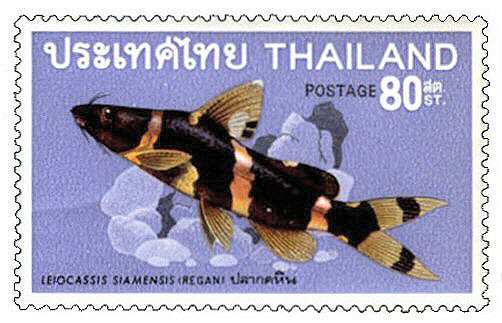
and Marine Catfishes" by Dr. Warren E.Burgess. It sometimes gets sold as Pseudomystus stenomus (again known in shops as Leiocassis) in some aquatic outlets but the colouration is different (stenomus does not sport banding in the body) and siamensis grows larger and is more predatory towards smaller tankmates. It is known under its common name of the "Asian Bumblebee Catfish", it is nocturnal and can be territorial with others and its own kind and will prowl the tank after lights out, so I would definitely not house them with smaller fish as they will view them as a snack!. They can also nip the fins of larger species, so keep well fed with a feeding after lights out to curb this aggression, but in saying that they are a favourite fish with myself and other catfish enthusiasts and it is worthwhile to find a niche in your (larger) community tank for this species. It is very hardy in a aquarium setting relating to water temperature and p.H. having a tolerance to a wide spectrum of water conditions, but of course not as extreme as to cause stress.
Pseudomystus siamensis is found in the rivers and streams of the Mekong and Chao Phrya basins along with the rivers that empty into the Gulf of Thailand.
|
 his
Bagrid has been a mainstay of the catfish hobby in
the U.K. for many years now and you can still purchase
them under the older genus name of Leiocassis
the name that most aquarists will be more familiar
with, so if you are looking for more info on this
species in books, Leiocassis will do for a
start. Pseudomystus was actually a subgenus
of Leiocassis which K.C. Jayaram had placed
siamensis in, in 1968, but is now a full genus
name.
his
Bagrid has been a mainstay of the catfish hobby in
the U.K. for many years now and you can still purchase
them under the older genus name of Leiocassis
the name that most aquarists will be more familiar
with, so if you are looking for more info on this
species in books, Leiocassis will do for a
start. Pseudomystus was actually a subgenus
of Leiocassis which K.C. Jayaram had placed
siamensis in, in 1968, but is now a full genus
name.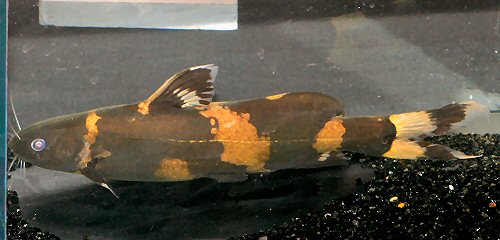
Common Name |
Asian Bumblebee Catfish |
Synonyms |
Leiocassis siamensis, Leiocassis albicolaris, Leiocassis albicollis, Leiocassis bicolor |
Family |
Bagridae |
Subfamily |
Bagrinae |
Distribution |
Asia: Thailand, Mekong and Chao Phraya River basins and peninsular Thailand. Type locality: Bangpakong River, Siam. |
Size |
16.0cm (6¼ins) |
Temp. |
21-26°C (70-79°F) |
p.H. |
6.0-8.0. |
Characteristics |
Dorsal spines (total): 1-1; Dorsal softrays (total): 7-7; Anal soft-rays: 16-17. short barbels (maxillary barbels not reaching base of pectoral spine); body depth at dorsal-fin origin larger than head width; a high, rounded adipose fin. |
Colouration |
Irregular vertical bars on a yellowish to dark grey background (sometime plain dark body); hyaline caudal fin with or without a single black blotch on each caudal lobe. |
Aquarium Care & Compatibility |
| Can be kept in a community tank but would watch if housing an adult with smaller Characins or Livebearers as they could be picked of at night when it starts cruising the tank. They can also nip the fins of larger species, so keep well fed with a feeding after lights out to curb this aggression. |
Reproduction |
Not reported but would appear to be a substrate spawner laying its eggs in tangled roots in the wild, I guess the p.H.would need to be on the acid side for any success with this species. |
Sexual Differences |
There is a fleshy appendage in front of the anal fin that would indicate sexual dimorphism which has been noticed in other Bagrids. |
Diet |
| In its native habitat it feeds on aquatic insect larvae including odonatans. A wide variety of foods can be given in the aquarium as this species is not fussy as long as it is fed, preferably after lights out. If you know where it hides out during the day you can drop tablet food, frozen food etc.into its resting place underneath stones/slates or bogwood. |
Etymology |
| Pseudomystus:
False Mystus. |
References |
Baensch,
H.A. and R. Riehl 1985 Aquarien atlas.
Band 2. Mergus, Verlag für Natur- und Heimtierkunde
GmbH, Melle, Germany. 1216 p. |
Photo Credits |
© Ian
Fuller @ |

|

If you would like to contribute to the monthly factsheets with an article, information or photos, please e-mail me. You will of course be credited for your work.
If you would like to donate any denomination of money to the site just click the above link button. All proceeds will go to running the site and hopefully to keep it going for a few years yet.
ScotCat Sources
 Article
 Etymology-genera
Etymology-specific name
Online Sources
 Search
 Fishbase
 Catalog of Fishes
 GBIF
GBIF
 Fishnet2
 iNaturalist

