SCOTCAT.COM
your internet guide to all things catfish
FACTSHEETS: August 2009 - no. 158
Synodontis clarias Linnaeus, 1758 |
Synodontis clarias belongs to the family Mochokidae from Africa; namely Cameroon, Chad, Egypt, Ethiopia, Gambia, Ghana, Mali, Niger, Nigeria, Nile, Senegal and Sudan and is documented as being found in lakes and rivers. This catfish is also documented as being found in the Gambia and Volta basins; Niger including the Bénoué River.
Synodontis clarias
Synodontis clarias is easily recognised by its distinct colour pattern and long dorsal fin spine. I would suggest that you would expect to pay around £25- £50.00 per fish (2008 U.K. prices) depending upon size. It prefers to be kept in water which has a pH in the range of 6.5-7.5 and a hardness of 18ºdGH. This catfish is ideally suited to temperatures in the range of 21-24ºC or 69-75°F I would suggest a minimum tank size of 60” x 18” X 18” for one or two of these stunning catfish, with plenty of hiding places amongst bogwood and plants. The ideal aquarium substrate to use with these catfish is aquarium sand such as BD Aquarium. As with all other species of fish, water quality and general husbandry is very important, and I would recommend that a minimum of 25% water is changed on a weekly basis. Remarks: Was the first Synodontis to be described by Linnaeus in 1758 and is the type species for this genus.
|
 riting
for us this month (August 2009) is regular contributor
Chris Ralph. He is having a look at a member of the
Mochokidae family and one of the more impressive looking
Syno's, Synodontis clarias. I now hand you
over to Chris for his in depth look at this African
catfish.
riting
for us this month (August 2009) is regular contributor
Chris Ralph. He is having a look at a member of the
Mochokidae family and one of the more impressive looking
Syno's, Synodontis clarias. I now hand you
over to Chris for his in depth look at this African
catfish.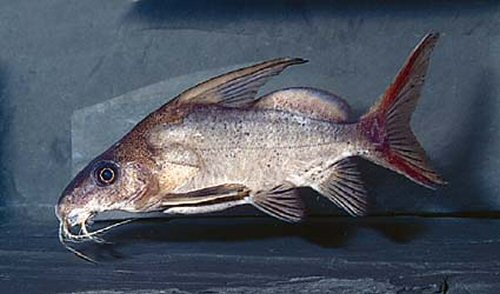
Common Name |
Red-tailed Synodontis, Red-Tail Synodontis, and Red Tail Syno. |
Synonyms |
Pimelodus clarias clarias, Pimelodus clarias, Silurus clarias, Silurus callarias, Pimelodus synodontis, Pimelodus synodontes, Synodontis macrodon |
Family |
Mochokidae |
Subfamily |
Mochocinae |
Distribution |
Africa: Chad, Niger (including the Bénoué River), Senegal, Gambia and Volta basins, also in the Nile. |
Size |
360mm s.l. (standard length – this is the measurement of the fish from the tip of the snout to the base of the caudal peduncle). |
Temp. |
21-24°C (69-75°F) |
p.H. |
6.5-7.5. |
Hardness |
18ºdGH |
Characteristics |
The body and head shape of Synodontis clarias is described as being compressed. The head shield is described as being pitted and granulated. The mouth is described as being sub-terminal. The body is described as being naked. This catfish has three pairs of barbels with the maxillary barbels having a small membrane at the base and small slender ramifications. The dorsal fin spine is described as being smooth anteriorly, with the top half being serrated posteriorly ending in a short filament. The pectoral fin spine is described as being finely serrated on the outer edge, with the inner edge being strongly serrated in the middle, becoming finer towards each end, and ending in a short filament. The caudal fin is described as being forked with each lobe forming a point, the top lobe being the longer turning downwards. |
Colouration |
The base colour of the body and head is described as being blue/grey, with the ventral region being whitish in colour. There are a number of dark spots present on the body and fins, which vary greatly in numbers and concentration. The caudal fin is red, whilst the remaining fins are the same colour as the body. Juvenile specimens are described as being dark bottle green in colour, with many dark coloured spots, and a blood red coloured caudal fin. |
Aquarium Care & Compatibility |
| Wherever possible I would recommend that the aquarist keep these catfish in a community aquarium with slightly larger fish such as large barbs, large tetras and cichlids, just as long as the other occupants are not too aggressive. |
Reproduction |
There are no documented reports of aquarium spawnings of Synodontis clarias as far as I am aware, most likely due to the fact that this catfish is not commonly imported. They are documented as forming distinct pairs during spawning scattering their eggs over the substrate. |
Sexual Differences |
As with most other species of catfish the males tend to be more slender than the females. When viewed from underneath they exhibit external genital papilla. |
Diet |
| Synodontis clarias prefer a mixed and varied diet which includes frozen bloodworm in addition to sinking catfish pellets and tablet foods to name but a few. |
Glossary of Terms |
Adipose is
defined as a second dorsal fin. |
Etymology |
| Synodontis:
Syn = together; odontis = teeth
(fused tooth plates). |
IUCN Red List |
This species has a wide distribution, with no known major widespread threats. It is therefore listed as Least Concern (IUCN 2020). |
Reference: |
Diouf, K., Awaïss,
A., Azeroual, A., Getahun, A. & Lalèyè,
P. 2020. Synodontis clarias. The
IUCN Red List of Threatened Species 2020. |
Photo Credits |
©
|

|

If you would like to contribute to the monthly factsheets with an article, information or photos, please e-mail me. You will of course be credited for your work.
If you would like to donate any denomination of money to the site just click the above link button. All proceeds will go to running the site and hopefully to keep it going for a few years yet.
ScotCat Sources
 Etymology-genera
Etymology-specific name
Other Sources
 Search
 Fishbase
 Wikipedia
 Catalog
of Fishes
Catalog
of Fishes
 GBIF
GBIF
 Fishnet2
 iNaturalist
 IUCN
IUCN

