SCOTCAT.COM
your internet guide to all things catfish
FACTSHEETS: May 2011 - no. 179
Tachysurus sinensis Lacepède, 1803 |
Tachysurus sinensis
Tachysurus fulvidraco has had a chequered history. In the 1980s you could purchase this species under one of its previous names, Pelteobagrus fulvidraco and it was reasonably common in the trade in the U.K. Today it is quite rare in imports which is a pity as this is a very interesting "cool water catfish" There is still ongoing discussions in the scientific fraternity on the validity of the genus name of Tachysurus as the original description of this genera was by La Cepède in 1803 and it depicted a member of the Ariid catfish family. He proposed the name Tachysurus sinensis for a catfish depicted in a Chinese illustration archived in Paris at the Muséum National d’Histoire Naturelle (MNHN). Tachysurus sinensis La Cepède, 1803 is the type species of Tachysurus La Cepède, 1803 (pp. 150, 151) by monotypy. The locality for the illustration is given as China. The only problem with this was the painting looked very much like a Bagrid and not an Ariid species and quite probably Pseudobagrus fulvidraco (Richardson, 1846) or P. nitidus Sauvage & Dabry de Thiersant, 1874. Of course this story is not as simple as that and if you want to read more on the pros and cons of this argument you can seek out and read the references listed below by López; J. Andrés 2008 and Ng, H.H. & Kottelat, M, 2007. Drifting away from the scientific slant to this species, how do we keep the "Tawny Dragon catfish?. Not too much of a problem catfish as long as you don't house them with smaller species as being a Bagrid they will do what the vast majority of Bagrids will do "chase and eat them". I mentioned 'them' earlier in the text as you can keep them in a group and they will get on fine together as long as you give them plenty of room and hiding places for each individual, but you would need a very large tank with a minimum length of 6ft. If you are set on a large big fish community type setup you would probably be better off with one individual.
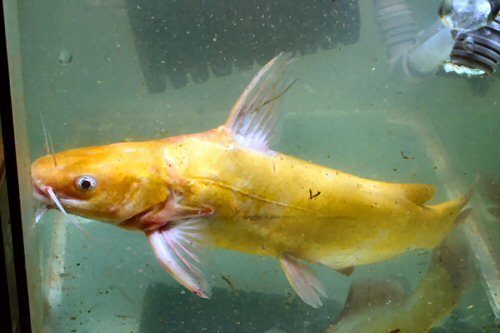
Tachysurus sinensis - gold
The image above depicts a golden variety of the Tawny Dragon catfish. This is a primarily a cool water catfish so placing the tank in a centrally heated house would suffice but there are also reports that this catfish is also happy at temperatures of between 23-26°C (72-79°F) so a very variable temperature range does not worry this Bagrid at all. Providing a good current in the aquarium will suit this catfish. The growth of these fish are quick and a report states that a 8cm (3¼ins) imported specimen reached 14cm (5½ins) in a matter of a few months. Remarks: At the moment (2024) in Eshmeyers Catalog of Fishes, the current status of T. fulvidraco is that it is a synonym of Tachysurus sinensis Lacepède 1803.
|
 s you can see in the image below,
this months factsheet (May 2011) is based on the Bagridae
family from Asia and a very nicely coloured member
by the common name of the "Tawny Dragon catfish"
so named for its specific (latin) name of fulva;
meaning tawny, and draco; meaning dragon.
(now T. sinensis as
T. fulvidraco is now a synomyn)
s you can see in the image below,
this months factsheet (May 2011) is based on the Bagridae
family from Asia and a very nicely coloured member
by the common name of the "Tawny Dragon catfish"
so named for its specific (latin) name of fulva;
meaning tawny, and draco; meaning dragon.
(now T. sinensis as
T. fulvidraco is now a synomyn)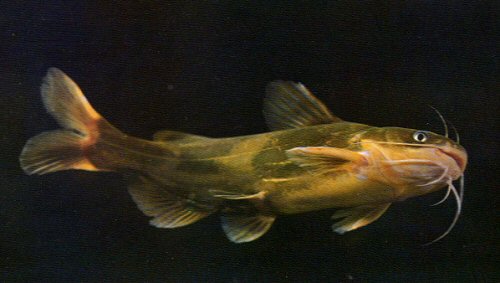
Common Name |
Tawny Dragon catfish |
Synonyms |
Arius sinensis, Bagrus calvarius, Macrones fulvidraco, Pelteobagrus fulvidraco, Pelteobagrus wittenbergii, Pelteobagrus wittenburgii, Pimelodus fulvidraco, Pseudobagrus fulvidraco, Pseudobagrus wittenburgii, Silurus calvarius, Tachysurus wittenburgii, Tachysurus fulvidraco. |
Family |
Bagridae |
Subfamily |
- |
Distribution |
Asia: Widely distributed in the plain part of the rivers of East Asia, from the Amur River, Russia, to Viet Nam. This species occurs within Russia, China, Viet Nam and the Korean Peninsula.Type locality: Huairou Reservoir, about 2 kilometers northeast of observatory, 40°19'00"N, 116°37'31"E, Huairou County, Beiging, China. |
Size |
32.0cm (14ins) |
Temp. |
16-25°C (59-77°F) |
p.H. |
6.0-7.0. |
Hardness |
8-12°dGH |
Characteristics |
Dorsal spines (total): 2; Dorsal soft rays (total): 7; Anal soft rays: 19 - 20. Body is naked, skin fairly thin particularly on the upper side of the head. The mouth is large with upper jaw extending slightly beyond lower. Four pairs of barbels, two mandibular, one maxillary and one nasal. Dorsal spine very stout only slightly serrated along posterior edge. Pectoral spines very stout with fine serrations along the anterior and coarser serae along the posterior edge. The caudal fin is forked with rounded lobes. |
Colouration |
Yellowish brown with irregular darker brown bands running into both caudal lobes. Colour contrast is more intense on juvenile specimens than in adults. |
Aquarium Care & Compatibility |
| Needs a large tank as they grow fast and they will squabble with conspecifics if kept in too small a tank. Create hiding places with rocks and bogwood with the tank densely planted and with floating plants as part of the setup. If keeping other fish with the "Tawny Dragon" you will need fish larger than this catfish that will accept cooler temperatures, although a mid 70s tank will suit them fine. Although they are a cooler water catfish don't keep them with Goldfish as they will be constantly harassed as they are slow swimmers and will be picked on during the night. |
Reproduction |
In the wild these fish form small breeding colonies by making burrows or depressions on the bottom near the shore. The eggs are guarded by the male. |
Sexual Differences |
As with most other species of catfish the males tend to be more slender than the females. It would appear also that the male can be determined by the papillae just prior to the anal fin, a feature found in other Bagridae. |
Diet |
| Will accept most prepared foods such as flake, tablets, live and frozen tubifex and bloodworm. |
Glossary of Terms |
Anal fin:
is defined as the medial fin immediately posterior
to the anus. |
Etymology |
| Tachysurus:
tachys, swift; oura, tail, referring to the presumed
agility of T. sinensis based on its “long
and nimble” tail (translation). |
IUCN Red List |
Tachysurus sinensis is widely distributed in the plain part of the rivers of East Asia, from the Amur River, Russia, to Viet Nam. This species occurs within Russia, China, Viet Nam and the Korean Peninsula. This species is widespread and while it is possibly declining in parts of its range from potential fishing over exploitation, it is not thought that any global population decline is likely to meet (or be close to meeting) the threshold for Vulnerable, and therefore the species is assessed as Least Concern, (IUCN 2022). |
References |
Goss,
Malcolm: Red in the - bed - tank. Thames
Valley Catfish Area Group. Magazine 1991. |
Photo Credits |
| Top image: © Chinese
Academy of Fishery Sciences |
|

If you would like to contribute to the monthly factsheets with an article, information or photos, please e-mail me. You will of course be credited for your work.
If you would like to donate any denomination of money to the site just click the above link button. All proceeds will go to running the site and hopefully to keep it going for a few years yet.
ScotCat Sources
 Etymology-genus name
Etymology-specific name
Other Sources
 Search
 Fishbase
 Catalog
of Fishes
Catalog
of Fishes
 GBIF
GBIF
 Fishnet2
 iNaturalist

