SCOTCAT.COM  

your internet guide to all things catfish
≡
  • HOME
  • FACTSHEETS
    • By Month/Year
    • By Family
    • by Genus
    • by Common Names
    • By Specific Names
    • By Continent
      • Index
      • Africa
      • Asia
      • Australasia
      • Europe
      • North America
      • South America
  • GALLERIES
    • Photo Gallery
    • Art Gallery
    • Movie Gallery
    • Stamps Gallery
  • FAMILIES
    • A-B
      • Ailiidae
      • Akysidae
      • Amblycipitidae
      • Amphiliidae
      • Anchariidae
      • † Andinichthyidae
      • Ariidae
      • Aspredinidae
      • Astroblepidae
      • Auchenipteridae
      • Auchenoglanididae
      • Austroglanididae
      • Bagridae
    • C-D
      • Callichthyidae
      • Cetopsidae
      • Chacidae
      • Clariidae
      • Claroteidae
      • Cranoglanididae
      • Diplomystidae
      • Doradidae
    • H-I
      • Heptapteridae
      • Heteropneustidae
      • Horabagridae
      • Ictaluridae
    • K-L-M
      • Kryptoglanidae
      • Lacantuniidae
      • Loricariidae
      • Malapteruridae
      • Mochokidae
    • N-P
      • Nematogenyidae
      • Pangasiidae
      • Phreatobiidae
      • Pimelodidae
      • Plotosidae
      • Pseudopimelodidae
    • R-S-T
      • Ritidae
      • Schilbeidae
      • Scoloplacidae
      • Siluridae
      • Sisoridae
      • Trichomycteridae
  • ARTICLES
    • Index
    • Breeding
    • By Author
    • Cat-Articles
    • General
    • Numbered List
    • Ichthyology
    • Travel/Collecting
  • IDENT-A-CAT
  • RESOURCES
    • Citation
    • Etymology
    • Fishhouse
    • Glossary
    • Scientific Papers
    • ScotShop
  • SITE MAP
  • FB GROUP
  • HELP
    • Index
    • Catfish Anatomy
    • Convertors
    • FAQ
    • Ident-A-Cat
    • Water Chemistry

FACTSHEETS: July 2024 - no. 337

 Xiurenbagrus xiurenensis (Yue, 1981)


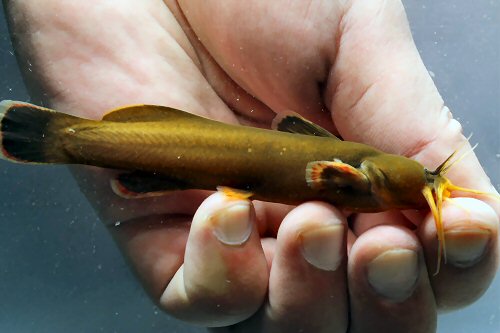
ow do you get your tongue around the name of this months (July 2024) factsheet, namely Xiurenbagrus xiurenensis ?. Well "Zee-yoo-ren-bagrus" is the genus name and "zee-yoo-ren-en-sis" is your species name.
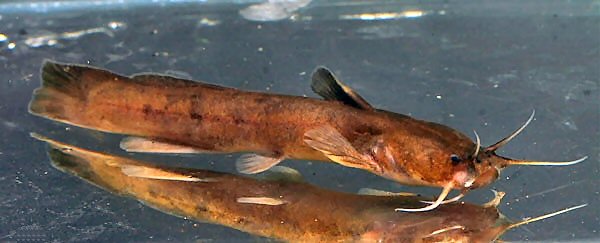

This member of the Amblycipitidae family from the Xiuren River, Pearl River drainage has three species in this genera, namely our factsheet of the month, Xiurenbagrus dorsalis Xiu, Yang & Zheng, 2014 from Guangxi China, and Xiurenbagrus gigas Zhao, Lan & Zhang, 2004 from Hongshuihe River China, all from the Pearl river basin. All have been in the Liobagrus genus at some point and the differences being because of the presence of two patches of vomerine teeth, lack of deep grooves along shafts of dorsal and pectoral fin spines, relatively acute snout, and short barbels. These characteristic is not found in any other species of Amblycipitidae except those of the genus Xiurenbagrus.


Xiurenbagrus xiurenensis

  Xiurenbagrus xiurenensis


The family Amblycipitidae has long been considered to contain only two genera Amblyceps and Liobagrus Hora (1933). In the course of a phylogenetic revision of the family, Chen (1994) discovered that Liobagrus could not be supported as monophyletic with the inclusion of Liobagrus xiurenensis Yue (1981). Accordingly, in this paper, we redescribe this species and establish for it a new genus, Xiurenbagrus. Further, phylogenetic characterisations of the amblycipitid genera and their phylogenetic interrelationships are presented (from Chen, X., & Lundberg, J. G. 1995).


Xiurenbagrus xiurenensis


  Xiurenbagrus xiurenensis


Little is known about the ecology of X. xiurenensis. Yue (1981) states that this species is benthic and inhabits streams in the Nan Ling mountain range. The stomach contents includes parts of arthropods, invertebrates in the phylum Arthropoda.


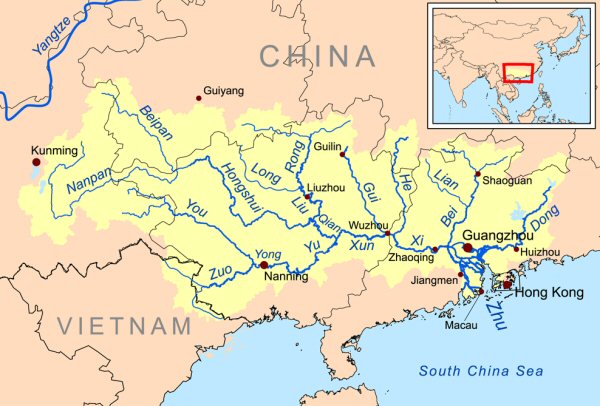
Pearl River Basin


Distrbution: China: Pearl River Basin.


The Map above shows the tributaries of the Pearl River, and the Pearl River Basin (watershed/drainage basin) in yellow. The Lubao Yong and Xinan Yong converge with the Liuxi River to form the main branch of the Pearl River just north of Guangzhou. The long and wide Pearl River Delta includes the dense network of cities that span nine prefectures of Guangdong Province, into the South China Sea.

X. xiurenensis inhabits the Pearl River, northward to Lijiang River near Guilin, Guangxi, southward to Zuojiang River near Longzhou, Guangxi.

Common Name

None

Synonyms

Liobagrus xiurenensis

Family

Amblycipitidae

Subfamily

-

Distribution

Asia: China, Zhujiang River.

Size

8.0cm (3¼ins)

Temp.

18-22°C (63-71°F)

p.H.

6.5-7.5.

Characteristics

Dorsal spines (total): 1; Dorsal soft rays (total): 6 - 6; Anal soft rays: 7 - 8; Vertebrae: 41 - 44. Elongated body, round-shaped in the front, gradually flat in the back, covered by membrane. Short dorsal fin; very small eyes, covered by skin membrane. Dorsal-fin rays i,6; Anal-fin rays vi,8 to vi,11; Pectoral-fin rays i,6 to i,7; Pelvic-fin rays i,6.

Colouration

The edge of dorsal, anal and caudal fins are yellowish; brownish back, yellowish stomach.

Aquarium Care & Compatibility

They are territorial, so avoid keeping multiple males together. Compatible tankmates include peaceful community fish like Danios, Barbs, and small Tetras. They are nocturnal, so provide hiding spots during the day. Use fine sand or smooth gravel as the substrate. Include caves, driftwood, and rocks for hiding and exploration. Live plants can enhance the environment.

Reproduction

Not recorded.

Sexual differences

Not recorded

Diet

They primarily feed on small aquatic organisms found in its natural habitat. These may include insects, crustaceans, and other small invertebrates. Their elongated bodies and unique adaptations make them well-suited for foraging near the bottom of freshwater environments. Feed them a varied diet of high-quality pellets, frozen foods (such as bloodworms), and live or freeze-dried options. They are omnivorous, so include both plant-based and protein-rich foods.

Glossary of Terms

Anal fin: The median, unpaired, ventrally located fin that lies behind the anus, usually on the posterior half of the fish.
Barbels: Whisker-like structure on the heads of most catfish.
Benthic: Bottom dwellers.
Caudal fin: The tail.
Dorsal fin: The primary rayed fin(s) on top of the body.
Monophyletic: The term monophyly, or monophyletic, derives from the two Ancient Greek words µóvoç (mónos), meaning "alone, only, unique", (phûlon), meaning "genus, species", and refers to the fact that a monophyletic group includes organisms (e.g., genera, species) consisting of all the descendants of a unique common ancestor.
Pectoral: The paired fins just behind the head.
Pelvic fins: The paired fins, between the pectorals and the anal fins. (also referred to as ventrals).
Phylogenetic: The study of evolutionary relationships among biological entities – often species, individuals or genes (which may be referred to as taxa).

Etymology

Xiurenbagrus: Named for Mister Ning Xiuren, Hangzhou, Institute of Oceanography; oceanographer and phytoplankton specialist.
xiurenensis: leuco-, white; rhynchus, snout, referring to the white end of the muzzle.

References

Chen, X., & Lundberg, J. G. (1995). Xiurenbagrus, a New Genus of Amblycipitid Catfishes (Teleostei: Siluriformes), and Phylogenetic Relationships among the Genera of Amblycipitidae. Copeia, 1995(4), 780–800.
Devi, R. & Boguskaya, N. 2009. Xiurenbagrus xiurenensis. The IUCN Red List of Threatened Species 2009.
Froese, R. and D. Pauly. Editors. 2009. FishBase. World Wide Web electronic publication. www.fishbase.org, version (01/2011).
The ETYFish Project Fish Name Etymology Database © Christopher Scharpf.

IUCN Red List

X. xiurenensis has been assessed as Data Deficient as the species is not well known beyond it's type locality. Potential threats to the species exist, including overfishing and pollution.

Photo Credits

© Zhu Hang
© 
Drake Shaw
Map: By Kmusser - Own work, CC BY-SA 3.0.

Donate towards my web hosting bill!


If you would like to contribute to the monthly factsheets with an article, information or photos, please e-mail me. You will of course be credited for your work.

If you would like to donate any denomination of money to the site just click the above link button. All proceeds will go to running the site and hopefully to keep it going for a few years yet.


ScotCat Sources

Etymology = Genus Etymology-genus name

Etymology = Species Etymology-specific name


Other Sources

Search  Search

FishBase Fishbase

Catalog of Fishes Catalog of Fishes

Global Biodiversity Information Facility GBIF

iNaturalist iNaturalist

IUCN IUCN

  • Facebook about us + contact us + citation + translate + site map + scotshop + glossary + etymology +
  • help YouTube

©2025 SCOTCAT.COM