SCOTCAT.COM
your internet guide to all things catfish
Ictalurus pricei (Rutter, 1896) |
Image contributors to this species: |
Tim Aldridge (3) |
ScotCat Sources: |
|
|

Other Sources: |
|


Relevant Information: |
This species is represented by a limited number of distinct occurrences, or subpopulations (probably fewer than 20). Varela-Romero et al. (2011) surveyed the entire Mexican range and found this species in three sites in the Yaqui basin, zero sites in the Mayo basin, and two sites in the Fuerte basin. Not more than a few small populations exist in Arizona (Varela-Romero et al. 2011). Based on pervasive threats in most occupied drainage basins, the number of distinct locations may not exceed five. The total adult population size is unknown. This fish is rare to uncommon throughout its range (Varela-Romero et al. 2011). Surveys in 1979 found Mexican populations to be seriously depleted. USFWS (1990) categorized the status as 'declining'. Recent surveys found Ictalurus pricei in only five collection sites in Mexico, compared to 15 historical collection sites (Varela-Romero et al. 2011). Global population trend over the past 10 years or three generations is uncertain, but distribution and abundance probably are still declining. Local population trend at Big Tank has declined by 15% annually since the 1990’s (Stewart et al. 2017). Threats (non-native species, new reservoirs) to the Yaqui Catfish have increased in recent years, and hybridisation with the Channel Catfish now appears widespread (Varela-Romero et al. 2011). Habitat: includes medium to slow currents over gravel/sand substrates in small to medium rivers (Lee et al. 1980, Page and Burr 2011). Habitat in Mexico includes moderate to large streams, at elevations up of 2,100 m, in moderate to swift currents; substrates of mud, sand, gravel, rock, and scattered boulders; vegetation may be sparse except for diatoms and green algae on riffles; depths of 1.0–4.0 m (Miller 2005). Etymology: The specific name pricei: In honour of American ornithologist William Wightman Price (1871–1922), who collected holotype. |
Common Name: |
Yaqui catfish |
Synonyms: |
Villarius pricei |
Family: |
Ictaluridae |
Distribution: |
North America: Rio Yaqui and Rio Casas Grandes drainages in northwestern Mexico and (presumably) extreme southeastern Arizona in USA. |
Size: |
57.0cm. (22¾ins) TL. |
Temp: |
18-25°C (63-77°F) |
p.H. |
|
6.5-7.5. |
IUCN Red List |
Once widespread in the Yaqui and Casas Grande drainage basins, this species is now likely restricted to the Yaqui, Mayo and Fuerte river basins. Major pervasive threats that have caused past and current declines in population size include habitat degradation resulting from land use changes, pollution, surface water diversion, ground water extraction and the impacts of nonnative species, including hybridisation with blue catfish. Ictulurus pricei is listed as Endangered (EN) because its area of occupancy is unlikely to surpass 500 km2, number of locations is unlikely to exceed five, and distribution and abundance exhibit ongoing declines (rate unknown, but threats have increased in recent years), (IUCN 2019). |
Reference: |
Froese, R. and D. Pauly.
Editors. 2019. FishBase. World Wide Web electronic
publication. www.fishbase.org, ( 04/2019 ). |

Family: Ictaluridae Back to Ident-A-Cat Click on Thumbnails |
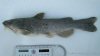 Ictalurus pricei
 |
 Ictalurus
pricei Ictalurus
pricei |
 Ictalurus
pricei Ictalurus
pricei |
If you would like to contribute to the monthly factsheets with an article, information or photos, please e-mail me. You will of course be credited for your work.

If you would like to donate any denomination of monies to the site just click the above link button. All proceeds will go to running the site and hopefully to keep it going for a few years yet.

