SCOTCAT.COM
your internet guide to all things catfish
Farlowella kirane Dopazo M, Deprá GC, Zawadzki CH, & Britto MR., 2025 |
Image contributors to this species: |
ScotCat Sources: |
|
|

Other Sources: |
|

Relevant Information: |
Description: A new species of Farlowella is described from the upper Paraguai River basin, Mato Grosso State, Brazil. The species was investigated by morphological and molecular datasets. The new species can be distinguished from its congeners by the following character combination: (1) absence of gular plates, (2) absence of breeding odontodes, (3) absence of the mid-dorsal plate series, (4) complete series of central abdominal plates, (5) five total rays in the pelvic fin, (6) modally i,10,i rays in the caudal fin, (7) lateral contour of the snout distinctly concave in dorsal view and (8) dorsal caudal-fin lobe fully covered with melanophores and ventral lobe pigmented only ventrally in adults. The new species has the smallest body size recorded for any species of Farlowella, not exceeding 96 mm in standard length (SL). Genetic divergence between the new species and other Farlowella ranged from 3.1–12.5% and three delimitation analyses recovered it as an independent lineage. A review of the cytochrome c oxidase subunit I (COI) sequences for Farlowella deposited in public repositories, an additional record of sexual dimorphism in the cloaca and a discussion about other species from the Paraguai River basin are provided. Aquarium Care: Not an easy catfish to keep as there have been many unexplained deaths attributed to this species (and other Farlowella) and as such would need dedicated care from an experienced catfish keeper who has worked with this species or its close cousins from the easier kept Sturisoma genera. As this is a very timid species, if housed with other inhabitants you would be better keeping away from boisterous fish such as some of the Barb species (such as tigers) and definitely Cichlids. Better companions would be the unobtrusive Corydoras species and small Characins or Rasboras. Needs a high oxygen content in the aquarium with regular water changes to keep the water in pristine condition. Prefers a dark substrate with a dense vegetation, floating and long leaved plants where they will hang on to. Diet: They are mostly vegetarian with algae being their number one source of food for adults and young fry so the above mentioned foods along with vegetable laden tablets should suffice. Etymology: The specific name kirane: The Paresi people inhabited the plateau called Parecis, from the Arinos River and headwaters of Paraguai River to the headwaters of the Guaporé and Juruena Rivers. Specifically, these rivers spread across the valley of the Sumidouro River, a tributary of the Arinos River, and headwaters of the Sepotuba and Sacuriu-ina Rivers, approximately the same area of occurrence of the new species (Povos Indígenas no Brasil, 2009). In the language of the Paresi, which is from the Aruak family linguistic trunk, kirane means small (Rowan, 2001). The species name alludes to the fact that Farlowella kirane is the smallest species known to date in the genus, reaching up to 96 mm SL. |
Common Name: |
None |
Synonyms: |
None |
Family: |
Loricariidae |
Distribution: |
South America: Brazil, State of Mato Grosso, between Nova Marilândia and Santo Afonso, Córrego das Pedras, tributary to Córrego Vermelho, Sepotuba River basin, Paraguai River basin, 14°21’03”S 57°33’07”W. |
Size: |
10cm (4ins) |
Temp: |
22-26°c (71-79°f.) |
p.H. |
|
6.0-7.0. |
IUCN Red List |
Not Evaluated. |
Reference: |
Dopazo M, Deprá
GC, Zawadzki CH, Britto MR. A new short-snouted
species of Farlowella (Siluriformes: Loricariidae)
from the upper Paraguai River basin. Neotrop Ichthyol.
2025; 23(3):e240140. |

Family: Loricariidae Back to Ident-A-Cat Click on Thumbnails |
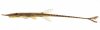 Farlowella
kirane Farlowella
kiraneHolotype-lateral view |
 Farlowella
kirane Farlowella
kiraneHolotype-dorsal view |
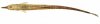 Farlowella
kirane Farlowella
kiraneHolotype-ventral view |
If you would like to contribute to the monthly factsheets with an article, information or photos, please e-mail me. You will of course be credited for your work.

If you would like to donate any denomination of monies to the site just click the above link button. All proceeds will go to running the site and hopefully to keep it going for a few years yet.

