SCOTCAT.COM
your internet guide to all things catfish
Rhadinoloricaria condei (Isbrücker & Nijssen 1986) |
Image contributors to this species: |
Haakon Haagensen (1) |
ScotCat Sources: |
|
|

Other Sources: |
|


Relevant Information: |
Description: Representatives of this genus are distributed in the upper Amazon and Orinoco drainages, along the Atlantic slope of the Andes. They inhabit sand substrates and are morphologically adapted to this habitat. As with other representatives of the Pseudohemiodon group, their body is strongly depressed and the pelvic fins are used for locomotion, enabling these fish to appear to “walk” on the substrate. Sexual dimorphism is apparent through differentiated lip structure (Covain, R et al 2015). The lip surfaces of the male are rather papillose while those of the female are filamentous (Nijssen & Isbrücker 1988). All species of Apistoloricaria have now been moved to the Rhadinoloricaria genera. Habitat: This species was collected in turbid and dark waters, in moderately fast flowing streams, between 2 to 10 meters deep. No submerged vegetation was noted, and the bottom was made of sand, mud, dead leaves, twigs, branches, and trunks (Covain, R et al 2015). Reproduction: These taxa are abdomino-lip brooders. Eggs are laid in a single layered mass, and are attached to the surface of the lower lip and abdomen of the male. Aquarium Care: Likes to bury itself in a deep sandy bottom substrate with only the eyes being visible so you would need to provide this for aquarium maintenance. A good water current and partial water changes are needed to keep this species/genera in good condition. As this genera is smaller than the other larger lip brooders of the Pseudohemiodon genus, Rhadinoloricaria would be a better bet for aquarium husbandry. Diet: In its natural habitat the stomach contents included larvae of aquatic insects, small seeds and debris. Feed with tablet foods, frozen mosquito larvae, daphnia etc. Remarks: The species is listed as Least Concern due to its wide range and because it is not exposed to any major threat (IUCN 2016). This species can still be found online as of 2023 as its synonym, Apistoloricaria condei. |
Common Name: |
shitari (Spanish; Castilian). |
Synonyms: |
Apistoloricaria condei |
Family: |
Loricariidae |
Distribution: |
South America: Ecuador, Rio Napo drainage, mouth of Rio Tiputini. Type locality: L’Equateur, Prov. Napo, bassin du Napo (haut Amazone) embouchure du Rio Tiputini dans le Rio Napo au confluent de l’affluent principal, en eau profunde (00º48.9'S, 75º32.5'O). |
Size: |
14.0cm (5½inch) |
Temp: |
24-27°c (75-81°f) |
p.H. |
|
6.5-7.5. |
Reference: |
Covain, R., S. Fisch-Muller,
C. Oliveira, J. H. A. Mol, J. I. Montoya-Burgos and
S. Dray 2015 (29 Oct.) Molecular phylogeny
of the highly diversified catfish subfamily Loricariinae
(Siluriformes, Loricariidae) reveals incongruences
with morphological classification. Molecular Phylogenetics
and Evolution v. 94 (Pt. B): 492-517 [1-26]. |

Family: Loricariidae Back to Ident-A-Cat Click on Thumbnails |
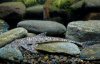 Rhadinoloricaria condei
 |
If you would like to contribute to the monthly factsheets with an article, information or photos, please e-mail me. You will of course be credited for your work.

If you would like to donate any denomination of monies to the site just click the above link button. All proceeds will go to running the site and hopefully to keep it going for a few years yet.

