SCOTCAT.COM
your internet guide to all things catfish
Chiloglanis brevibarbis Boulenger, 1902 |
Image contributors to this species: |
FAO (1) |
ScotCat Sources: |
|

Other Sources: |
|
|


Relevant Information: |
Description: Caudal fin is deeply forked, the caudal fin lobes of equal length. Adipose fin short. Vertebrae: 34 - 35. Lips greatly enlarged in a big flat sucker. Habitat: Occurs in rapids and fast flowing waters; clings onto stones and can even climb up waterfalls. Reproduction: Oviparous. Distinct pairing during breeding. Colouration: Mid brown colouration, with indistinct light brown spots on the upper body and extending to the lateral line, in front of the dorsal fin, behind the adipose fin, and between the dorsal and adipose fins. The belly is light brown-beige. There is a dark spot on each of the caudal fin lobes. Aquarium Care: Good oxygenated water from a power filter. Sand or gravel substrate with smooth rocks or pebbles. Their dorsal and pectoral fins are sharp and can cause wounds if not handled carefully. Diet: Feeds on algae and aquatic insects. Etymology: brevibarbus - With short barbels. |
Common Name: |
Short barbelled suckermouth |
Synonyms: |
None |
Family: |
Mochokidae |
Distribution: |
Africa: Athi and Tana River basins in Kenya. Type locality: Mathoiya River, in the Kenya district, East Africa. |
Size: |
6.0cm. (2½ins) T.L. |
Temp: |
22-25°C (71-77°F) |
p.H. |
|
6.0-7.2. |
IUCN Red List |
This species is endemic to Tana and Athi rivers, Kenya. It has an extent of occurrence (EOO) of 79,407 km2 and an area of occupancy (AOO) of 29,760 km2. It occurs in 20-30 locations and is experiencing a continuing decline in quality of its habitat due to pollution, riparian land cultivation, nutrient loads and sand harvesting. There are no species specific conservation efforts in place for this species. However, the species range extends to protected areas (Tsavo and Meru national parks and Mwingi and Kora game reserves), where it is not under immediate threat. However, if the threatening events outside of protected areas continue unabated, this may drive the species into a threatened category. Further research is needed to understand the population size and trend, as well as the life history and ecology of this species. This species is therefore assessed as Least Concern (IUCN 2023). |
Reference: |
Breder, C.M. and D.E.
Rosen, 1966. Modes of reproduction in fishes.
T.F.H. Publications, Neptune City, New Jersey. 941
p. |

Family: Mochokidae Back to Ident-A-Cat Click on Thumbnails |
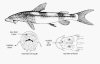 Chiloglanis
brevibarbus Chiloglanis
brevibarbusLine drawing-Tanzania |
If you would like to contribute to the monthly factsheets with an article, information or photos, please e-mail me. You will of course be credited for your work.

If you would like to donate any denomination of monies to the site just click the above link button. All proceeds will go to running the site and hopefully to keep it going for a few years yet.

