SCOTCAT.COM
your internet guide to all things catfish
Pangasius larnaudii Bocourt, 1866 |
Image contributors to this species: |
Allan James (3) Jean-Francois Helias (7) Cheilinus Aquarium Photography (1) |
ScotCat Sources: |
|
|

Other Sources: |
|


Relevant Information: |
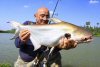
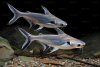
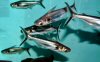
Description: Anal soft rays: 28 - 32. A large black spot above the base of the pectoral fin and a black longitudinal stripe along each caudal lobe. Dorsal and pectoral fins with a strong spine and a long, filamentous rays. With 13-17 gill rakers in first arch. Habitat: Occurs in medium to large-sized rivers and inhabits deep pools in the river. Found in rapids and riffle. Enters flooded forest. Reproduction: Migrates into floodplains and spawns at the beginning of the flood season. Artificially reared fry of 3.5 mm at 12 hrs., 8.4 mm at 4 days, 8.8 mm at 8 days and 23 mm at 18 days. Larval teeth present in 12 hr and 4 day larvae. Diet: Feeds on shrimps, small fishes, gastropods and plants. Remarks: This catfish is not really recommended for the home aquarium as they grow too big and have special requirements that we as aquarists can never attain. Do not buy from Fish stores if they are labeled as such, or as Pangasius species. |
Common Name: |
Black Eared Pangasius, Black Ear Catfish |
Synonyms: |
Pangasius taeniura, Pangasius taeniurus, Pangasius burgini, Pangasius larnaudi |
Family: |
Pangasiidae |
Distribution: |
Asia: Mekong and Chao Phraya basins. |
Size: |
130.0cm. (52ins) |
Temp: |
22-26°C (71-79°F) |
p.H. |
|
7.0-8.5. |
Reference: |
Froese, R. and D. Pauly.
Editors. 2009. FishBase.World Wide Web electronic
publication.www.fishbase.org, version (04/2009). |

Family: Pangasiidae Back to Ident-A-Cat Click on Thumbnails |
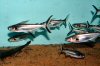 Pangasius larnaudii
Juveniles |
|
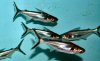 Pangasius
larnaudii Pangasius
larnaudiiJuveniles |
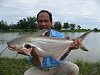 Pangasius
larnaudii Pangasius
larnaudiiSub-Adult: Caught, Ratchaburi, Thailand. |
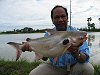 Pangasius
larnaudii Pangasius
larnaudii Sub-Adult: Caught, Ratchaburi, Thailand. |
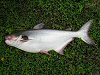 Pangasius
larnaudii Pangasius
larnaudii Sub-Adult: Caught, Ratchaburi, Thailand. |
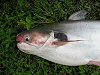 Pangasius
larnaudii Pangasius
larnaudii Sub-Adult: Caught, Ratchaburi, Thailand. |
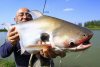 Pangasius
larnaudii Pangasius
larnaudiiHead view |
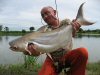 Pangasius
larnaudii Pangasius
larnaudii |
 Pangasius
larnaudii Pangasius
larnaudii |
 Pangasius larnaudii
 |
If you would like to contribute to the monthly factsheets with an article, information or photos, please e-mail me. You will of course be credited for your work.

If you would like to donate any denomination of monies to the site just click the above link button. All proceeds will go to running the site and hopefully to keep it going for a few years yet.

