SCOTCAT.COM
your internet guide to all things catfish
Pangasius sanitwongsei Smith, 1931 |
Image contributors to this species: |
Allan James (2) Frants Lehmann (1 Stamp) Johnny Jensen's Photographic Library (1) Jean-Francois Helias (7) Cheilinus Aquarium Photography (2) |
ScotCat Sources: |
|
|

Other Sources: |
|


Relevant Information: |
Important food fish and is often referred to in textbooks and popular press or news media. Threatened due to over harvesting, habitat loss and pollution. Fishery used to be accompanied by rites and ceremonies of a religious nature. Description: Fins are pigmented with dusky melanophores. First soft ray in dorsal, pectoral and pelvic fins prolonged into a filament. Broad head; black tips on first few anal-fin rays in individuals of all sizes, particularly in juveniles; palatine and vomerine teeth united into a single long crescentic patch. Mouth wide, its width 5.5-5.9 times in SL. Habitat: Inhabits large rivers. Juveniles are found in larger tributaries. Reproduction: A migratory species which spawns just before the rainy season and the young of the year reach a length of about 10 cm by mid-June. Diet: Both young and adults feeds on fishes and crustaceans. Larger individuals have been known to feed on carcasses of fowl or dog (which are commonly used for bait). Etymology: The specific name sanitwongsei: In honour of the late Yai Suapan Sanitwongse, physician and medical officer in Thai government service, for “his keen personal interest” in the fishes of Thailand; he brought this species to Smith’s attention and pointed out its distinctive characters. Remarks: This catfish is not really recommended for the home aquarium as they grow too big and have special requirements that we as aquarists can never attain. Do not buy from Fish stores if they are labeled as such, or as Pangasius species. |
Common Name: |
Giant Pangasius, Paroon Shark |
Synonyms: |
Pangasius beani |
Family: |
Pangasiidae |
Distribution: |
Asia: Chao Phraya and Mekong river basins. Type locality: Menam Chao Phya at Koh Yai, Central Siam. |
Size: |
250.0cm. (8ft.4ins) |
Temp: |
22-26°C (71-79°F) |
p.H. |
|
7.0-8.5. |
IUCN Red List |
There are ongoing threats to P. sanitwongsei, including harvesting, and alteration of the river for dams and increased shipping. Assessed as Critically Endangered due to an estimated population decline of more than 99% over three generations, even using the most optimistic values for generation time and population size (assuming a constant exponential rate). This rate has been inferred for the whole population given that the same threats exist throughout the range of P. sanitwongsei, but needs updating (IUCN 2009). |
Reference: |
Froese, R. and D. Pauly.
Editors. 2009. FishBase. World Wide Web electronic
publication. www.fishbase.org, version (02/2010). |

Family: Pangasiidae Back to Ident-A-Cat Click on Thumbnails |
 Pangasius sanitwongsei
 Juvenile |
 Pangasius
sanitwongsei Pangasius
sanitwongsei Juvenile |
 Pangasius
sanitwongsei Pangasius
sanitwongsei Stamp |
 Pangasius
sanitwongsei Pangasius
sanitwongsei |
 Pangasius
sanitwongsei Pangasius
sanitwongsei |
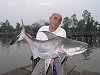 Pangasius
sanitwongsei Pangasius
sanitwongseiCaught by Image contributor, Jean-Francois Helias |
 Pangasius
sanitwongsei Pangasius
sanitwongsei25.50kg current IGFA World Record |
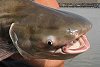 Pangasius
sanitwongsei Pangasius
sanitwongseiHead view |
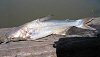 Pangasius
sanitwongsei Pangasius
sanitwongseiJuvenile |
 Pangasius
sanitwongsei Pangasius
sanitwongsei29.50 kg specimen which set a world record on Sept 8, 2007 |
 Pangasius
sanitwongsei Pangasius
sanitwongsei |
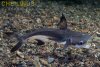 Pangasius
sanitwongsei Pangasius
sanitwongseiJuvenile |
 Pangasius
sanitwongsei Pangasius
sanitwongseiJuvenile |
If you would like to contribute to the monthly factsheets with an article, information or photos, please e-mail me. You will of course be credited for your work.

If you would like to donate any denomination of monies to the site just click the above link button. All proceeds will go to running the site and hopefully to keep it going for a few years yet.

