SCOTCAT.COM
your internet guide to all things catfish
Pericambeva iheringi (Eigenmann, 1917) |
Image contributors to this species: |
Junior Hübner (3) Donin LM, Ferrer J, Carvalho TP. 2022 (1) |
ScotCat Sources: |
|
|

Other Sources: |
|


Relevant Information: |
Abstract: Trichomycterus comprises about 170 valid species, but its monophyly has been challenged in the last decades. Bayesian Inference and Maximum Likelihood analyses comprehending mitochondrial genes COI and CYTB and nuclear genes GLYT, MYH6 and RAG2 from 71 Trichomycterinae terminal taxa and eight outgroups were performed. The analyses highly supports a clade containing Trichomycterus nigricans, the type species of the genus, and several other congeners endemic to eastern and northeastern Brazil, herein considered as the genus Trichomycterus, the sister clade the southern Brazil and adjacent areas clade; the latter clade comprises two subclades, one comprising species of the genus Scleronema and another comprising species previously placed in Trichomycterus, herein described as a new genus. The new genus (Peri) Cambeva (2020) is distinguished from all other trichomycterines by the presence of a bony flap on the channel of the maxillo-dentary ligament, the interopercle shorter than the opercle, a deep constriction on the basal portion of the antero-dorsal arm of the quadrate, absence of teeth in the coronoid process of the dentary, the maxilla shorter than the premaxilla, the cranial fontanel extending from the the medial posterior of frontal to the medial region of supraoccipital, and absence of the postorbital process of the sphenotic-prootic-pterosphenoid. Description: Dorsal spines (total): 2; Dorsal soft rays (total): 9-10; Anal spines: 1-2; Anal soft rays: 5. Habitat: Species of (Peri) Cambeva occur in the Paraná, São Francisco, Ribeira de Iguape, and Uruguay river basins, as well as in smaller isolated coastal river basins of south-eastern and southern Brazil. Colouration: Colouration composed of numerous black spots or sparse rounded black blotches, sometimes concentrated along de mid-lateral line of the body, over a pale-yellow or a grayish background (vs. body with mottled pattern of blotches) (Donin LM, Ferrer J, Carvalho TP. 2022). Etymology: The genus name Pericambeva: perí, near or around, referring to its geographical proximity with Cambeva.The specific name iheringi: In honour of Rodolpho von Ihering (1883–1939), zoologist and fish culturist, who collected part of the type series. Remarks: Still found on some online sources as Trichomycterus iheringi, Camveva iheringi and Pygidium iheringi (synonyms). |
Common Name: |
None |
Synonyms: |
Pygidium iheringi, Trichomycterus iheringi, Camveva iheringi |
Family: |
Trichomycteridae |
Distribution: |
South America: Ribeira do Iguape River basin in Brazil. Type Locality: São Paulo in coastal streams and Parana basin, Brazil. |
Size: |
16.0cm. (6¼ins) |
Temp: |
22-26°c (71-79°f.) |
p.H. |
|
6.0-7.0. |
IUCN Red List |
Not Evaluated. |
Reference: |
Burgess, W.E.,
1989. An atlas of freshwater and marine catfishes.
A preliminary survey of the Siluriformes. T.F.H. Publications,
Inc., Neptune City, New Jersey (USA). 784 p. |

Family: Trichomycteridae Back to Ident-A-Cat Click on Thumbnails |
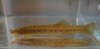 Pericambeva iheringi |
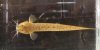 Pericambeva
iheringi Dorsal view |
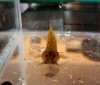 Pericambeva
iheringi Head view |
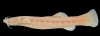 Pericambeva
iheringi Piagui River, coastal drainage of São Paulo State |
If you would like to contribute to the monthly factsheets with an article, information or photos, please e-mail me. You will of course be credited for your work.

If you would like to donate any denomination of monies to the site just click the above link button. All proceeds will go to running the site and hopefully to keep it going for a few years yet.

