SCOTCAT.COM
your internet guide to all things catfish
Sciades parkeri (Traill, 1832) |
Image contributors to this species: |
Jian Ruilong (1) Donald Taphorn (1) Gerry van Tonder (2) |
ScotCat Sources: |
|

Other Sources: |
|
|


Relevant Information: |
The classification of species within the Ariidae is arguably the most poorly resolved of any catfish family. In recent years, there have been three independent attempts to examine the phylogeny of the family (Marceniuk, 2003; Kailola, 2004; and Betancur et al., 2004) and produce classifications that reflect the resulting phylogenetic hypotheses (see Ferraris 2007). Description: Dorsal spines (total): 1; Dorsal soft rays (total): 7; Anal soft rays: 18 - 20; Vertebrae: 49 - 51. This species is distinguished by the following characters: in life, yellowish body; swim bladder divided into 3 chambers; shield-shaped nuchal plate, usually larger than the supraoccipital process; head shield exposed and granulated in orbital and postorbital regions; first 2 gill with no mesial gill rakers. Sciades parkeri can further be distinguished from sympatric congeners by the following: fleshy furrow connecting posterior nares absent (vs. present in S. couma, S. herzbergii and S. passany); moderately sized posterior chamber of swim bladder (vs. small in S. proops; absent in S. couma, S. herzbergii, S. passany); nuchal plate with no anterior notch (vs. anterior notched in S. proops, sometimes notched in S. herzbergii); palatal patches forming a U-shaped band (vs. transverse in S. passany, lateral edge on accessory patches not emarginated or shallowly notched; lateral edge with an angled and pronounced notch in S. proops). Habitat: Mainly found in turbid waters over muddy bottoms in coastal areas, estuaries and lower parts of rivers. Sexually mature after around two years of age. Upon hatching, the alevins are relatively large, approximately 6.0-6.5 cm. Aquarium Care: Grows too large for the home aquarium. Etymology: The genus name Sciades: sciado-, canopy or umbrella, probably referring to the occipital process, described as a “distinct bony helmet” (translation). The specific name parkeri: in honour of Traill’s friend Charles Stewart Parker (1800-1868), British merchant who “favoured” the author with a drawing of the catfish and its skin. |
Common Name: |
Synonyms: |
Silurus parkeri, Arius parkeri, Aspistor parkeri, Hexanematichthys parkeri |
Family: |
Ariidae |
Distribution: |
Western Atlantic: from the Gulf of Paria, Venezuela to Maranhao State, Brazil. Habitat: brackish, marine. |
Size: |
190.0cm. TL (6ft 4ins) |
Temp: |
22-26°c (71-79°f) |
p.H. |
|
7.0-8.0. |
IUCN Red List |
This species is widely distributed, common and abundant where it occurs in estuaries and lower reaches of rivers. Its generation length is 11 years. It is commercially exploited as a food source with high market value throughout its range. It is targeted for national and international trade not only for its meat, but also its swim bladder which also gains high market prices. Off Brazil, landings declined by 47-54% between 1997 and 2007 (10 years). There has been no decrease in effort. The area off Brazil comprises approximately 40% of its global range. High catch levels are also reported for Venezuela and French Guyana, but landings data are not available. Overall, data are not available over a period of three generation lengths (33 years). However, it is suspected that since this fishery has been in existence since the late 1800s and effort has only been increasing, it is likely that declines are in the order of at least 30% throughout its range over the three generation length period. Therefore, this species is listed as Vulnerable under A2bd, but needs updating (IUCN 2015). |
Reference: |
Betancur, R., Marceniuk,
A.P., Giarrizzo, T. & Fredou, F.L. 2015.
Sciades parkeri. The IUCN Red List of Threatened
Species 2015. |

Family: Ariidae Back to Ident-A-Cat Click on Thumbnails |
 Sciades
parkeri |
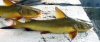 Sciades
parkeri Georgetown, Guyana Fish Market |
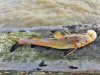 Sciades
parkeri |
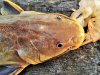 Sciades
parkeri Dorsal head view |
If you would like to contribute to the monthly factsheets with an article, information or photos, please e-mail me. You will of course be credited for your work.

If you would like to donate any denomination of monies to the site just click the above link button. All proceeds will go to running the site and hopefully to keep it going for a few years yet.

