SCOTCAT.COM
your internet guide to all things catfish
| Breeding Corydoras arcuatus |
by Graham Ramsay |
Hoplisoma granti
It’s a lovely catfish and would be top of many enthusiasts’ popularity lists. Not only is it pretty but C. arcuatus are reasonably common in pet shops and are not too expensive. For these reasons it’s a popular and familiar fish and many fish-keepers have a shoal of these little cats. First described by M.G. Elwin in 1939 it has been in the hobby since at least the 1970s so it is a little surprising that breeding records of this fish are few and far between. In fact I could find only one documented case, that by Ian Fuller and described in his book – Breeding Corydoradine Catfishes. All this being so it was more in hope than in expectation that I bought a group of these in 2004 from a local shop and another group of very young fish from BAS in Bolton the following year. Over the next few years I tried the usual methods used to spawn fish of this genus with no success. By the start of 2008 they were happily, but celibately sharing a 4ft tank with some C. rabauti, Brochis splendens and a few Danio margaritatus. That Spring, when a few eggs appeared on the glass and on the plants I at first suspected the brochis. The C. rabauti had spawned once before and their several hundred eggs had been placed along the water line. In addition the brochis had been dancing around the tank and nuzzling each other for a while. In any event the eggs appeared to be infertile so I didn’t give it much thought. A further batch of eggs was similarly ignored although I noted that the eggs were appearing after a water change. I looked forward to my first brochis fry.
7In May 2008 I noticed some fry – a tiddler which must have been several weeks old and a couple of fry which were only just free swimming. They clearly weren’t brochis and a quick visual check confirmed they weren’t C. rabauti either. So, unless I had some highly unusual danios then they could only be young C. arcuatus. My delight was tempered by the knowledge that so few fry had been produced. I crossed my fingers and waited for a further spawning. Three weeks later, and a couple of days after a water change, more eggs appeared (I have yet to witness the actual spawning which I assume occurs at night). This time I collected those that weren’t obviously infertile and placed them in an ice cream tub which I floated in the tank. I added some alder cones and an air line to try and prevent fungus. The eggs themselves were scattered around the tank, some stuck to plants and some to the glass. They weren’t very large as corydoras eggs go, about the same size as C. panda.
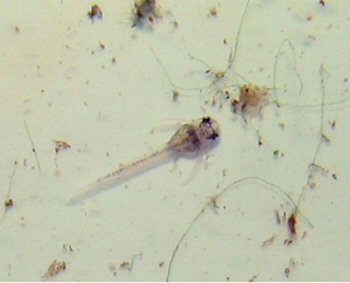
A dozen fry hatched out four days later. They were small and, looked at from above, the dark pigmentation on their upper surface made a T-shape. Their yolk sac was very small so after just one day I started to feed them on live microworms and pre-soaked ZM-100 fry food. They all appeared to be eating fine but I always have trouble rearing small numbers of fry. I suspect it’s because it’s difficult to feed such tiny amounts and most of the food is spoilt. After ten days a couple of the fry had perished so I made the decision to move them into a larger tank (18” x 12” x12”) with a breeding colony of C. pygmaeus and some fry of both C. concolor and C121. I was due to go on holiday the first week in July anyway and they would have to fend for themselves. This tank is very mature and is stuffed full of Java moss. I raise handfuls of C. pygmaeus in it and any other small spawn usually finds its way in here also. So in they went and off I went to Center Parcs with the wife and kids. The lions of Longleat are nice enough but I’m a fish person myself so I was happy to be back a week later to check up on the fishy kids.
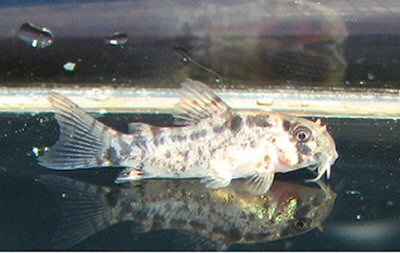
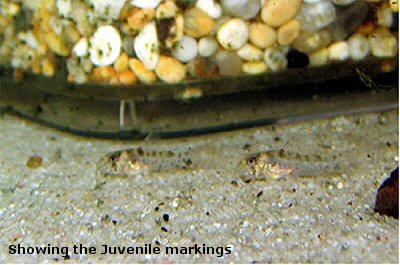
The C. arcuatus fry are easy to spot amongst the other species due to two distinctive spots - one on the lower part of the caudal peduncle, just where it joins with the caudal fin and one at the base of the dorsal spine. As the fry mature these spots merge into the distinctive black stripe.Happily most of the young C. arcuatus have survived and I now have fish from three different spawnings showing the complete range of patterning from fry to adulthood. As yet there has been no fourth breeding attempt (although it’s possible they spawned whilst I was away) and it could be that this species is a seasonal breeder. I’ll be keeping a close watch on them anyway.
• The tank
is a standard four footer – 48” x 12”
x 18” (L x D x H) Of all the fish I’ve bred over the years this is the most satisfying although, if I’m being honest, the fish ignored my tinkering and went about their business on their own terms and in their own time. Perhaps they just needed some peace and quiet and be left to themselves for a while, something we can all relate to!
All
images by author and are copyrighted.
Fair City Aquarist Society - July 2008 Editors note: We now know (2017) that this species C. arcutaus is actually a long nosed species, CW036, and the species in this article is actually C020 and has now been described for U.K aquarist and amateur ichthyologist Steven Grant: Corydoras granti Tencatt, Lima & Britto 2019. Remarks: *Placed in Lineage 9, the "short-snouted" species with the designated type species: C. punctatus. A revision in the future would constitute the resurrection of the genus name Hoplisoma (Agassiz, 1846). As of the latest revision (Dias et al 2024) Corydoras granti has now been placed in Lineage 9 and has the new genus name of Hoplisoma.
|
 orydoras
arcuatus has a couple
of common names - arched cory or skunk cory and both
allude to the black stripe that arches over the fish’s
back from its nose to its tail. Neither of these names
is used much in the hobby however, most being happy
to use its scientific name (*please see editors
note below at bottom of article for the up to date code
and change of genus name for this species).
orydoras
arcuatus has a couple
of common names - arched cory or skunk cory and both
allude to the black stripe that arches over the fish’s
back from its nose to its tail. Neither of these names
is used much in the hobby however, most being happy
to use its scientific name (*please see editors
note below at bottom of article for the up to date code
and change of genus name for this species).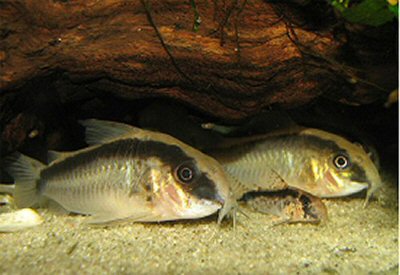

If you would like to contribute an article, please e-mail me. You will of course be credited for your work.
If you would like to donate any denomination of money to the site just click the above link button. All proceeds will go to running the site and hopefully to keep it going for a few years yet.
Print or e-mail this article below


