SCOTCAT.COM
your internet guide to all things catfish
| Collecting in the Paraná River Basin, Argentina (Part 2) |
by Haraldo & Noemí Bishop Edited by Allan James |
South
America Argentina Paraná
River basin Posadas
City Corrientes
Province
Allan has replied on the identification of this species and below are his comments. < I have been in touch with Hans Georg-Evers who wrote the Catfish Atlas for the Mergus publishing house with Ingo Seidel in Germany, and he tells me that there are a lot of Rineloricaria species in the Rio Uruguay and Parana drainage to be described. There was supposed to have been about 10 new species being described but the paper never did come about so I was advised at the moment to call these species Rineloricaria sp. "Parana" which I was doing originally. Each species will have to be numbered "Parana" 1- Parana 2 etc.> As you can see in the photos this fish has a double whiptail, not only the upper radius of the tail are elongated in a filament, but also the lower radius. Click on thumbnails for larger image. Rineloricaria sp. "Paraná 1"
Along with the Rineloricaria we captured two Otocinclus species, we believe O.huaorani and O. affinis, a Hypoptopoma species, Callichthys callichthys, juvenile Herichthys facetum and Cichlasoma portalegrensis, and several characins. The most interesting fish was a Farlowella sp, but unfortunately it did not eat and only survived a week. We put all of our fishes in a 130l community tank. In the beginning the Rineloricaria sp. was almost all the time sitting on a rock that seemed to be a favourite place. After several weeks the fishes hid behind the rocks or plants. It passed all the autumn and winter hidden, only to come out in the open waters in the night, if one put the the lights on they would go quickly back to their hiding places. In the spring they reappeared more and more, and in the summer they spend the most of the time in open waters. As the time passes we can confirm that this fish is a seasonal fish. They pass the autumn and winter hidden and come out to to the open in the spring. In the autumn and winter they only come out in the night. These fishes are totally vegetarians, they never pick over the meat foods and wait for the vegetable food that we offer in the night. Today our fishes have about 110 mm TL, and have not grown for the last year. We believe that they are adult specimens now. We kept four for them and sold or gave away several to people that liked them. We ask, and all the people say that the fishes are hardy and easy to keep. We later found out from Allan that the Otocinclus species is actually O. vittatus which you can see in the photographs below. Click on thumbnails for larger image. Otocinclus vittatus
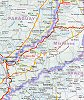
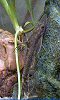
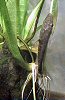
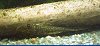
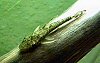
We hope that the next species will be more easy to identify, we believe that this is a Hypoptopoma species, we caught the first fish for this species a year and half ago (June 2003) in a trek to Misiones province, and to its capital, Posadas city, which is over the same Paraná river but on the border with Paraguay. We caught a few fishes. A Corydoras species, two Otocinclus species and a unknown species, only a bit more larger that an Otocinclus. We call this Hypoptopoma species "Flat nose" and put it in a 50 l. tank with Xiphophorus variatus (Platy), Xiphophorus helleri (Swordtail) and some Corydoras aeneus (now Osteogaster aenea). The Hypoptopoma species that are described from this area are Hypoptopoma inexspectatum. There are no description notes but we would think that this is indeed this species. Click on thumbnails for larger image. Hypoptopoma inexspectatum
The next summer we caught some fish of this species [Hypoptopoma inexspectatum] in the same Paraná river, but much more near to our home, about 25 miles near to Valle María town. There we caught a dozen or so, that are living among floating plants with various Otocinclus species, Hemiloricaria parva?, Callichthys callichthys, juvenile Herichthys facetum and Cichlasoma portalegrensis, and several characins. This was the same site where we caught some of our Rineloricaria sp. "Paraná 1", a quiet site with a lot of floating plants, to a distance of 100 m, with no floating plants and no quiet water, where there are not the same fishes to be found. These fish are
totally sedate, they are always over a submerged branch,
they really love the wood. When we want to take photos
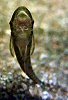
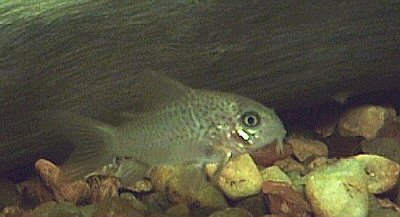
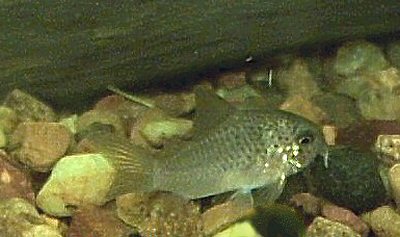
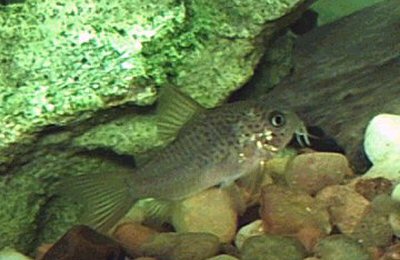
we can The next species is not a Loracariidae species, but a Corydoras. We fish for them along with our first Hypoptopoma specimen in Posadas city. When we caught them we looked and .... it is a Corydoras but .... what species?. It was pale with fear and his colour was gone, we took it to our home and into a 60 l tank. In a week or so it was settled and its colour came through, then we waited for it to grow, but it grows very slowly. We would think that it could be Corydoras polystictus, but the photos that we have show a totally spoted fish, and this is spoted only in the head, also, the size is very small. All the Corydoras are a bit shy, but they are extremely shy, and spends all its time behind a branch or a rock. We would think that it is unhappy because it is alone .... In the same tank there are four Corydoras undulatus, but it will not join them in a group. This may be its final size .... may be, may be not. Click on thumbnails for larger image. Corydoras polystictus (caught in Posadas City)
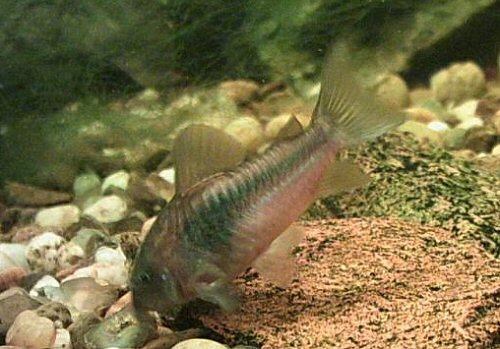
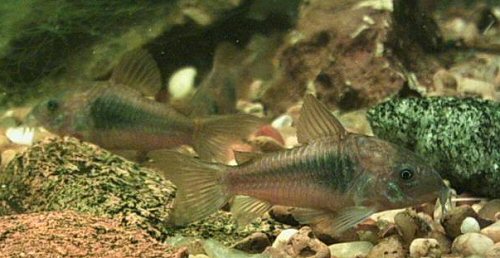
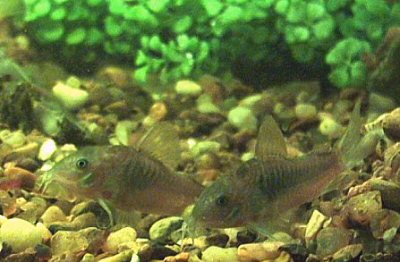
At this time of the year our Corydoras aeneus (now Osteogaster aenea) are specially beautiful and we get some good photos, They are all wild captured specimens. We caught them in a little creek in Corrientes province, about 400 km to the north. The creek has a rocky and sandy bottom, clear water and portions of plenty plants along the bottom, the Corydoras are almost always in the planted portions, but some times they come out among the rocks and we can see them swimming over the substrate. A lot of people say that there are Osteogaster aenea to the South, in the Buenos Aires province, but I have had no luck over there, some times the sports fishermen say that there are Osteogaster aenea in the Paraná islands and they use them as bait. In all cases Osteogaster aenea are reported in quite clear waters, but we have no data about the pH and dH, when we caught them the water temp was about 15 ºC, yes, I put my feet in the water and it was quite cold!. Click on thumbnails for larger image. Corydoras aeneus (caught in the Corrientes Province) - now Osteogaster aenea
Next in the series we will be showing you pictures of the habitats around our area in the Paraná River basin. We hope that you enjoyed the latest in this "Collecting Argentina" series.
All Photo's by the authors.
|
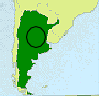
 his is the second in a series
of three articles on the collections carried out by
the authors in their native environment around the Paraná
River in northern Argentina near to the city of the
same name, (Paraná City), and also into the Misiones
province near Posadas city in the south west zone of
the province near the Paraguayan border. I will now
hand you over to Carlos and Noemi to take you through
their collecting experiences.
his is the second in a series
of three articles on the collections carried out by
the authors in their native environment around the Paraná
River in northern Argentina near to the city of the
same name, (Paraná City), and also into the Misiones
province near Posadas city in the south west zone of
the province near the Paraguayan border. I will now
hand you over to Carlos and Noemi to take you through
their collecting experiences.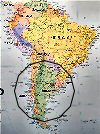







If you would like to contribute an article, please e-mail me. You will of course be credited for your work.
If you would like to donate any denomination of money to the site just click the above link button. All proceeds will go to running the site and hopefully to keep it going for a few years yet.
Print or e-mail this article below


