SCOTCAT.COM
your internet guide to all things catfish
| Collecting in the Paraná River Basin, Argentina (Part 3) |
by Haraldo & Noemí Bishop Edited by Allan James |
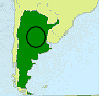
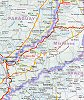
South
America Argentina Paraná
River basin Posadas
City Corrientes
Province
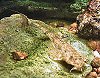
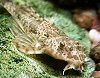
Ed: note. There are close on 10, still to be identified species of Rineloricaria in the Paraná river basin and we have labeled them as they are collected as, "Paraná 1" & 11 etc. The species below has one filament on the top lobe of the caudal fin and is light brown in colouration. It also has irregular blotches on the head and down the length of its body and a more blunted head than "Paraná 1" or Paraná 111" and it also possess more rounded dorsal and pectoral fins. Click on thumbnails for larger image. Rineloricaria sp. "Paraná 2 "
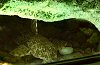
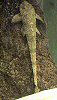
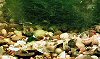
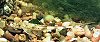
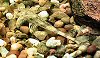
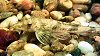
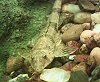
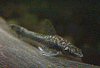
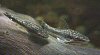
There are sites with soil bottom and others with rocky bottom, mostly calcareous rocks. These fish are always in the rocky bottom and never in the soil bottom, when one passes the net one must take some bottom rocks in, and among the rocks are the young fish together with juvenile Hypostomus plecostomus that have about 50 or 60mm total length. In the photos there is an adult fish that has been with us for about two years, and a semi adult fish that has been with us for about a year. They are both secretive fishes but the big one, (and the more stout with a wide head) is more shy, we only see him when feeding. The big one is 140 mm total length and the little one about 120 mm total length. Ed: note. There are close on 10, still to be identified species of Rineloricaria in the Paraná river basin and we have labeled them as they are collected as, "Paraná 1" & 11 etc. "Paraná 111" below has one filament on the top lobe of the caudal fin unlike "Paraná 1" which has two and it is also lighter in body colouration. Click on thumbnails for larger image. Click on your Web browsers back button to return to this page. Rineloricaria sp. "Paraná 3 "
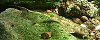
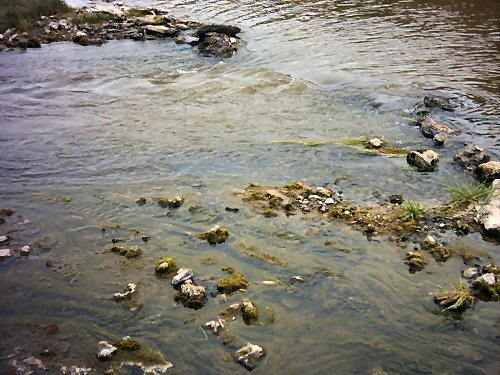
Below are the location shots of La Ensenada. As stated earlier the environment is a quite clear water, a pH between 7.0 and 7.5 and the water is hard. Click on thumbnails for larger image. Click on your Web browsers back button to return to this page. La Ensenada
We went back to fish last sunday, but had no luck, the river is too low and the fishes are not there, we only caught a little Gymnogeophagus, we believe that is a G. balzanii but is too little to tell at the moment, only time will tell us the identity. The list of the catfishes that we catch in our zone are:
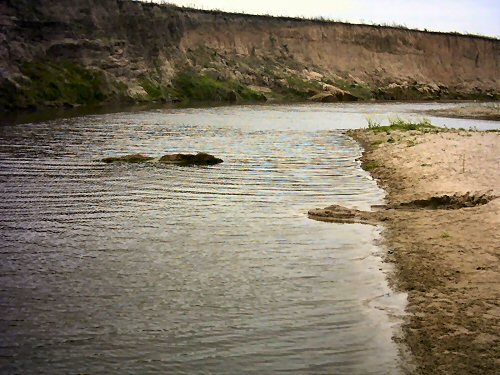
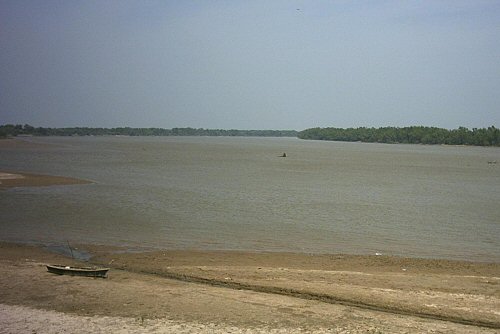
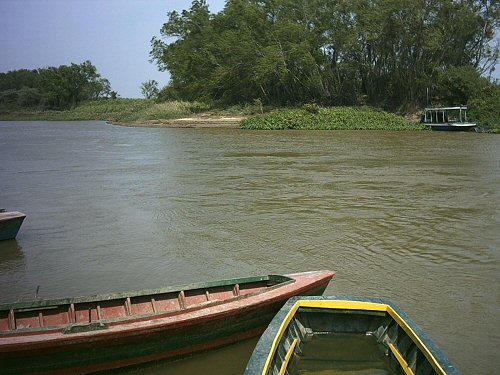
Some people says that there are Corydoras aureofrenatus and Hypostomus borelli, but we have had no luck with these species Two species of Rineloricaria, you have the photos of one, we have no photos of the other species as we only caught two and they lived only few days, but it is similar to Rineloricaria simillima. There are other loricaria species, we only see the bodies on the river banks, they are about 450 mm TL. Also there are other species in the creeks that are difficult to keep in the aquaria, it is very common, and very similar to the last Rineloricarias that we send photos for I. D., only the color is more dark and the nose is more pointed. More to the North, in Misiones province, we catch Ancistrus sp.,Corydoras polystictus and a different loricaria species that has no whiptail. We must mention the big catfish that there are over here, we have several species of "Bagre", they have nude skin, long bristles and hard spines in the pectoral and dorsal fins that can hurt your fingers and produce severe infections. We never ate them but the people say that they taste good. The sizes are from 300 mm to 600 mm TL. Also we have "Paty", a silver "bagre" about 800 mm TL., they have a good taste also. The "Surubí" can reach about 1500 to 1600 mm TL, and is a good catch for the sport fishers. We never ate these but the people say that eating them fried, they are delicious. There is an armoured catfish called "Armado", it can reach 800 mm TL and is quite common. The meat has no flavour, but the people prepare this with several vegetables and spices. Also there is a big species called "Manguruyú". We never see this, but the people says that if one catches the bait it is a very difficult fish, also, the people says they reach over 2000 mm. There are more species, but we are not experts on this theme, but these are the more common species. All these species have only food or sports fishing interest. The photos below were taken in the Paraná river, in a site 4 to 5 Km (2.5 to 3 Mi) to the south from Diamante city. The first photo was taken from the top of a ravine, before you get down to the river banks. The other photos show the river and the islands in this zone. The photo 05 shows a little boat to give you an idea of the size of the river. The photos were taken from an old aground ship that named the site ("El barco encallado" translated means, "The aground ship"). In this site we catch Corydoras paleatus, Rineloricaria sp. and juvenile Hypostomus plecostomus. In this zone, when one gets down the ravine, there is a low plain, about 500 m wide, and then the banks. The substrate is a mix between sand and soil. This time the river's level was too low, but most of the time the borders have so much grass and floating plants as you can see in the opposite bank at the photo 04. Habitually, the little trees that you can see in the photo 05, are in a little island, but this time they were joined with the bank. Click on thumbnails for larger image. El barco encallado
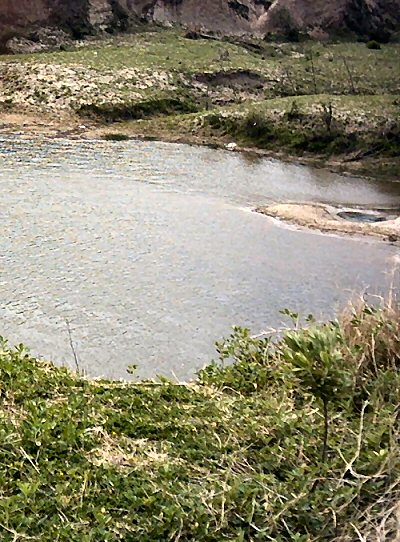
These photos below were taken in the same Paraná river, but about 30 Km (18.75 Mi) to the North, up from the part of the river, that the "El barco encallado" photos were taken. This locality is named "Valle María" and here we catch Hypoptopoma inexpectatum, Hemiloricaria sp. "provisional parva" Otocinclus arnoldi, Otocinclus vittatus and Hypostomus plecostomus. Other fishes were Herichthys facetum, Crenicichla sp. and several species of Characins. The photos 01 and 02 are from a little lagoon about 300 m from the river bank, when the river is flooded the lagoon is filled. There are a few fishes in there at this moment, mostly characins and some viviparous (We believe Gambusia genera). In the background you can see the Paraná ravines, they are about 20 to 30 m high (66 to 98 feet) at the highest point. If you look to the photo 002 you can see, around the water, something that looks like a grass, well, this is not grass but floating aquatic plants that cover a great portion of this lagoon. You can tell them apart from the color's, the grass is live green and the floating plants are a brownish green around the waters edge. Click on thumbnails for larger image. Click on your Web browsers back button to return to this page. Valle María
The bottom images of Otocinclus vittatus are from individuals collected in the above habitat of "Valle María". Click on thumbnails for larger image. Otocinclus vittatus
We hope that you enjoyed the last in the series as much as we enjoyed sharing with you.
All Photo's by the authors.
|
 his is the third and last in a
series of three articles on the collections carried
out by the authors in their native environment around
the Paraná River in northern Argentina near to
the city of the same name, (Paraná City), and
also into the Misiones province near Posadas city in
the south west zone of the province near the Paraguayan
border. I will now hand you over to Carlos and Noemi
to take you through their collecting experiences.
his is the third and last in a
series of three articles on the collections carried
out by the authors in their native environment around
the Paraná River in northern Argentina near to
the city of the same name, (Paraná City), and
also into the Misiones province near Posadas city in
the south west zone of the province near the Paraguayan
border. I will now hand you over to Carlos and Noemi
to take you through their collecting experiences.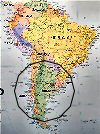







If you would like to contribute an article, please e-mail me. You will of course be credited for your work.
If you would like to donate any denomination of money to the site just click the above link button. All proceeds will go to running the site and hopefully to keep it going for a few years yet.
Print or e-mail this article below


