SCOTCAT.COM
your internet guide to all things catfish
| Cephalosilurus apurensis - a voracious ambushing predator but not without charm | ||||||||||||||||||||||||||||||||||||||||||||||||||||||||||||||||
by Christopher and Wolfgang Ros |
||||||||||||||||||||||||||||||||||||||||||||||||||||||||||||||||
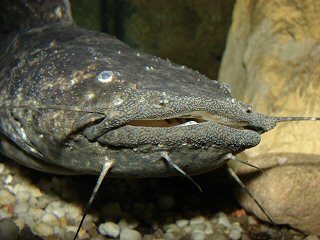
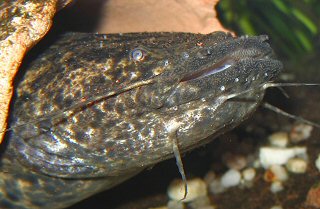
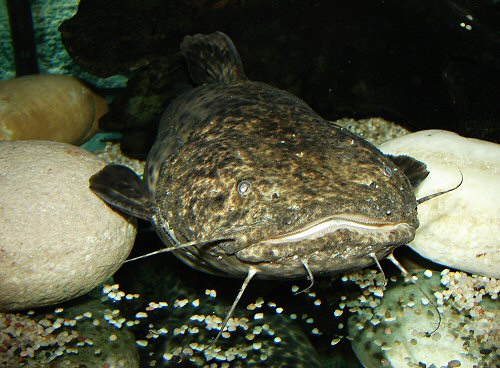
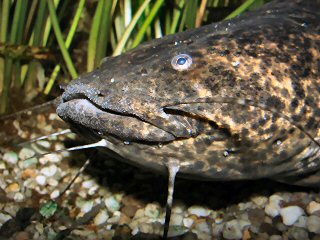
The genus Cephalosilurus was described with four species so far. To that extent it surprises me that even in relevant internet forums confusion still prevails. It concerns the species identification from specimens of this genus belonging to the family of the Pseudopimelodidae, which are introduced to the forum members by means of photos. The first part of its name originates from the Greek as the the genus name underlines very clearly, with what animals we have here: "Cephalos" stands for head, and its broad shape captivated by its massive front body half and particularly by its uncommonly large head, which looks more enormous because of the small eyes, and the not less enormous broad head muzzle. Therefore however it has authorization already, to state the species belongs to this genus in English language predatory fish forums as prime examples of the way specified monstercatfish may be undecided. A short overview of the genus follows to describe our own experiences and the determination and care of some specimens. Amongst the two largest of the four described Cephalosilurus species are C. fowleri resident in Brazil and C. apurensis from Venezuela, followed by C. nigricaudus from Surinam and the smallest species C. albomarginatus from Guyana. Above all the larger species they prefer rivers with a rocky soil which is associated with plenty of good hiding places. There they mainly pursue fish motionless, as in the best way camouflaged hunters do. Refraining from C. albomarginatus, which were probably not introduced for keeping in aquariums, the other species are imported occasionally at least to Germany. In the trade there they cost, depending upon size, and (not always correctly) sales designation, between 60 and 200 euro, in most cases it is C. apurensis that is sold. Identifying
Species:
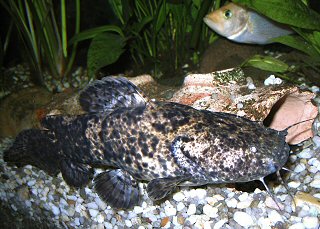
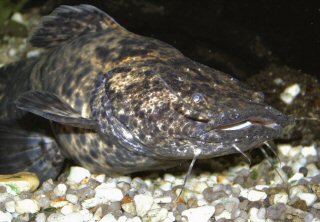
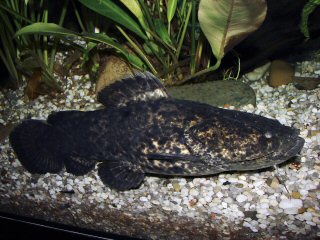
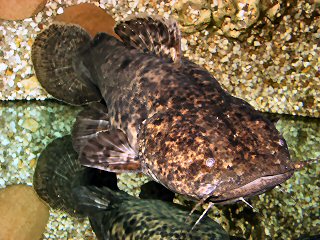
Both recovered rapidly from the strains of transport. They were brownish with grey-black, exhibiting partly arranged markings. A colouring in this young age is typical for C. apurensis. Also their strong body with the large rounded tail fin spoke for this species. What made us somewhat perplexed was this quite dark colouring of the tail fin which referred rather to C. nigricaudus (the Latin name means „black tail"). Thus we sent photos of the animals to the Brazilian ichthyologist Dr. Oscar Shibatta (Londrina) who is scientifically involved with the Pseudopimelodidae family and addressed him particularly on this coloured likeness. He described in his answer that all kinds of the genus Cephalosilurus, at least in youngsters, have dark tail fins. So from this alone no conclusion could yet be ascertained on a certain species. Since it concerned our own specimens with twelve and 16 centimetre young animals, their identification remained further unclear, particularly since photos, which show with sufficient clarity the species C. nigricaudus which are suitable for comparison purposes, have scarcity value. And with scientifically still unconfirmed theories of keepers, according to which for example the same length of the upper (mandibular) and lower outside barbels (maxillary), is to speak for C. nigricaudus, and if these are longer, it points to C. apurensis. We would not like to occupy the reader with more intensity. The fact seems to be that C. nigricaudus is actually more darkly coloured than C. apurensis. The demarcation of the species becomes extremely difficult, and according to the statement of Dr. Shibatta not only the knowledge is necessary around the exact discovery location for identification, free of doubts, but also counting the gill rakers (it concerns bony or gristly extensions of the gill arch). Their number varies with C. apurensis, around 27, and lies with C. nigricaudus between 11 and 16. However we wanted to save this procedure to our animals, anyway it can probably only be used with dead specimens.
According to the statement of the dealer with whom we had taken up contact again, our catfish originated from a Colombian import, however they were definitely caught in the Rio Apure in Venezuela. Therefore it must represent, to its discovery place, which is the Apure River, the species C. apurensis. Later we ourselves had further dealer send us a third specimen of the genus Cephalosilurus, which was offered as C. fowleri. The price made us a bit perplexed because this species was always sold more expensively. Indeed it was approximately already 20 centimetres long and the specimen differed in terms of colour from the two other animals, however it was clearly not C. fowleri as it would have been typical, but rather still more darker. Its shape also was not noticeably flatter - as characteristic of this species -; see André Werner (2005): „New imported: Cephalosilurus fowleri"
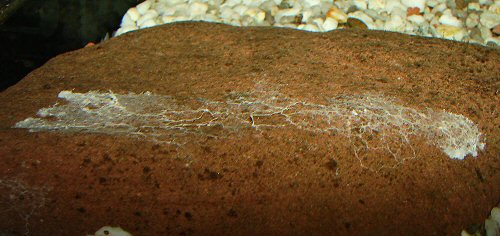
Does it possibly concern an undescribed species of the genus so far?. For the thesis, except the four mentioned it could give a number of further not described species, so at least some specimens illustrated in predatory fish forums, which due to remarkable differences can not be determined to the one or the other, until now described species. Nevertheless most of them might have to be added as C. apurensis in the long run because there are obviously different variants of this species which look different in colour and patterning depending upon origin. On request the second dealer communicated that the sent specimen originated from Venezuela, the exact discovery location was not known. With this exclusive information the knowledge of C. fowleri occurring in Brazil separated them. Perhaps with our third specimen it could be C. nigricaudus, however its circulation area would be then more largely and not exclusively limited to Surinam, or may be a variant of C. apurensis. After given photos to Dr. Shibatta he explained that the identification problem here could be finally clarified only by a scientific investigation of the animal (including counting of its gill rakers). This with increasing size it became more darker and exhibits also otherwise little differences in the body form, even in the behaviour. So compared with the two other animals it altogether does not only seem to be somewhat more aggressive and more attack minded, but it is also far more greedy, in addition only this specimen in its hiding place seems to give off every now and then a kind of secretion (probably primarily over its muzzle).
Keeping
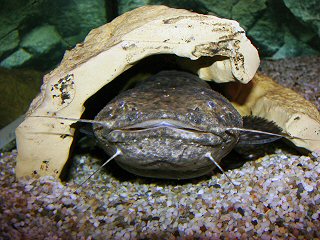
in the aquarium: So that the photo sensitive catfish feel well, the aquarium should be only moderately lit up during the day. A floating plant cover, which provides parts of darker zones, offers itself likewise. During the recommended weak lighting many plant types are not applicable. Beside undemanding floating plants other plants such as Vesicularia dubyana and Microsorum pteropus are suitable. Otherwise one can use if necessary still frugal Cryptocoryne or Anubias species, however these can be easily disrooted by the strong animals. As ground soil of a mixture from gravels of different granulation is recommended. The creation of a possibility for hiding is particularly important. Cave hiding places of any kind are gladely taken. These are necessary at least for the well being of juvenile animals.
This animal has taken its hiding place between large stones
Obviously C. apurensis is very durable, because diseases never arose with our animals. And even the concern of keeping them being more difficult, because they originate from running waters, is unfounded due to its amazing adaptability, nevertheless one should provide an easy current . Recommend is also the employment of a high performance filter/cleaner, and as with all large fish weekly partial water changes are an obligation. The water equivalents are of subordinated importance. The temperature should lie between 22 and 26 degrees, however the animals can stand higher temperatures temporarily. Nutrition:
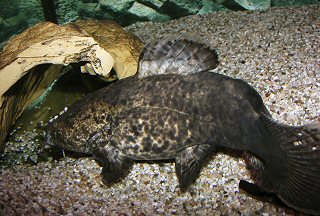
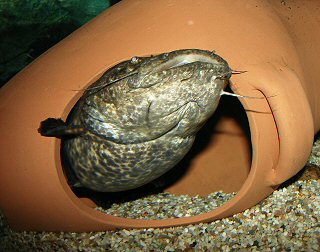
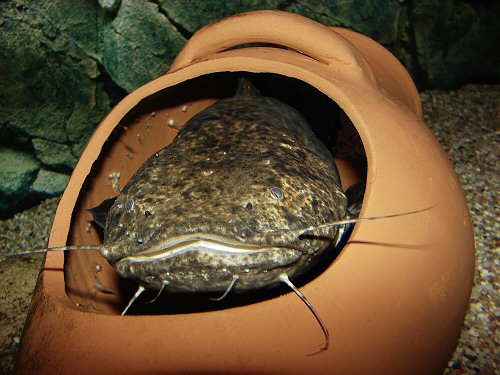
In order not to have to give up its hiding place, C. apurensis with its progressive body size, undertakes all efforts to extend this and adapt to its respective body form. If the animal takes its usual quiescent place for example under a wood root, then one is able to observe soon how it moves parts of its body back and forth on the soil, in particular head and belly, in order to widen its place in such a way as to develop the recess.
The second opening of the same dwelling is gladly used in this way for observation purposes
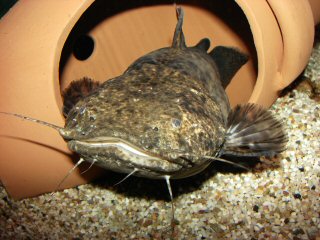
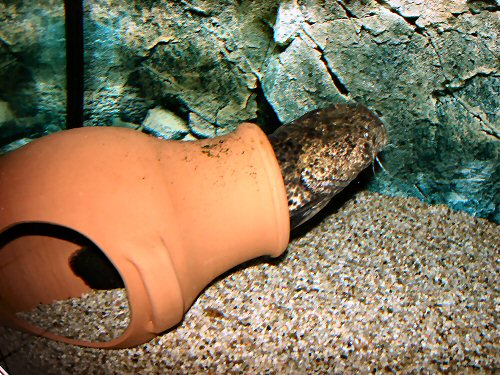
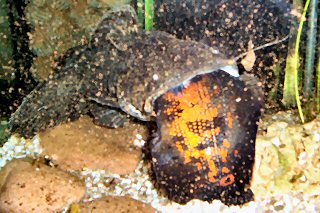
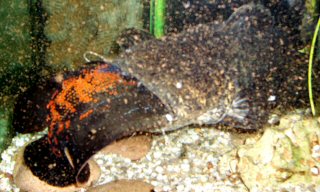
C. apurensis releases enormous forces with these excavation activities and here particularly can move even larger stones by means of its tail fin. The aquarium trade can offer artificial caves only to serve young animals as hiding places. Already for specimens of more than 30 centimetres body length, commercial cave sizes might be limited and usually too small. From then on we took accordingly large hiding place possibilities such as roots and/or large wood-pieces which are visually good looking. One can help also with largely dimensioned hiding places like to some extent optically pleasing, amphora (A two-handled jar with a narrow neck used by the ancient Greeks and Romans to carry wine or oil) from the horticulture shops, whose openings were if necessary additionally extended. As soon as C. apurensis accepts a new hiding place, it defends this exactly the same as any other species.
Unrestrained strength: Over night the animal turned the heavy amphora over
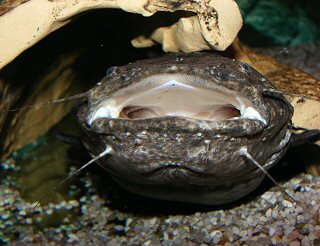
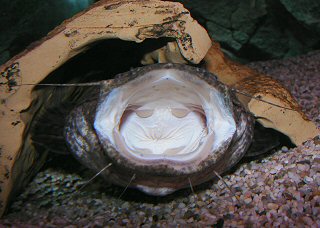
With the onset of darkness C. apurensis usually comes out from its shelter and moves sedately one or two turns around the tank, before it returns back into its hiding place. Interestingly enough all our specimens at night have alternative staying places in the proximity of the outlets of the filters, on which they rest over some hours. Probably the animals visit places of different flow at this time, also in nature, depending on the locally of available feeder fish. With their "tours" if obstacles stand in their way such as wood pieces, they try sometimes, despite their thick bellies, to go directly through them. If that does not succeed, they react with an expressive change of mind. They become "enraged" and they seem to rear up formally against the barricade, and with opened mouths they try to completely force this away. The unrestrained strength used can not be underestimated by the keeper. Above all, larger specimens in this situation show less tolerance in relation to the aquarium mechanism/outfit. Then it can happen that they abruptly try to force away any objects and among these, heavy wood and also large stones, but that is still the harmless variant. Because the enormous mouth in such a situation is able to destroy technical devices, thus the aquarist, who fastened the heater for example directly to the side glass! Accessories such as heaters and pumps may not be unprotected in the tank with these strong and sometimes somewhat self willed animals! They can show this described behaviour also when they are long overdue a feeding.
Relationship
to the keeper: As soon as the food touches the water surface, C. apurensis tears it up with its mouth in addition to being so gluttonous, if we immerse the disk magnet in order to clean the tank panes of algae this causes the animals to bite heartily into our fingers so that it would be better to refrain from their designation as "tame to the hand". In such an inadvertent practice test however it can be reconstructed very close to that shortly after actually snatching immediately a second time, stronger and biting, escaping hardly is possible even for large prey fish. For the keeper such a gripping is not dramatic, if it concerns adolescent individuals, bites of larger animals however are pretty painful and can lead to bloody skin scratches for the consequences.
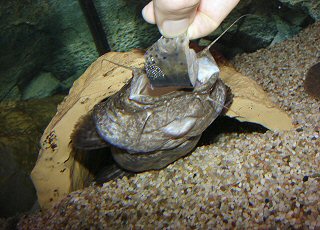
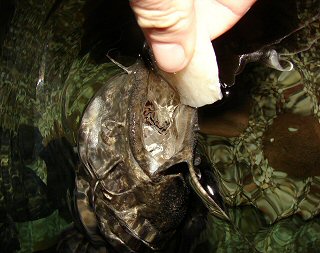
Against this background it may surprise that we touch and even pet one of our specimens with the hand. Its body feels exquisitely soft probably due to the high fat content. Unfortunately it does not send peaceful signals in time, as soon as it is weary of the "tender loving care” it rather abruptly tries to snatch at the hand, one must be already rather fast, in order to be able to with draw the fingers in time.
Growth
and final size: With the growth of the animals also their colour pattern changes. The youth dress of C. apurensis loses something at contrast, the brown yields a rather base ochre-pattern. Therefore apart from the characterisation as "jelly catfish" comes the not completely applicable designation of "orange catfish”, which is common likewise for C. fowleri and fits this rather because of the orange base colour of C. fowleri. In the adult stage the animals are even more sedate, however they emit a rather uncommon peace and dispassionateness, as if they would almost know that hardly anything can harm them.
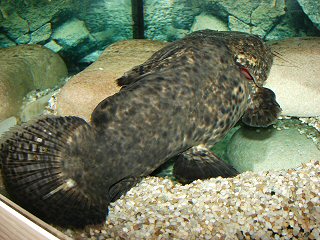
Optimally to the environment (stones and wood) the adapted colouring of an older specimen
Rapid movements,
which could affect the result of measurement and which
could bring some aquarists to the edge of despair,
if they put the measuring tape at their fish, do not
to fear with this species. In all peace of mind the
animals will remain at least for a long time in their
vertical position and will accept measuring until
feeding was made.
Socialisation: At first, when the moving was possible without larger circumstances, we united our animals several times in different constellations for short times. The result was always the same, either the added specimen straightway moved to the cave in which the other one was, by the way it showed this purposefulness also during supply of several hiding places, or however the "long time-resident" attacked the new species comrade immediately. Probably the animals deliver substances which due to their strongly pronounced sense of smell make a goal exact detection for them possible. Directly before meeting the two fish took a threatening position. Thereby in each case the smaller specimen usually could not be impressed by its larger species comrade, so that meetings with one another was inevitable. With their bodies pressed together both animals measured their powers in horizontal attitude, with muzzles opened far and by trying to force itself away mutually. Additionally the tail fins were struck against each other. These fights looked threatening, however were only for a short duration, because usually one of the rivals would take flight whereupon we separated the fish again.
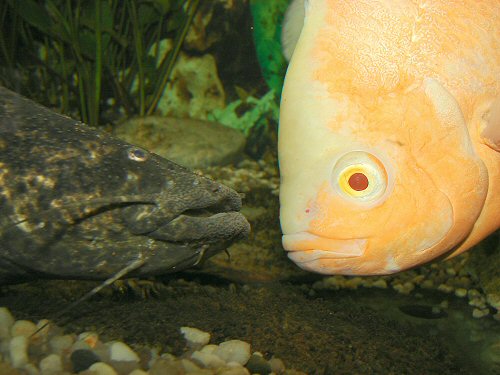
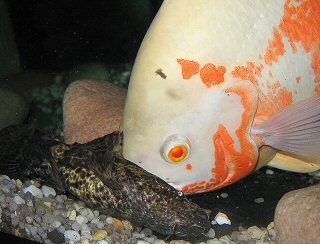
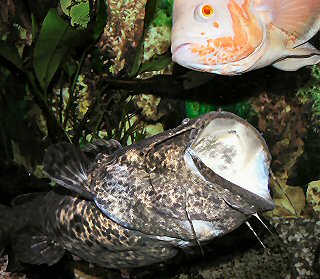
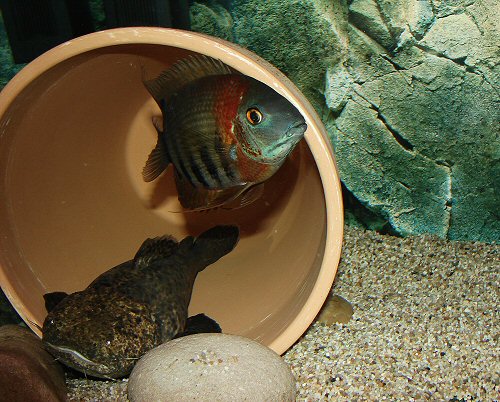
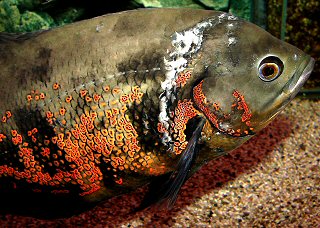
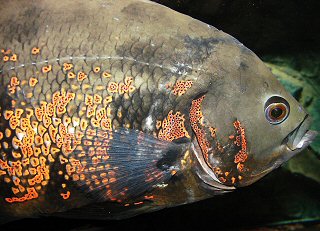
Indeed C. apurensis behaves as a young animal, up to a length of 20 to 30 centimetres, with co-inhabitants rather peacefully, but already then all fish, which are not larger, live constantly in the danger to be eaten. If one would like to keep this species with other catfish, then put non predatory beside them, those like the Loricariidae are applicable above all predatory catfish of South America, however they should not be too territorial for their part and at least equal in size, because as soon as C. apurensis takes offence, or if the other fish want to make its hiding place disputable, it proves itself as quite assertive. In the context of such an argument it positions itself first before the aggressor, confident on the fact that this alone can turn them away at the sight of its massive shape. If that does not help, C. apurensis snatches at him abruptly. Thus C. apurensis then terrifies the opponent so much that in future meetings the opponent always pulls back. Also different large, durable cichlids can be kept together with C. apurensis and soon as these come into the direct proximity of its favourite place, it snatches at them to make clear the requirement for possession. They soon realise however they have noted the quite small radius, which they may not cross, in order to release its attacks. If one falls back to cichlids, then a weak night lighting system is of advantage. With one tank we decided in this regard for moon light lighting, it ensures that the catfish does not disturb its co-inhabitants too much at night, in this case, two adolescent Astronotus ocellatus. If the lighting is completely switched off, then the danger is largest that even with only moderate appetite, co-inhabitants due to contact by the catfish, scurry away frightened in the aquarium and thus only the hunt instinct is wakened by C. apurensis.
"Eye to eye“: Generally C. apurensis gets along with its associated cichlids only if they are large enough
In principle it applies with a considered socialization to respect the habituation effects. If a C. apurensis was already fed over a long time with living fish, then other species can hardly be kept together with it, otherwise the socialization functions after our early experiences, if socialized fish grew up together with the catfish; then they are regarded probably less as victims and rather as co-inhabitants. Actually a Petenia splendida female of not even 20 centimetres of length has been kept since the beginning in one of the apurensis tanks without have been ever troubled by the catfish. However a Crenicichla sp. at 25 centimetres, from which a friendly aquarist had to separate owing to circumstances and which we put to one of our apurensis, couldn't survive on the first night. On the next morning one saw the tail fin, which looked out from the mouth of the predator while the front part was already digested. The animal nearly motionless awaiting in its hiding place breathed very heavily, its whole abdomen seemed nearly to burst, so strongly it had swollen, and that was a further day after the prey was completely eaten. Here it does not only show up how strongly new acquisitions are endangered, but that C. apurensis posesses the ability to be able to attack and to devour even fish and other predator catfish of comparable size.
This co-inhabitant (Heros efasciatus spec. "Rotkeil“) remains undisturbed even in the dwelling place of C. apurensis
In another case, the victim, a nearly 25 centimetres long A. astronotus, which was given in addition to the two mentioned above somewhat smaller species comrades, yet had luck. Already a few hours after putting it in the tank we saw it in the mouth of the only about 15 centimetres larger catfish. Even strong knocking at the glass sides did not impress the apurensis in the slightest. Only when it was gripped at the head with the hand did it release its victim again. Thereupon the astronotus immediately dashed to another part of the tank. Indeed clearly branded by the bite, he survived the attack as by a miracle, even only one week later the bite wound could hardly be seen. We of course immediately removed the astronotus to another tank.
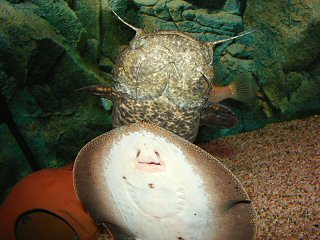
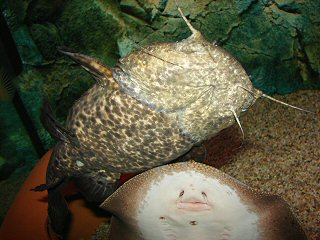
To some extent the socialization with fresh water Potamotrygon of comparable size such as Potamotrygon leopoldi can function, however it requires completely different tank lengths than those which were mentioned before for the single keeping of the catfish. One of our animals is associated with a P. hystrix male. The past experiences speak for the fact that a peaceful coexistence is possible here. On the other hand the aggressiveness of C. apurensis is to increase with age. Since Potamotrygon can defend themselves if necessary with their poison pricks, a separate keeping of them would be indispensable and culminating as soon as it can be found out.
Once it came after feeding, in the dwelling of C. apurensis associated with the Potamotrygon hystrix a fight with nearly fatal consequences and a fraught exit. Into the apurensis amphora hiding place came the Potamotrygon for the first time it had dared, attracted by the food remains, whereupon the catfish snatched immediately at him. Thereupon the Potamotrygon was running scared and had not found the exit at once and probably therefore under threat defended himself. It hit the apurensis within the range of the tail fin, fortunately it survived the sting. For approximately one month it lived completely withdrawn and took no more food to itself. After a further three weeks however nothing more was to be seen of the wound and the animal behaved again completely normally. This could permit the conclusion that C. apurensis is at least partly immune to the Potamotrygon poison partly because the prick hit the catfish in a comparatively rather insensitive place and in addition obviously not completely. Thereupon as a precaution we have replaced the amphora by a large clay container with additionally extended openings by which the Potamotrygon in doubt can swim free without any problem. Since then there has been no recent incidents.
Spine of Potamotrygon hystrix
If you have an extremely large tank, a socialization could be considered for example with "Giant Characidae" as to the red Pacu (Piaractus brachypomus), since the prognosis even on a long-term basis seems favourable here. However with C. apurensis the single keeping remains general and always the safest variant. Sex
differences: Result:
Even if these catfish in our opinion are suitable, of the large predators, for home aquariums, their care remains something for experienced specialists. It must be clear that a socialisation is only conditionally possible in very large tanks. For most aquarists however, even the absolute "Catfish freaks" among them, in the long term it might be too monotonous to fill their tank with a single giant.
Note: This article is published in May 2007 in the German publication: Die Aquarien- und Terrarienzeitschrift“ (Datz) 60 (5): 38-42.
|
||||||||||||||||||||||||||||||||||||||||||||||||||||||||||||||||
 nformation
to care and behaviour of species of the genus Cephalosilurus
up to today are rather scarce, but perhaps it is just
this "breath of mystery", which stimulates
one or another aquarium enthusiast, because finally
we can get these unusual animals and study some fascinating
observations.
nformation
to care and behaviour of species of the genus Cephalosilurus
up to today are rather scarce, but perhaps it is just
this "breath of mystery", which stimulates
one or another aquarium enthusiast, because finally
we can get these unusual animals and study some fascinating
observations. 
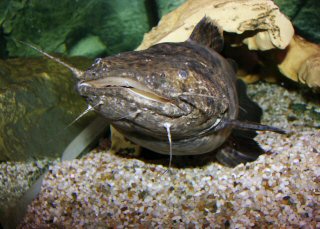
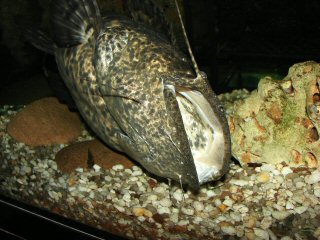
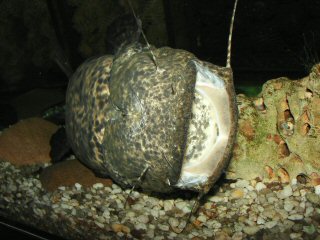
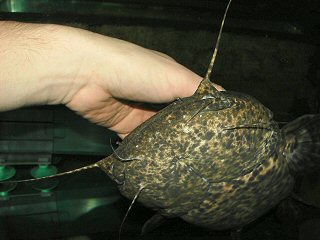
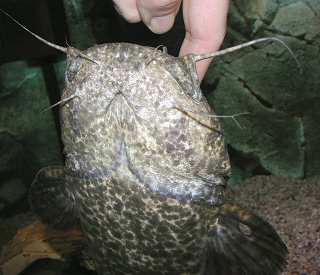
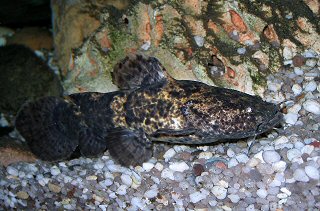
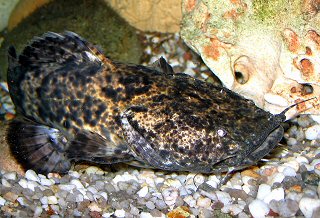

 By the way for the keeper of
C. apurensis it is made very easy to measure
his animals and so to be able to make secured statements
about growth. That is connected with their described
"begging position", which they take punctually
at the stated feeding time within the area of the
tank sides.
By the way for the keeper of
C. apurensis it is made very easy to measure
his animals and so to be able to make secured statements
about growth. That is connected with their described
"begging position", which they take punctually
at the stated feeding time within the area of the
tank sides. 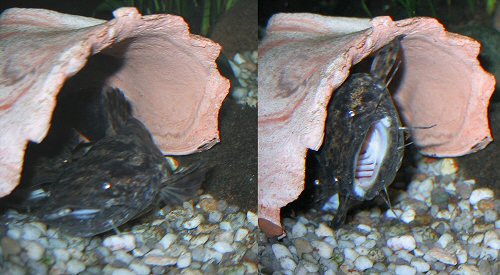

If you would like to contribute an article, please e-mail me. You will of course be credited for your work.
If you would like to donate any denomination of money to the site just click the above link button. All proceeds will go to running the site and hopefully to keep it going for a few years yet.
Print or e-mail this article below


