SCOTCAT.COM
your internet guide to all things catfish
Mystus bleekeri (Day, 1877) |
Image contributors to this species: |
Beta Mahatvaraj (1) Johnny Jensen's Photographic Library (1) Andrew Rao (2) University of Kansas (1) |
ScotCat Sources: |
|

Other Sources: |
|
|


Relevant Information: |
Description: Maxilary barbels moderately long, extending posteriorly to end of pelvic fin or as far as anal fin origin. Gill rakers in first arch 2-3 + 9-12 = 11-15. Long adipose fin. Habitat: Found in lakes, tanks, rivers, canals and beels. Colouration: Brownish becoming lighter towards ventral side. Three broad conspicuous dark bands seperated by two narrow pale lines on either side of lateral line and parallel to it present. A large tympanic not shoulder, spot present. Reproduction: Oviparous, distinct pairing possibly like other members of the same family. Caught with other fishes from fishing operations. Etymology: The genus name Mystus: "Mystax" meaning whiskered (hair on the upper lip) Mystus was first used by Belon in 1553 to describe all fish with whiskers. The specific name bleekeri: in honour of Dutch medical doctor and ichthyologist Pieter Bleeker (1819-1878), who reported this catfish as M. keletius in 1853. Remarks: Differs from all other Mystus sensu stricto except M. rufescens in having a large dark tympanic (not shoulder) spot. |
Common Name: |
Day's mystus |
Synonyms: |
Aoria bleekeri, Macrones bleekeri. |
Family: |
Bagridae |
Distribution: |
Asia: Ganges, Indus and Mahanadi River basins. Type locality: Sind, Jumna, upper waters of the Ganges, and Burma. |
Size: |
14.0cm. (5½ins) |
Temp: |
18-26°C (63-79°F) |
p.H. |
|
6.0-8.0. |
Reference: |
Ferraris, C.J. Jr.,
2007. Checklist of catfishes, recent and fossil (Osteichthyes:
Siluriformes), and catalogue of siluriform primary
types. Zootaxa 1418:1-628. |

Family: Bagridae Back to Ident-A-Cat Click on Thumbnails |
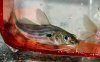 Mystus
bleekeri Mystus
bleekeri |
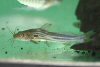 Mystus
bleekeri Mystus
bleekeri |
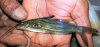 Mystus
bleekeri Mystus
bleekeri |
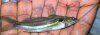 Mystus
bleekeri Mystus
bleekeri |
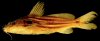 Mystus
bleekeri Mystus
bleekeri |
If you would like to contribute to the monthly factsheets with an article, information or photos, please e-mail me. You will of course be credited for your work.

If you would like to donate any denomination of monies to the site just click the above link button. All proceeds will go to running the site and hopefully to keep it going for a few years yet.

