SCOTCAT.COM
your internet guide to all things catfish
Dianema urostriatum (Miranda-Ribeiro, 1912) |
Image contributors to this species: |
Helen Burns (1) Danny Blundell (2) Daniel Blom (1) Graeme Robson (1) Chris Ralph (2) Johnny Jensen's Photographic Library (5) Allan James (1) Benny Hubel Hansen (1) |
ScotCat Sources: |
|


Other Sources: |
|


Relevant Information: |
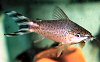
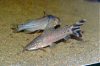
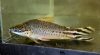
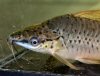
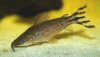
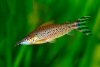
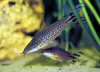
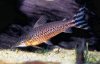
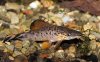
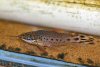
There are only two species in the genus Dianema, the other being Dianema longibarbus, the Porthole cat. This is of course the Flagtail cat as looking at the image you can see this trait in the caudal fin, it shares these unusual markings along with Corydoras robineae, it is also placed in the same family, Callichthyidae. Aquarium Care: This is a peaceful midwater to bottom swimmer that will do better if kept in a group of at least 4 as individuals on their own tend to sulk and never seem to progress too well. Try to resist placing them in an aquarium with aggressive species such as some Cichlids, they will do better with the usual community type fish and of course along with Corydoras sp. Diet: Omnivorous, taking most foods but preferring live and frozen such as daphnia, worms, white and grindal, and bloodworms. Will also accept good quality flake and tablet foods. Reproduction: This fish has proved a challenge for quite a few catfish enthusiasts over the years. There has been unconfirmed reports of breeding triumphs but no documentation as yet to prove this theory. It is reported to be a bubblenest breeder just like its cousins in the Hoplo, Megalechis, Lepthoplosternum complex. |
Common Name: |
Flagtail Catfish |
Synonyms: |
Decapogon urostriatum |
Family: |
Callichthyidae |
Distribution: |
South America: Brazil, Amazon River basin. Type locality: Manáos, Brazil. |
Size: |
11.5cm (4½ins) |
Temp: |
22-26°C (71-79°F) |
p.H. |
|
6.0-7.5. |
Reference: |
Burgess,
W.E. 1989 An atlas of freshwater and marine
catfishes. A preliminary survey of the Siluriformes.
T.F.H. Publications, Inc., Neptune City, New Jersey
(USA). 784 p. |

Family: Callichthyidae Back to Ident-A-Cat Click on Thumbnails |
 Dianema
urostriatum Dianema
urostriatum |
 Dianema
urostriatum Dianema
urostriatum |
 Dianema
urostriatum Dianema
urostriatum |
 Dianema
urostriatum Dianema
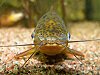
urostriatumHead profile |
 Dianema
urostriatum Dianema
urostriatum |
 Dianema
urostriatum Dianema
urostriatum |
 Dianema
urostriatum Dianema
urostriatumHead view |
 Dianema
urostriatum Dianema
urostriatum |
 Dianema
urostriatum Dianema
urostriatum |
 Dianema
urostriatum Dianema
urostriatum |
 Dianema
urostriatum Dianema
urostriatum |
 Dianema
urostriatum Dianema
urostriatum |
 Dianema
urostriatum Dianema
urostriatum |
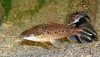 Dianema
urostriatum Dianema
urostriatum |
If you would like to contribute to the monthly factsheets with an article, information or photos, please e-mail me. You will of course be credited for your work.

If you would like to donate any denomination of monies to the site just click the above link button. All proceeds will go to running the site and hopefully to keep it going for a few years yet.

