SCOTCAT.COM
your internet guide to all things catfish
Cetopsis candiru Spix & Agassiz, 1829 |
Image contributors to this species: |
Chris Ralph (2) Mark Henry Sabaj (1) |
ScotCat Sources: |
|
|

Other Sources: |
|


Relevant Information: |
Description: Can be distinguished from all of its congeners by the combination of its relatively shallow body at the origin of the dorsal fin (0.20 of SL or less versus 0.22 of SL or more, respectively) and the form of the teeth on the vomer and dentary (incisiform versus conical, respectively). Sexual Dimorphism. The first ray of the dorsal fin of mature males is prolonged to varying degrees beyond the condition present in both females and immature males. Mature males also have a moderately-developed, distal filament on the first pectoral-fin ray, whereas such extensions of that fin ray are absent in both females and immature males. The convexity of the anal-fin margin in mature males is distinctly more pronounced than is the form of the fin margin that characterises both females and immature males of the species. Diet: Cetopsis candiru and C. coecutiens which achieve the largest body sizes within the Cetopsinae, are notorious for their voracious feeding habits; attacking not only carrion, but also live fishes in gill-nets (Barthem & Goulding, 1997: 44), and on occasion humans (Goulding, 1989: 185). The predatory and scavenging feeding habits of these species of Cetopsis perhaps contributed to the erroneous assumption that members of the Cetopsinae are “parasitic”; a conclusion that may have lead various previous researchers to align members of that subfamily with the species of the family Trichomycteridae, some members of which feed on the blood of their hosts. In contrast to the voracious feeding habits of Cetopsis candiru and C. coecutiens, all other members of the subfamily for which the diet is known prey primarily on allochthonous and aquatic insects. Etymology: The specific name candiru: Vernacular name for parasitic catfishes (Trichomycteridae) in Brazil, probably referring to the voracious predatory and scavenging feeding habits of this species and C. coecutiens (attacking carrion, live fishes in nets, and sometimes humans), which contributed to the erroneous assumption that they are parasitic. |
Common Name: |
None |
Synonyms: |
Hemicetopsis candiru, Cetopsis spixii |
Family: |
Cetopsidae |
Distribution: |
South America: Amazon River basin. Type locality: Brasiliae aequatoralis fluviis. |
Size: |
26.5cm. (10½ins) |
Temp: |
22-28°c (71-83°f ) |
p.H. |
|
6.0-7.0. |
Reference: |
Ferraris, C.J. Jr.,
2007. Checklist of catfishes, recent and fossil (Osteichthyes:
Siluriformes), and catalogue of siluriform primary
types. Zootaxa 1418:1-628. |

Family: Cetopsidae Back to Ident-A-Cat Click on Thumbnails |
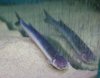 Cetopsis candiru
 |
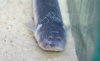 Cetopsis
candiru Cetopsis
candiruClose up of head |
|
If you would like to contribute to the monthly factsheets with an article, information or photos, please e-mail me. You will of course be credited for your work.

If you would like to donate any denomination of monies to the site just click the above link button. All proceeds will go to running the site and hopefully to keep it going for a few years yet.

