SCOTCAT.COM
your internet guide to all things catfish
Diplomystes viedmensis MacDonagh 1931 |
Image contributors to this species: |
Karl-Heinz Dau (1 Stamp) |
ScotCat Sources: |
|

Other Sources: |
|
|


Relevant Information: |
Description: Dorsal spines (total): 2; Dorsal soft rays (total): 6 - 6; Anal spines: 4 - 5; Anal soft rays: 8 - 11; Vertebrae: 41 - 43. Six species of Diplomystidae are currently recognized (Arratia, 1987; Azpelicueta, 1994a-b). Berra (2001) depicts the family distribution. Half of the species occur west of the Andes in south central Chile. The trans-Andean species are D. chilensis from rivers near Valparaíso and Santiago, D. nahuelbutaensis from the Bío Bío basin, and D. camposensis from the Valdivia region (Arratia, 1987). Three other species occur east of the Andes in southern Argentina. Arratia (1987) erected the genus Olivaichthys for the Argentinian specimens and Lundberg, et al (2004) follow Azpelicueta (1994a-b) and most subsequent authors who treat Olivaichthys as a synonym of Diplomystes. Habitat: The cis-Andean species are D. viedmensis from the Río Negro system, D. cuyanus from the Río Colorado and the Desaguadero-Salado basin, and D. mesembrinus known only from relatively few specimens from Chubut and Senguerr rivers (Azpelicueta, 1994a-b). Diplomystes viedmensis has been taken from rivers near sea level to about 1,900 m (Azpelicueta, 1994a). Diet: Diplomystids are generalised carnivores that consume annelids, mollusks, and arthropods (Arratia, 1987; Azpelicueta & Gosztonyi, 1998). Etymology: The specific name viedmensis: -ensis, Latin suffix denoting place: Viedma, Río Negro Province, Argentina, near type locality. |
Common Name: |
Otuno |
Synonyms: |
Olivaichthys viedmensis |
Family: |
Diplomystidae |
Distribution: |
South America: Negro River and tributaries in Argentina. Type locality: Río Negro, Argentina, frente a Viedma. |
Size: |
32.5cm. (13ins) |
Temp: |
20-24°C (67-75°f.) |
p.H. |
|
6.0-7.0. |
Reference: |
Ferraris, C.J. Jr.,
2007. Checklist of catfishes, recent and fossil (Osteichthyes:
Siluriformes), and catalogue of siluriform primary
types. Zootaxa 1418:1-628. |

Family: Diplomystidae Back to Ident-A-Cat Click on Thumbnails |
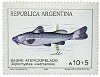 Diplomystes
viedmensis
Diplomystes
viedmensisCatfish Stamp |
If you would like to contribute to the monthly factsheets with an article, information or photos, please e-mail me. You will of course be credited for your work.

If you would like to donate any denomination of monies to the site just click the above link button. All proceeds will go to running the site and hopefully to keep it going for a few years yet.

