SCOTCAT.COM
your internet guide to all things catfish
Leptodoras marki Birindelli & Sousa, 2010 |
Image contributors to this species: |
José Birindelli (1) |
ScotCat Sources: |
|
|

Other Sources: |
|


Relevant Information: |
Description: Leptodoras marki is distinguished from its congeners by having a large dark submarginal blotch on distal half of dorsal-fin spine and anteriormost dorsal-fin branched rays (vs. dorsal fin hyaline in L. acipenserinus, L. cataniai, L. linnelli, L. myersi, L. nelsoni, L. rogersae, or dorsal fin with basal third to half of dorsal-fin spine and dorsal-fin branched rays blackened, forming a triangular blotch tapered posteriorly in L. copei, L. oyakawai, L. praelongus, or dorsal fin with base of branched rays darkened in L. juruensis); lower labial extension of modified oral hood extending more posteriorly than upper labial extension (vs. upper labial extending posteriorly to lower labial extension in L. acipenserinus, L. cataniai, L. juruensis, L. myersi, L. nelsoni, L. rogersae, or upper and lower labial extensions finishing more or less even in L. hasemani, L. linnelli); relatively few midlateral scutes (34–37 vs. 37–46 per side in all congeners except in L. copei, L. oyakawai, L. praelongus); gas bladder moderately sized, not reduced (vs. reduced in all congeners, except in L. oyakawai); paired bony capsules on anteriormost vertebrae reduced to paired cup-like laminar ossifications separated by a triangular septum (vs. paired bony capsules longitudinally expanded, rounded, and more bulbous, not compressed anteriorly in all congeners, except in L. oyakawai); pair of small, swelling-like diverticula on each side of the anterior chamber of gas bladder (vs. gas bladder with smooth walls, without diverticula in L. oyakawai); a well-developed anterior nuchal plate and parieto-supraoccipital not contacting middle nuchal plate (vs. anterior nuchal plate reduced, permitting contact between parieto-supraoccipital and middle nuchal plate in most specimens of L. praelongus); and nuchal foramina present (vs. absent in medium to large specimens of L. copei, L. hasemani, L. praelongus), (Birindelli, J.L.O. and L.M. Sousa, 2010). Aquarium Care: Best kept in a group in a tank of 48ins or over with a sand substrate, rock and branchwork. Floating plants is a good addition to cut down on the overhead light. Peaceful and will do well alongside species such as Geophagus Cichlids and other larger Characins that will appreciate flowing water. Diet: Insect larvae, frozen foods, mosquito larvae and shrimp. Etymology: Named in honour of Mark Henry Sabaj Pérez, for his dedicated service to the ichthyological community as Collection Manager of Fishes at the Illinois Natural History Survey (1995–2000) and at the Academy of Natural Sciences of Philadelphia (2000–present), and for encouraging the study of doradids as a co-principal investigator of the All Catfish Species Inventory. |
Common Name: |
None |
Synonyms: |
None |
Family: |
Doradidae |
Distribution: |
South America: Fresco-Xingu basin, Brazil. |
Size: |
9.5cm. (3¾ins) |
Temp: |
22-25°C (71-77°F) |
p.H. |
|
6.0-7.0. |
IUCN Red List |
Leptodoras marki is endemic to Brazil and known only from the Fresco River, Xingu River basin, Pará state. Most of the Fresco River basin (about 60%) is heavily impacted by deforestation for agricultural and mining purposes, suggesting a continued decline in habitat quality for the species. The calculated Extent of Occurrence for L. marki was 24,000 km² , and the Area of ??Occupation was 680 km². Based on this information, Leptodoras marki was categorised as Near Threatened (NT), approaching the Vulnerable (VU) category according to criteria B1b(iii), (IUCN 2022). |
Reference: |
Birindelli, J.L.O. and L.M. Sousa, 2010. New Species of the Thorny Catfish Genus Leptodoras (Siluriformes: Doradidae) from Rio Fresco, Xingu Basin, Brazil. Copeia 2010(2):292-299. |

Family: Doradidae Back to Ident-A-Cat Click on Thumbnails |
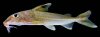 Leptodoras marki
 |
If you would like to contribute to the monthly factsheets with an article, information or photos, please e-mail me. You will of course be credited for your work.

If you would like to donate any denomination of monies to the site just click the above link button. All proceeds will go to running the site and hopefully to keep it going for a few years yet.

