SCOTCAT.COM
your internet guide to all things catfish
FACTSHEETS: February 2008 - no. 140
Acanthodoras cataphractus (Linnaeus, 1758) |
Acanthodoras
cataphractus Acanthodoras cataphractus belongs to the family Doradidae (Thorny Catfishes) from South America namely the Amazon River basin and coastal drainages of French Guiana, Guyana and Suriname. Acanthodoras cataphractus is also documented as being native to Brazil, Bolivia, Colombia and Peru.
Acanthodoras cataphractus prefer to be kept in water which has a pH in the range of 6.0-7.5, and hardness in the range of 4.0 to25.0°dGH. This catfish is ideally suited to temperatures in the range of 22-26ºC or 71-79°F.
I would suggest a minimum size of 36” x 15” X 12” for a shoal of these fascinating catfish. The preferred substrate for keeping these catfish should be good quality aquarium sand such as BD Aquarium Sand, or very smooth rounded gravel in order to prevent their barbels from being damaged. The aquarium should provide some shelter in the form of rocks, bogwood and aquatic plants. As with all other species of fish, water quality and general husbandry is very important, and I would recommend that a minimum of 25% water is changed on a fortnightly basis.
|
 canthodoras cataphractus
is very popular amongst a number of catfish enthusiasts
myself included. Unfortunately it is not commonly
available to the hobbyist, but is sometimes imported
amongst other representatives of the family Doradidae.
When this fascinating catfish is available expect
to pay £10- £12 for an adult fish (2005
u.k. prices). In their natural habitat these catfish
are said to be abundant in the calm waters of swamps
and mangroves. These catfish are most active at night
preferring to take refuge during the day.
canthodoras cataphractus
is very popular amongst a number of catfish enthusiasts
myself included. Unfortunately it is not commonly
available to the hobbyist, but is sometimes imported
amongst other representatives of the family Doradidae.
When this fascinating catfish is available expect
to pay £10- £12 for an adult fish (2005
u.k. prices). In their natural habitat these catfish
are said to be abundant in the calm waters of swamps
and mangroves. These catfish are most active at night
preferring to take refuge during the day.
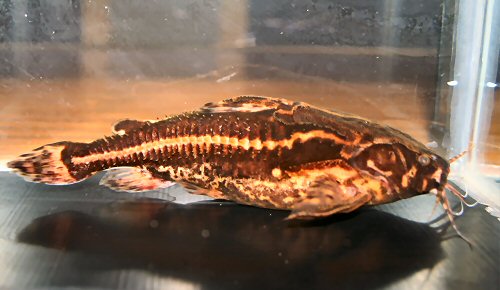
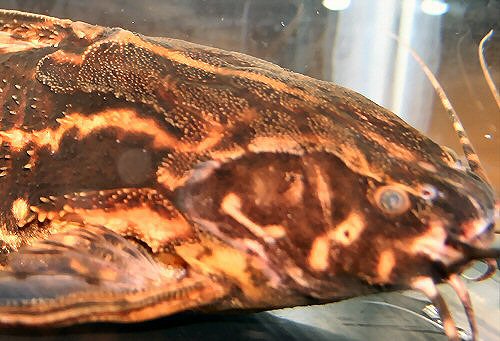
Common Name: |
Spiny Catfish, Milky Catfish, Talking Catfish, Chocolate Talking Catfish, Chocolate Raphael or Bacu. |
Synonyms: |
Silurus cataphractus, Cataphractus americanus, Doras blochii, D.brunnescens, D.castaneoventris, Callichthys asper |
Family: |
Doradidae |
Subfamily: |
Doradinae |
Distribution: |
South America: Amazon River basin and coastal drainages of French Guiana, Guyana and Surinam. |
Size: |
15.0cm. (6ins) (standard length – this is the measurement of the fish from the tip of the snout to the base of the caudal peduncle). |
Temp: |
22-26°C (71-79°F) |
p.H. |
6.0-7.5. |
Characteristics |
The body shape of Acanthodoras cataphractus is described as being depressed or flattened and elongated. The body is naked and is best described as being without scales. The body has a lateral row of bony plates which bear backwardly projecting spines referred to as “scutes”. There are a number of small spiny projections above and below the lateral line situated behind the dorsal fin and extending towards the caudal fin. The head of Acanthodoras cataphractus is large and flattened and is described as being granular with solidly united bones. The mouth is described as being terminal, with three pairs of barbels one pair of maxillary and two pairs of mandibular. The eyes are small or “piggy”. The dorsal fin has 1 spine and 5 soft rays and the anal fin has 10-11 soft rays. |
Colouration |
The base colour of the body and head is chocolate brown (hence the common name of Chocolate Talking Catfish) overlaid with some almost creamy orange markings almost forming a stripe which leads from the head into the lateral line and body scutes; whilst giving some blotchy markings over the rest of the body which are mainly on the ventrolateral region of the body. The fin spines are coloured as are the fins themselves. |
Aquarium Care & Compatibility |
| Wherever possible I would recommend that the aquarist keep these catfish in small groups of four to six specimens, assuming that they are available in these numbers; failing this Acanthodoras cataphractus are quite happy to shoal with other members of the family Doradidae. In their natural habitat they would be found in very large shoals. These catfish are ideally suited to being kept in a community aquarium environment with other medium to large species of fish such as Bleeding Heart Tetras, Emperor Tetras and other catfish. The main thing to remember is that these catfish have quite a large mouth and are capable of eating any fish small enough to fit inside. |
Reproduction |
Acanthodoras cataphractus are documented as having been spawned in aquaria. Both parents were observed digging a depression in the substrate into which the eggs were deposited. The eggs were guarded by both fish. The eggs hatched after 4-5 days although unfortunately the young did not survive beyond the fry stage of development. |
Diet |
| As with all the other doradids that I have had the pleasure to keep over the years, Acanthodoras cataphractus is omnivorous and readily accepts a mixed and varied diet which they search through the substrate for. I personally feed all of my doradids on sinking catfish pellets, good quality flake foods, granular foods, cultured whiteworm, earthworms, aquatic snails which they relish and frozen foods such as bloodworm to name but a few. |
Glossary of Terms |
Ventrolateral
is defined as extending from below and to the side. |
Etymology |
| Acanthodoras
from the Greek acantha = thorns, and doras, meaning
skin; in reference to the spines on the bony scutes
along the lateral line. |
IUCN Red List |
This species has been assessed as Least Concern due to its wide distribution. However, little is known about the population or the threats it faces and efforts should be made to improve this knowledge in order to inform future conservation efforts (IUCN 2023). |
Photo Credits |
All images by Author |
|

If you would like to contribute to the monthly factsheets with an
article, information or photos, please e-mail
me. You will of course be credited for your work.
If you would like to donate any denomination of money to the site just click the above link button. All proceeds will go to running the site and hopefully to keep it going for a few years yet.
ScotCat Sources


Online Sources
 Search
 Fishbase
 Wikipedia
 Catalog of Fishes
 GBIF
GBIF
 Fishnet2
 iNaturalist
 IUCN
IUCN

