SCOTCAT.COM
your internet guide to all things catfish
FACTSHEETS: September 2009 - no. 159
Ageneiosus magoi Castillo & Brull G., 1989 |
Ageneiosus
magoi
- adult male As you can see by the above image that this is indeed a very pretty species but beware as it is very predatory, as all Ageneiosi are, and would need to be housed in a large tank of 6ft (180cm) or over. This is one of the smallest of the Ageneiosus but they do need a lot of swimming space especially if keeping more than one. As mentioned, a good sized aquarium furnished with driftwood and high plants around the edges. The type of substrate is not too much of a problem but will need good fltration with a external filter the best option. The main criterea is to give them plenty of swimming space as, unusual for this family, they will swim about sometimes during the day. The other common names of this sub-family apart from Slopehead catfishes are "bottlenose" or "barbelless catfishes". Ageneiosus magoi only possess very small maxillary barbels but in common with the rest of the Auchenipteridae family the males possess an elongated and thickened anal fin, a genital papilla. The male has it modified into a copulatory organ with the first and second ray thickened and longer, it is thought that the male uses this to clasp the female during the spawning embrace.
Ageneiosus magoi: showing the lack of any discerning barbels.
|
 here
is a school of thought that the Ageneiosus
genera should be in its own family of Ageneiosidae
(Walsh and Eschmeyer, 1990) but the thirteen species
in this genus have been placed in the Auchenipteridae
family ( Ferraris, 1988a) with Auchenipterinae as
the sub-family. In addition to this Walsh also feels
that A. magoi
is a synonym of A.vittatus.
here
is a school of thought that the Ageneiosus
genera should be in its own family of Ageneiosidae
(Walsh and Eschmeyer, 1990) but the thirteen species
in this genus have been placed in the Auchenipteridae
family ( Ferraris, 1988a) with Auchenipterinae as
the sub-family. In addition to this Walsh also feels
that A. magoi
is a synonym of A.vittatus.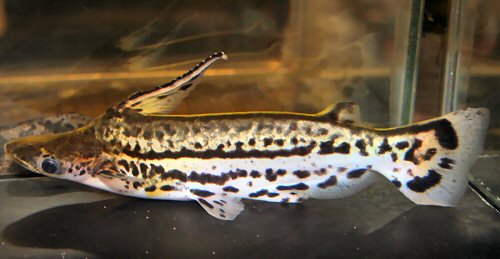

Common Name: |
Slopehead Catfish |
Synonyms: |
None |
Family: |
Auchenipteridae |
Subfamily: |
Auchenipterinae |
Distribution: |
South America: Venezuela; Orinoco basin. Type locality: Los esteros de Camaguán, km 270, Estado Guárico. |
Size: |
24.0cm. (9½ins) |
Temp: |
23-28°c (73-83°f.) |
p.H. |
6.5-7.2. |
Characteristics |
Head flattened and wedge shaped. Profile almost straight, sloping slightly towards snout. Dorsal 6/7 rays. Small adipose fin and a long anal fin. The ventral fins are placed behind the dorsal fin and has 7/8 rays. Eyes lateral. |
Colouration |
Marbled markings to body. Two black bands along body split by a white band. Some specimens have a yellow tinge but may lose this in captivity. There can be differences in seperate individuals. |
Aquarium Care & Compatibility |
| If kept with other species they would need to be the same size or larger species, such as Loriicarids and larger Characins such as Silver Dollars. Can be kept with equal sized conspecifics. |
Reproduction |
There are no documented reports of aquarium spawnings. |
Sexual differences |
In common with the rest of the Auchenipteridae family the males possess an elongated and thickened anal fin, a genital papilla. The male has it modified into a copulatory organ with the first and second ray thickened and longer, it is thought that the male uses this to clasp the female during the spawning embrace. Sexually active males also have an elongated and curved dorsal spine and the maxillary barbels are also elongated. |
Diet |
| Primarily meat eaters so will need this somewhere in their diet. Earthworms, shrimp, beafheart and fish flesh would be an adequate diet. |
Glossary of Terms |
Dorsal fin
is defined as the medial fin on top of the back. |
Etymology |
| Ageneiosus:
Beardless, pertaining to the very small maxillary
barbels. |
References |
Burgess,
W.E. 1989 An
atlas of freshwater and marine catfishes. A preliminary
survey of the Siluriformes. T.F.H. Publications, Inc.,
Neptune City, New Jersey (USA). 784 p. UPDATE. |
Photo Credits |
|
© Allan James
@ |

|

If you would like to contribute to the monthly factsheets with an
article, information or photos, please e-mail
me. You will of course be credited for your work.
If you would like to donate any denomination of money to the site just click the above link button. All proceeds will go to running the site and hopefully to keep it going for a few years yet.
ScotCat Sources
 Etymology-genera
Etymology-specific name
Online Sources
 Search
 Fishbase
 Wikipedia
 Catalog of Fishes
 GBIF
GBIF
 Fishnet2
 iNaturalist

