SCOTCAT.COM
your internet guide to all things catfish
FACTSHEETS: August 2007- no. 134
Ancistrus dolichopterus Kner, 1854 |
Ancistrus dolichopterus
Günther Sterba mentions in his work (Sterba's freshwater fishes of the world vol:2) that it was first imported into Germany in 1911 and also first bred in this year by Lehmann and describes the fish as having white spots on the body and fins with the dorsal and anal fins carrying a brilliant white margin. No mention is made of the same trait in the caudal fin which I find strange as the line drawing in the same publication shows the caudal fin margin. Other earlier literature have mentioned "Body dark blue with white dots with the dorsal and caudal fins dark blue, with white borders". According to Muller (1999), L 183 is the "true" Ancistrus dolichopterus. In the original description it states that the species has 8-9 soft rays in the dorsal fin, as is the case in L 183. In the aquarium trade and literature, L 183 is mistakenly referred to as Ancistrus hoplogenys. Even the first and third Baench Atlas's have A. dolichopterus as A. hoplogenys and vice versa on page 486/487(1) and 364/365(3) On an adult speciman shown below the colours are not quite as vivid, but you can still see the white margins to the dorsal and caudal fins.
Ancistrus dolichopterus - adult pattern
As there is a few Ancistrus species with white spots on a dark background you can be sure of this species by making sure that the dorsal count is 1/9 as most other Ancistrus species have 8 soft rays in the dorsal fin. The lower lobe of the caudal fin is longer than the top, thus the meaning of the species name; long, or lengthy fins. Keeping Ancistrus dolichopterus in the aquarium is not problematic as long as you keep the oxygen levels up as they will be the first fish to feel the effects of reduced oxygen in the aquarium. They will start by moving up the tank walls until their snout is nearly out of the water, this is even more of a problem with young fry. This is a danger sign and a large water change must be made, filters cleaned out and water flow back up again. Two internal power filters at each end of the tank or a combination of one internal and one external filter is needed in a larger tank. Bogwood is the preferred option as decor as they will graze on it and is a necessary part of their diet. Small rounded gravel or sand for the substrate and pipes or slate caves for spawning are a good addition. Plants such as Anubias and Java Fern can be used in a low light situation as bright tank lights will keep your Ancistrus hidden from view.
|
 ur
catfish of the month, this month (Aug. 2007), has
had a checkered history down the years as this beautiful
Ancistrus species has been misidentified on numerous
occasions as "body brown to green brown, upper
parts darker, lower side lighter". The body is
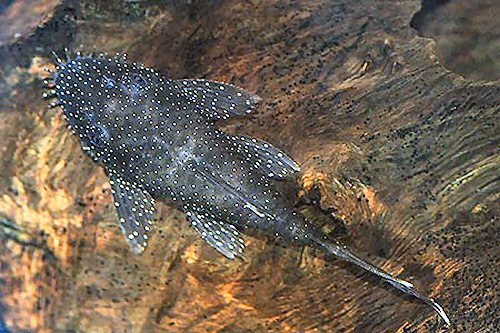
also noted to have dark spots. As you can see from
the lower image of a sub-adult that this is well of
the mark and this description in the publication "Die
Aquarienfische in Wort und Bild" by Holly, Meinken
and Rachow may have snowballed and added to the confusion
in the intervening years that this was published (1932).
The fish was known at this time by its synonym, Xenocara
dolichoptera.
ur
catfish of the month, this month (Aug. 2007), has
had a checkered history down the years as this beautiful
Ancistrus species has been misidentified on numerous
occasions as "body brown to green brown, upper
parts darker, lower side lighter". The body is
also noted to have dark spots. As you can see from
the lower image of a sub-adult that this is well of
the mark and this description in the publication "Die
Aquarienfische in Wort und Bild" by Holly, Meinken
and Rachow may have snowballed and added to the confusion
in the intervening years that this was published (1932).
The fish was known at this time by its synonym, Xenocara
dolichoptera.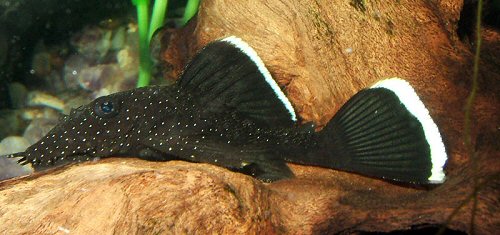
Common Name: |
L183, Starlight Bristlenose Catfish. |
Synonyms: |
None |
Family: |
Loricariidae |
Subfamily: |
Ancistrinae |
Distribution: |
South America: Brazil, Amazonas, Rio Negro (lower and middle course). |
Size: |
14.0cm. (5½ins) |
Temp: |
23-27°c (73-81°f.) |
p.H. |
6.0-7.5. |
Hardness: |
0-15ºdGH. |
Characteristics |
D 1/9; A 1/4; V 1/5; 32-24 bony scutes in a lateral series. 6-9 hooked spines on the movable interopercular. |
Colouration |
Colour dark brown to grey or green-brown to some extent with dark blotches. Healthy fishes are very dark with a blue-black sheen. Underside somewhat paler. Fins blue-black, the dorsal and anal with dirty white spots and a pale margin, (this also applies to the caudal fin: A.J.). In young fishes (see first image) the blue tint is usually more intense and is also enlivened with numerous white spots on the body and fins. The dorsal and anal fins also have a brilliant white margin (as does the caudal: A.J.). |
Aquarium Care & Compatibility |
| No problem with other fishes in the aquarium. |
Reproduction |
As per genus with eggs laid in tubes, in caves or under bogwood. The male will fan the eggs and will hatch after about 5 days. The fry will use up their yolk sac after about 7 days and then will have to be fed soft vegetables such as blanched lettuce. |
Diet |
| Mainly vegetarian with a liking for algae but as this will be in short supply in a tank set-up can be fed on soft veg such as cucumber, courgette (zucchini), raw potato plus loricaria tablets. Will also eat worm food but its main diet would have to be vegetarian. |
Glossary of Terms |
Synonym:
Different name for the same fish. |
IUCN Red List |
The species is assessed as Least Concern due to its very large distribution, the lack of major threats, and because it is locally common (IUCN 2023). |
Etymology |
| Ancistrus:
With barbed hooks, (hooked spines). |
References |
Holly,
M; Meinken, H; Rachow,
A; Die Aquarienfische in wort und bild: 1932. |
Photo Credits |
Top picture: © Hayley
Ahern |

|

If you would like to contribute to the monthly factsheets with an
article, information or photos, please e-mail
me. You will of course be credited for your work.
If you would like to donate any denomination of money to the site just click the above link button. All proceeds will go to running the site and hopefully to keep it going for a few years yet.
ScotCat Sources
 Etymology-genera
Etymology-specific
name
Online Sources
 Search
 Fishbase
 Wikipedia
 Catalog of Fishes
 GBIF
GBIF
 Fishnet2
 iNaturalist
 IUCN
IUCN

