SCOTCAT.COM
your internet guide to all things catfish
FACTSHEETS: July 1999 - no. 037
Aspidoras menezesi Nijssen & Isbrücker, 1976 |
Aspidoras
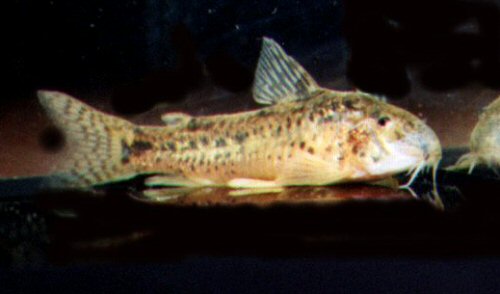
menezesi Identifying Aspidoras can be problematic as most of them (apart from Aspidoras pauciradiatus which is now a Corydoras) have body marking of spots and blotches on a tan background and unless you know the precise area in Brazil where they were collected it can be very difficult. I have over the past few years taken drawings of species I have kept, and also seen on the show bench, to differentiate between each species, and will hopefully some day, to be able to identify them from these sketches.
Aspidoras menezesi
The picture depicted above shows what is believed to be A. menezesi although the colouration is more golden with less spots than the normal form. The fry of this form have black in the leading rays of the dorsal fin and have carried this trait into the juvenile stage. Aspidoras menezesi needs a little more care to their husbandry than most Corydoras species, in that the water parameters should stringently be adhered to, in that regular water changes of the same chemistry to keep them in good condition. These fish don't seem to do well in the hurly-burly of a community tank and would be better placed in a species tank with strong filtration and well planted, as they do tend to hide and are nervous if there is no protection from the open spaces. They also like the temperatures to be on the lower side of tropical i.e. below 75°f. If purchasing this nice little catfish do buy at least four, (better six), as they do better in their own company and tend not to sulk with their own kind and of course you could have a better chance of breeding them. Lineage: All Aspidoras belong to Lineage 2 with the exception of A. pauciradiatus which will prove to be a Corydoras and if a revision is carried out will be Gastrodermus (Cope, 1878) and a member of Lineage 5 alongside members of the "elegans group". Remarks: As of 2018 A. spilotus is now believed to be a synoynm of A. menezesi.
|
 hese
small 'Corydoras type' fish from the Callichthyidae
family are very similar to Corydoras but are
smaller and slimmer with smaller eyes and have one
very important distinct difference from the latter,
of having a dual fontanel (opening in the head bone),
whereas the Corydoras genus has a single fontanel.
To find out more about these differences you can go
to
hese
small 'Corydoras type' fish from the Callichthyidae
family are very similar to Corydoras but are
smaller and slimmer with smaller eyes and have one
very important distinct difference from the latter,
of having a dual fontanel (opening in the head bone),
whereas the Corydoras genus has a single fontanel.
To find out more about these differences you can go
to 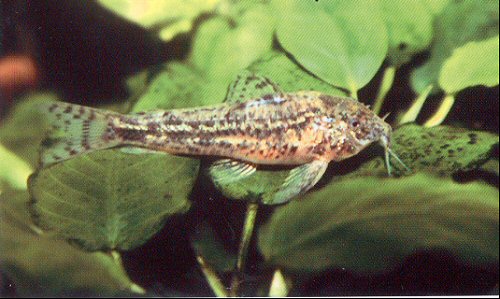
Common Name: |
Menezes's Aspidoras |
Synonyms: |
Aspidoras spilotus |
Family: |
Callichthyidae |
Subfamily: |
Corydoradinae |
Distribution: |
South America: Brazil, Ceará, Rio Granjeiro at Crato, 07°10’S, 39°25’W, tributary on left bank of Rio Salgado. |
Size: |
Male: 4.5cm (1¾ins) Female: 5.0cm (2ins) |
Temp: |
22-24°c (71-75°f.) |
p.H. |
6.0-7.0. |
Characteristics |
Dorsal 1/7; Anal ii,5; Pectorals; 1/9; Ventrals 1/5. 26 Dorsolateral body scutes. 23 Ventrolateral body scutes. 6 pre-adipose scutes. |
Colouration |
Row of elongate blotches along the side from the gill cover to the caudal peduncle. The posterier blotches may be united. The upper back is dusky, perhaps with some blotches or showing a marbled pattern. The lower portion of the body is generally unpigmented. The dorsal fin has some blackish markings and the caudal fin is banded. |
Aquarium Care & Compatibility |
| Inoffensive catfish which will suffer at the hands of aggressive tank mates. Will do well in a species tank or a community tank with smaller inmates such as tetras and rasboras. Best to keep in a shoal of at least four. |
Reproduction |
Has been bred. Similar to Corydoras in this respect but they do tend to eat their eggs, so removing parents or eggs after spawning is a good idea. They lay their eggs in Java moss or on the aquarium glass and you can raise the young as per the Corydoras genus. |
Diet |
| Prefers live food such as newly hatched brine shrimp but will also take frozen food and good quality flake food, plus tablet food. |
Glossary of Terms |
Anterior:
The head end. |
Etymology |
| Aspidoras:
Aspidos = shield; doras = cuirass. |
References |
Burgess,
W.E., 1989 An Atlas of Freshwater and Marine
catfishes: a preliminary survey of the Siluriformes.
T.F.H. Publications, Neptune City, New Jersey. |
Photo Credits |
Top:
©
Ingo Seidel @ |

|

If you would like to contribute to the monthly factsheets with an
article, information or photos, please e-mail
me. You will of course be credited for your work.
If you would like to donate any denomination of money to the site just click the above link button. All proceeds will go to running the site and hopefully to keep it going for a few years yet.
ScotCat Sources
 Article
 Etymology-genera
Etymology-specific name
Online Sources
 Search
 Fishbase
 Catalog of Fishes
 GBIF
GBIF
 iNaturalist

