SCOTCAT.COM
your internet guide to all things catfish
FACTSHEETS: February 2005 - no. 104
Aspidoras sp. (C125) |
Aspidoras
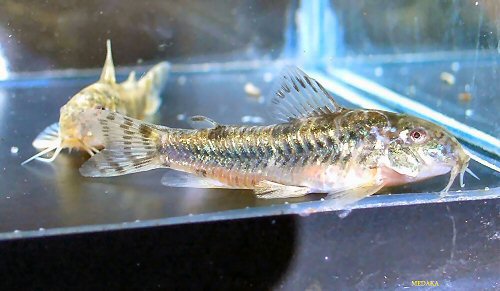
sp. (C125) When we talk of C-numbers for Corydoras we should rightly name them for the Corydoradine subfamily which includes the Aspidoras genus which takes us nicely on to this months factsheet (Feb.2005) and to a small species from Brazil, Aspidoras sp. (C125). All Aspidoras species occur in Brazil but there is no named location so far for this fish and only the exporters will know of its capture location. This Aspidoras first appeared in the German DATZ magazine (page 32) by Hans Georg-Evers in the 3rd edition of 1993 and was bred by him and other aquarists in Germany. I visited Hans in August 2003 and was fortunate enough, along with another Corydoras author and aquarist, Ian Fuller, to take away a dozen or so fry from his premises and safely home to the U.K. These fish are pictured above at full size which I believe to be 4.0cm. and are very active at feeding and at any other times.
Aspidoras sp. (C125)
Above are a breeding pair of C125s spawned by Adrian Taylor, secretary of the Catfish Study Group. The colours on this pair are muted owing to the absence of any substrate in the photographic tank.
Above you can see the fruits of his labour, and to read his breeding report you can view his article, exclusive to ScotCat, here. There are at present 6 species of Aspidoras that are unclassified and been given C-numbers. The following are C035, C036, C037, C118, C119 and our factsheet of the month, C125. Lineage: All Aspidoras belong to Lineage 2 with the exception of A. pauciradiatus which will prove to be a Corydoras and if a revision is carried out will be Gastrodermus (Cope, 1878) and a member of Lineage 5 alongside members of the "elegans group". Update: C125 and CW119 have both been proven to be Aspidoras raimundi.
|
 e are all now very familiar with the L-number
codes that frequent many importers establishments
and there are not many of us without at least one
L-number in our tanks, but since late 1993 we have
had the C-numbers implemented for the Corydoras
by German aquarist and author Hans Georg-Evers for
the DATZ magazine and this has now grown (Feb. 2005)
up to, and including C158.
e are all now very familiar with the L-number
codes that frequent many importers establishments
and there are not many of us without at least one
L-number in our tanks, but since late 1993 we have
had the C-numbers implemented for the Corydoras
by German aquarist and author Hans Georg-Evers for
the DATZ magazine and this has now grown (Feb. 2005)
up to, and including C158.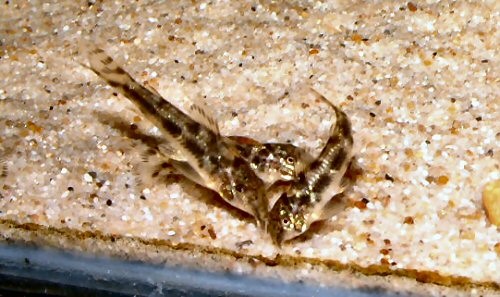

Common Name: |
C125 |
Synonyms: |
None |
Family: |
Callichthyidae |
Subfamily: |
Corydoradinae |
Distribution: |
South America: Brazil. |
Size: |
Male: 3.5cm (1½ins) Female: 4.0cm (1¾ins) |
Temp: |
22-25°C (71-77°F) |
p.H. |
6.5-7.2. |
Characteristics |
Basic Aspidoras shape with small eyes and dual fontanel. Smaller size and body shape in Aspidoras compared to the much more bulkier Corydoras. Smaller head shape in Aspidoras compared with Corydoras. Aspidoras posses a duel fontanel bone structure in skull whereas Corydoras have only the one larger fontanel. |
Colouration |
Longitudinal band on body is interrupted by 3 to 4 dark blotches with the caudal blotch sometimes joined up to form a band. Common to this genus is the three blotches on the dorsolateral part of the body with the first at the beginning of the dorsal spine and the second on the rear of the dorsal position. The third is just in front of the adipose fin. Four bands to caudal fin and one to dorsal. |
Aquarium Care & Compatibility |
| Can be kept in a community tank but would need to be housed with small fish such as tetras and rasboras. A best bet would be a species tank or as mentioned, a small community tank with non aggresive species, with a sand or small gravel substrate and an internal or sponge filters. Plants would be an advantage to make them feel more secure, but this is basicly not a shy species when settled in to your tank set-up. |
Reproduction |
Breeds in the Corydoras fashion laying their eggs on either java moss or spawning mops. You can remove the eggs to a separate small container and raise the fry in this method for a few days after they have taken up their egg sac and gone on to a feeding regime. You can then move them further on to a small tank with a bubble-up or sponge filter, making sure that the water parameters are the same all along the line. |
Diet |
| Will take flake food, tablet food and small based live or frozen food such as micro worm or brine shrimp. |
Relevant Articles |
Etymology |
| Aspidoras: Aspidos = shield; doras = cuirass. |
References |
Evers-Georg, Hans; DATZ magazine 3/2004 (p32). |
Photo Credits |
Top:
©
Ingo Seidel @ |

|

If you would like to contribute to the monthly factsheets with an
article, information or photos, please e-mail
me. You will of course be credited for your work.
If you would like to donate any denomination of money to the site just click the above link button. All proceeds will go to running the site and hopefully to keep it going for a few years yet.
ScotCat Sources
 Article
 Etymology-genera
Online Sources
 Search
 CorydorasWorld

