SCOTCAT.COM
your internet guide to all things catfish
FACTSHEETS: June 2011 - no. 180
Aspistor quadriscutis (Valenciennes, 1840) |
|
Aspistor quadriscutis
In 2004 TAG contributor Jackie Goulder phoned, in a very excited voice, to let me know that some kind fishkeeper had literally dropped onto her doorstep an unknown, and very large, catfish. Now this fish I had to see so Jackie arranged to collect me and down to Flamingo Land we went for a ‘night visit’ (which you can read all about on the Aquarticles website at www.aquarticles.com). When my eyes fell upon the wonderful catfish pictured above, I was truly amazed. From first sight I could tell that the large catfish was an Ariid of some type and it had a resemblance to the large Asian catfish 'Mystus' wyckii. Armed with e-mail friendly copies of Jackie's photographs I contacted several 'catfish experts' and asked for their help in providing some clues as to the exact identity of the Flamingo Land Ariid. As I really should have guessed TAG contributor Steven Grant was the only person to reply and left me with the following lead (the reference to Mystus comes from my comments that the Arrid had a look of 'Mystus' wyckii. "‘Hello David - Yes it's difficult to tell from a photograph but it does look like an Ariid. Mystus wyckii (now known as Hemibagrus wyckii ) has long maxillary barbels. My closest guess from the photos is Aspistor quadriscutis (used to be in Arius) but it is only a guess. The only sure way of identifying it is drawing/photographing the cephalic shields (Head plates), and also if possible the tooth patches but this is virtually impossible in live fishes. - Regards Steven".
Aspistor
quadriscutis
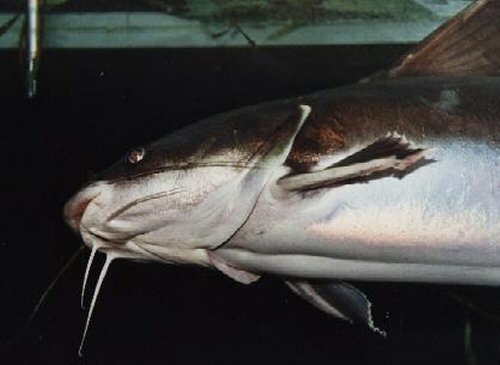
- head
view Searching through textbooks revealed that Valenciennes scientifically named Aspistor quadriscutis in 1840. The only other member of this genus is A. luniscutis. A. quadriscutis has a natural distribution from north west Guyana through to northeastern Brazil (off Orinoco Delta) with unconfirmed reports placing it around the coastline of Venezuela. This fish is known commonly as the Bressou Sea Catfish but is equally at home in brackish and freshwater environments. Unlike many members of the Arius grouping this fish does not have a 'shark catfish' tag. The exact spawning ritual is unknown but eggs are orally incubated by the male. I was absolutely thrilled to get this far, having never heard of the scientific name, so began to cross-reference the above on the 'search' facility of our Internet supplier. I did not expect to find much more information than had already come to light so was thrilled when 12 sites were revealed as possible sources of further bits and pieces about Aspistor catfish. From the first eleven sites the information we already had was confirmed and the following points added:- - The Bressou Sea Catfish had been the subject of scientific research on sustainable food resources on two occasions. 1- Ichthyologists
had been unable to find a definite way of telling
males and females apart. Now with site 12 left to view I expected to find very little else to report upon so imagine my joy when the FishBase org., first time I had visited this site, had a wonderful two page information sheet on the Bressou Sea Catfish that had been compiled by A. P. Marceniuk and C. J. Ferrais Jr. After reading this sheet I was able to confirm that the Flamingo Land monster was indeed Aspistor quadriscutis. Although the only photograph with the file was of a museum specimen, this fish, which looked like a deflated version of our photographs and lacked natural colour, looked very similar and fins and whiskers certainly appeared to match. The description talked of 3 pairs of barbels on rostral region, 2 pairs on lower jaw, a single pair posterior end of maxilla and of the fish having a large saddle-shaped bony plate with rugose surface in front of dorsal fin. Although the body colour is quoted as more yellow in appearance this could be to do with pigmentation increase due to a natural food source? The Bressou Sea Catfish is found in turbid waters over muddy bottoms in shallow coastal areas, also around estuaries, and coastal rivers. In aquaria Jackie
found the Bressou Sea Catfish to be no trouble in
the company in which it was kept, that ‘he’
fed from her fingers and was a real ‘pet’
(as many large catfish can become). Sadly, a few weeks
before Jackie retired from her work, a second phone
call was received informing me that very suddenly,
and without warning, the Apistor catfish had died.
How this fish had come into the U.K. we never knew
and no aquatic retailer I have spoken with have found
this fish on their list from wholesalers. So it looks
as though our Apistor most likely came in as a ‘contaminant’
with more readily available South American catfish?
‘He’ was a unique fish and putting together
this article reminded me of all those wonderful evening
visits to Flamingo Land in which Jackie, Sue, the
members and friends of Ryedale Aquarist Society (on
occasions) had ‘free wander’ of the wonderful
aquarium and Zoo. Note: This article was published in The Aquarium Gazette no.19.
|
 oining
us this month (June 2011) is David Marshall with an
in depth look at the Bressou sea catfish from the
Ariidae family and a catfish that is not often seen
or discussed in aquarium literature. David is a show
judge and also editor of The
Aquarium Gazette, a CD based aquarium publication
in the U. K. and distributed worldwide. We will let
David carry on from here with his look at the 'Bressou
sea catfish'.
oining
us this month (June 2011) is David Marshall with an
in depth look at the Bressou sea catfish from the
Ariidae family and a catfish that is not often seen
or discussed in aquarium literature. David is a show
judge and also editor of The
Aquarium Gazette, a CD based aquarium publication
in the U. K. and distributed worldwide. We will let
David carry on from here with his look at the 'Bressou
sea catfish'.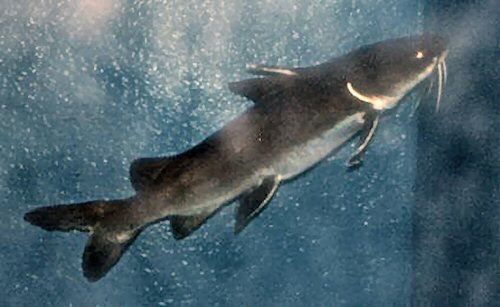
Common Name: |
Bressou sea catfish |
Synonyms: |
Arius quadriscutis, Notarius quadriscutis |
Family: |
Ariidae |
Subfamily: |
- |
Distribution: |
South America: Atlantic coastal rivers of South America from Guyana to northeastern Brazil. Type locality: Cayenne ou de la Mana ... Cayenne. |
Size: |
50.0cm.TL (1ft 8ins) |
Temp: |
20-27°c (67-81°f ) |
p.H. |
6.5-8.0. |
Characteristics |
Dorsal spines (total): 1. Three pair of barbels on rostral region, two pairs on lower jaw, one pair on posterior end of maxilla; end of maxilla barbel reaching pectoral fin insertion; large saddle-shaped bony plate with rugosa surface in front of dorsal fin, anterior margin of this plate waved but no deep medial incision. |
Colouration |
Body yellow or gray-yellow dorsally, white ventrally. |
Aquarium Care & Compatibility |
| In aquaria Jackie found the Bressou Sea Catfish to be no trouble in a large aquarium in which ‘he/she’ had an Xanthic Giant gourami and several large Pacu for company. 'He/she' fed from her fingers and was a real ‘pet’ (as many large catfish can become). |
Reproduction |
Reproduction period is probably between September and November. Egg diameter is 9-11 mm. Males practice mouth brooding of the eggs. |
Sexual differences |
The sexes can be told apart, at the right time of the year, in this respect due to a bulging male mouth. |
Diet |
| Raw marine fish with a lettuce and carrot side salad formed the favoured food dish. |
Etymology |
quadriscutis: Four spined. |
Glossary of Terms |
Rugose: Covered
in ridges, knobs or protuberances, deeply wrinkled
etc.. |
References |
Froese, R. and D. Pauly. Editors. 2009. FishBase. World Wide Web electronic publication.www.fishbase.org, version (05/2011). |
Photo Credits |
Image credits: Jackie Goulder |
|

If you would like to contribute to the monthly factsheets with an article, information or photos, please e-mail me. You will of course be credited for your work.
If you would like to donate any denomination of money to the site just click the above link button. All proceeds will go to running the site and hopefully to keep it going for a few years yet.
ScotCat Sources
 Etymology-specific name
Online Sources
 Search
 Fishbase
 Catalog of Fishes
 GBIF
GBIF
 Fishnet2
 iNaturalist

