SCOTCAT.COM
your internet guide to all things catfish
FACTSHEETS: August 2003 - no. 086
Bagrus meridionalis Günther, 1894 |
Bagrus meridionalis
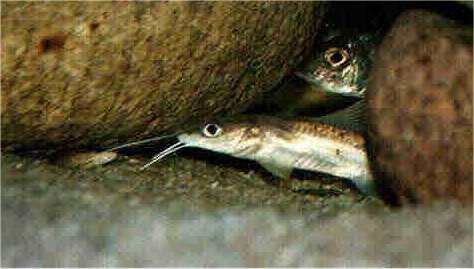
One of the common names for this catfish is "Kampango" from the local Chichewa language and it is highly prized as a major food fish for the native population, as it grows to around the 5ft (150cm) mark, and so can be quite a challenge for the fishermen of Lake Malawi. It is served in the local restuarants wrapped in leek leaves and gently poached and placed on a bed of roasted vegetables. As you can guess by now this is not a fish for your community tank as it will eat anything that it can fit into its mouth. You can of course keep it as a juvenile in a Rift Valley set-up containing cichlids from the lake as long as the occupants are larger than the catfish. When it gets to an adult size it would do better on its own in a very large tank but realistically it is a fish for the public aquarium when it gets to that size. Carsten Larsen from the Malawi Danish web site, www.Malawicarsten.dk, states below on how ferocious this Bagrid can be. "It can be kept with cichlids from the lake without any problems, as long the Bagrus can't get the other fish in it's mouth. One of my Bagrus ate a Ancistrus sp. The Bagrus was 12cm and the Ancistrus around 9cm... This tells a lot about it's appetite and size of the "dangerous" end"
Bagrus meridionalis - (15.0cm juvenile)
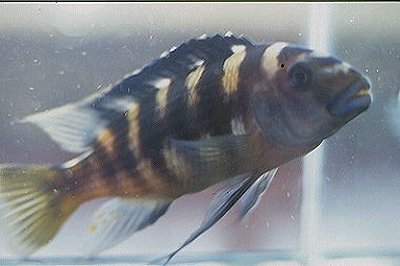
Pseudotropheus crabro - (Hornet or bumblebee cichlid) |
 his
month we move on to the African continent and to a
large predatory catfish which is indigenous to one
of the Rift Valley lakes, Lake Malawi. You can also
find this bagrid in some of the surrounding rivers
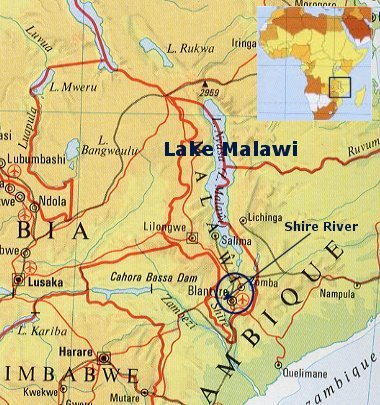
such as the Shire and other connecting rivers. The
Shire River was actually the spot where the first
known specimen was recorded.
his
month we move on to the African continent and to a
large predatory catfish which is indigenous to one
of the Rift Valley lakes, Lake Malawi. You can also
find this bagrid in some of the surrounding rivers
such as the Shire and other connecting rivers. The
Shire River was actually the spot where the first
known specimen was recorded.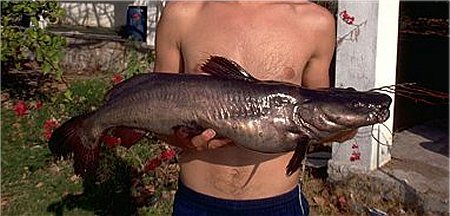
A little bit of its habitat is that Lake Malawi is the most southerly of the great African Rift Valley lakes. It is about 560 km long and has a greatest width of about 75 km. In contrast with Lake Tanganyika, it consists of a single basin with greatest depth of about 706 m near the western shore about 45 km north of Nkhata Bay. It lies between 9:30-and 14:30S at an altitude of about 500 m in a tropical climate. However it lies far enough south of the equator to experience marked seasonal variations in wind, temperature and precipitation. The lake occupies part of the southern end of the Rift Valley system and is to a large extent delimited by faults, particularly to the north and on the eastern coast. In these areas the shores are steep and depths in excess of 200 m are found close inshore. At the southern extremity and along the southern half of the west coast the shoreline is more gently shelving. From here the bottom rises gradually to north and south and, except for a ridge some 20 m high at 10:25S, there is no trace of separate basins as in Lake Tanganyika. In further contrast to Lake Tanganyika, where a depth of 200 m is found within 20 km of the southern extremity of the lake, in Lake Malawi such a depth is not encountered within 110 km of the southern end.
Mike
Oliver from malawicichlids.com for information
and image.
|
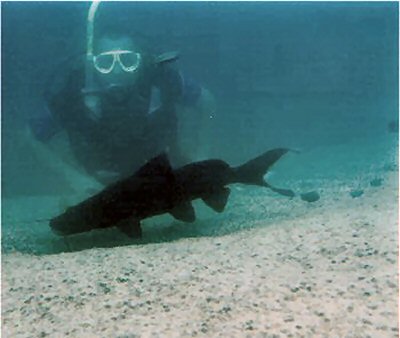
Common Name: |
Kampango |
Synonyms: |
Porcus meridionalis |
Family: |
Bagridae |
Subfamily: |
Bagrinae |
Distribution: |
Africa: Shire River and Lake Malawi. Type locality: Upper Shire River (British Central Africa). (click for location map) |
Size: |
150.0cm (5ft) |
Temp: |
24-27°C (75-81°F) |
p.H. |
7.5-8.2. |
Characteristics |
Head about twice as long as broad, with smooth texture. Dorsal fins widely separated. |
Colouration |
Body Bronze/silver. Fins have a ruby colouration when reaching adulthood. |
Aquarium Care & Compatibility |
| Not a fish for your community tank as it will eat anything that it can fit into its mouth. You can of course keep it as a juvenile in a Rift Valley set-up containing cichlids from the lake as long as the occupants are larger than the catfish. When it gets to an adult size it would do better on its own in a very large tank but realistically it is a fish for the public aquarium when it gets to that size |
Reproduction |
Very caring parents. Lays its eggs in a nest on bottom of lake and guards and feeds its young. The female also produces non-fertile eggs for its young to feed on which makes it a match for any parenthood properties that the cichlid population of this lake indulge in. |
Diet |
| A nocturnal feeder on cichlids on rocky shores, and occurs from the lower reaches of rivers to the deepest habitable parts of the lake. It also feeds on mollusks, crabs and zooplankton. |
Etymology |
| Bagrus:
From 'bagre', a South American name for a catfish,
but is only used for African and Asian species. |
References |
Carsten,
Larsen
K.: www.Malawicarsten.dk. |
Photo Credits |
Top:
©
Mike Oliver:
www.malawicichlids.com |

|

If you would like to contribute to the monthly factsheets with an article, information or photos, please e-mail me. You will of course be credited for your work.
If you would like to donate any denomination of money to the site just click the above link button. All proceeds will go to running the site and hopefully to keep it going for a few years yet.
ScotCat Sources
 Etymology-genera
Etymology-specific name
Other Sources
 Search
 Fishbase
 Wikipedia
 Catalog of Fishes
 GBIF
GBIF
 Fishnet
 iNaturalist