SCOTCAT.COM
your internet guide to all things catfish
FACTSHEETS: November 2026 - no. 365
Batasio tengana (Hamilton, 1822) |
|
The author Francis Buchanan FRSE FRS FLS (15 February 1762 – 15 June 1829), later known as Francis Hamilton but often referred to as Francis Buchanan-Hamilton, was a Scottish surgeon, surveyor and botanist who made significant contributions as a geographer and zoologist while living in India. He did not assume the name of Hamilton until three years after his retirement from India. The standard botanical author abbreviation Buch.-Ham. is applied to plants and animals he described, though today the form "Hamilton, 1822" is more usually seen in ichthyology. In 1822, he published his major work, "An Account of the Fishes Found in the River Ganges and Its Branches". The illustrations were most likely by a young Bengali artist, Haludar, whom Buchanan had trained in scientific illustration since the late 1790s, but about whom little else is known. It stands as one of the earliest and most comprehensive systematic surveys of South Asian freshwater fish, establishing the baseline scientific descriptions for hundreds of indigenous species (such as various barbs, loaches, and catfishes) (Wikipedia).
|
 ur
factsheet for November 2026: Batasio tengana
was once known as Pimelodus tengana, Macrones
tengana, Gagata tengana, and Bagrus
tengana, and is now named Batasio tengana
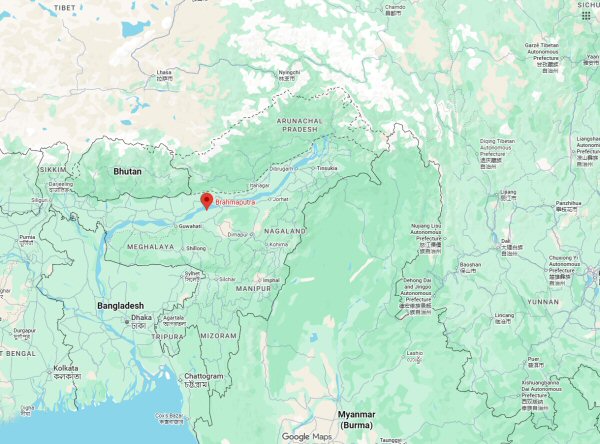
(Hamilton, 1822). Hamilton first published the original
genus name in his 1822 work, "An Account of the
Fishes Found in the River Ganges and Its Branches",
from the Tista River at Tista barrage, 26°45'10"N,
88°34'11"E, India. The type locality of B.
tengana is often given as the Brahmaputra River
(e.g. see Eschmeyer, 1998), following the original
description, but Hora (1949) narrowed it down to "Gualpara"
(=Goalpara in Assam state, Northeast India) based
on original notes made by Hamilton.


Common Name |
Assame batasio |
Synonyms |
Bagrus tengana, Gagata tengana, Macrones tengana, Pimelodus tengana |
Family |
Bagridae |
Subfamily |
- |
Habitat |
Batasio species are small, laterally compressed bagrid catfishes generally found in fast-flowing hill streams throughout South Asia, Myanmar, the Salween and Mae Khlong drainages of Thailand and the northern Malay Peninsula. |
Distribution |
Asia: India, Bangladesh, Myanmar and Thailand. Type locality: Brahmaputra River. |
Size |
7.0cm (2¾ins) |
Temp. |
20-25°C (68F-77°F) |
p.H. |
6.5-7.5. |
Characteristics |
Rayed dorsal fin inserted above posterior end of pectoral fin, spine smooth, shorter than head length. Pectoral fin not reaching pelvic fin, spine with 8 or 9 antrorse teeth along inner margin. Pelvic fin reaching anal fin. Anal fin not reaching caudal base. Caudal fin forked, lobes bluntly pointed. Least depth of caudal peduncle 0.8 to 1.6 in its length. |
Colouration |
Varies considerably. Body grey olivaceous, deeper above, lighter beneath. A broad black spot on nape. A number of oblique saddle shaped bands on body, not extending to ventral surface. |
Aquarium Care & Compatibility |
| To successfully keep Batasio tengana, you need to replicate a cool, fast-flowing hillstream environment. They are sensitive to poor water quality and lack of oxygen, making them best suited for aquarists with some experience. Use a base of fine sand mixed with smooth, water-worn rocks, cobbles, and larger river stones. Provide plenty of hiding spaces using driftwood, roots, and stone caves. They are naturally nocturnal and shy, so they need secure places to retreat during the day. Small barbs and other temperate species are probably best to keep with them in the higher water column, as they can sustain the lower water temperatures; also, small, peaceful cyprinids (e.g., White Cloud Mountain Minnows, certain Danio or Devario species). Avoid large, aggressive, or overly boisterous fish. Excellent tank mates include other peaceful species that thrive in high-flow, cooler water. |
Reproduction |
Females become fat with eggs when in good condition, but no spawnings have been known up to date. |
Sexual differences |
Males posses a genital papilla. |
Diet |
| Diet: They are carnivores that feed on insect larvae and small crustaceans in the wild. Offer live or frozen foods such as bloodworms, daphnia, brine shrimp, and tubifex worms. They rarely accept dry flakes or pellets right away. You can try introducing sinking carnivore pellets or gel foods once they are settled, but live/frozen food should remain their primary diet. |
Glossary of Terms |
Anal
fin: The median, unpaired,
ventrally located fin that lies behind the anus, usually
on the posterior half of the fish. |
Etymology |
| Batasio:
From
the local (Bengali) name of the fish (batasio
or batashi). |
IUCN Red List |
Batasio tengana is distributed in the Ganges and Brahmaputra river basins in India, Nepal and possibly Bangladesh indicating a fairly large distribution. However, the population size and trend for this species remain unknown, and it is only known from scanty museum records. There is also very little information on the biology of this species and potential impacts of threats (especially those of an anthropogenic nature). Based on its wide distribution it is currently assessed as Least Concern, but needs updating (IUCN 2010). |
References |
Heok Hee Ng &
Maurice Kottelat.
2007. Batasio feruminatus, a new species of bagrid
catfish from Myanmar (Siluriformes: Bagridae), with
notes on the identity of B. affinis and B. fluviatilis. |
Photo Credits |
© Beta Mahatvaraj |
|

If you would like to contribute to the monthly factsheets with an
article, information or photos, please e-mail
me. You will, of course, be credited for your work.
If you would like to donate any amount of money to the site, simply
click the link above. All proceeds will go to running the site and
hopefully to keep it going for a few years yet.
ScotCat Sources
 Etymology-genus name
Etymology-specific name
Other Sources
 Search
 Fishbase
 Catalog
of Fishes
 GBIF
 FishNet2
 iNaturalist
 IUCN

