SCOTCAT.COM
your internet guide to all things catfish
FACTSHEETS: April 2002 - no. 070
Brachyplatystoma tigrinum (Britski, 1981) |
Brachyplatystoma
tigrinum is also
known as the Tiger-striped Catfish. This magnificent
catfish belongs to the family Pimelodidae,
representatives of which can be found widespread throughout
the rivers of South America. The original specimens
that were caught and described by Dr Britski of the
Saô Paulo Zoology Museum were from the Rio Maderia
in Brazil. It was originally thought that this was
the only location where this species of catfish was
found, however this catfish is known to be collected
in Columbia and I personally have experience of Peruvian
exporters collecting these fish in Peru. The original
fish were collected in 1978 by Michael Goulding. A
publication by Dr Dario Castro of the University of
Bogotá in 1984 recorded this catfish as being
collected from the lower Caqueta River in Columbia.
Brachyplatystoma
tigrinum
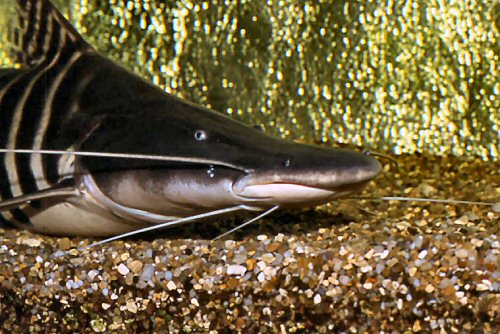
Brachyplatystoma tigrinum - head view
The show size listed in the Catfish Study Group U.K. listing is 450mm s.l. i.e. from the tip of the snout to the base of the caudal peduncle. In their natural habitat, however they grow well in excess of this size and can attain lengths in excess of 600mm quite easily. This catfish is perhaps one of the most expensive specimen from this family of fish. The first specimen that I ever saw back in the mid eighties had a price tag of £1000 (U.K.), and I have recently seen specimens for sale at between £500 and £600. Obviously consideration needs to be given to the size of aquarium in which to keep such a magnificent catfish as this, I would not recommend anyone to keep one of these catfish in anything less than a 72" x 24" x 24". As well as the size of aquarium good filtration is also very important in order to keep a catfish such as this in perfect condition. I would also suggest that sand such as BD Aquarium sand be used as a substrate for the aquarium. This is a catfish that I have not personally kept which probably has something to do with the high price that these fish demand. I know of a couple of catfish enthusiasts that have kept this fish successfully over the years, one of which was Graham Crook (Danny Blundell's son-in law) and Robin Warne. It was whilst on a recent fish collecting trip to Peru with Robin Warne, Giles Barlow, Allan James, Jools and Clare Dignall, Stephen Pritchard and Alan Appleton that I found out some little known information about this fish. The exporter in Peru that specialises in large specimen fish such as this informed us that they collect them as juvenile specimens from a local breeding area in the river and grow them on for export. We were informed that when collected at between 50 and 75mm they could be reared successfully in the holding tanks and fed on their favourite food of knife fish. This particular exporter found that when collected at a size of around 300mm they did not fare well and would not feed in captivity. The Peruvian exporter keeps these catfish at his premises for around six months before offering them for sale.
|
 cotCat
has now reached its 70th factsheet and to celebrate
this milestone we have regular contributor and catfish
expert for the U.K.magazine Practical Fishkeeping,
Chris Ralph, who has picked a quite magnificent catfish
in the Tiger-striped catfish, Brachypatystoma tigrinum.
Over now to Chris for an in-depth look at this beauty.
cotCat
has now reached its 70th factsheet and to celebrate
this milestone we have regular contributor and catfish
expert for the U.K.magazine Practical Fishkeeping,
Chris Ralph, who has picked a quite magnificent catfish
in the Tiger-striped catfish, Brachypatystoma tigrinum.
Over now to Chris for an in-depth look at this beauty.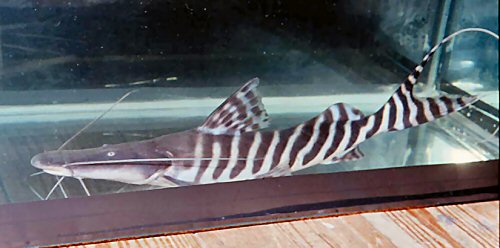
Common Name: |
Tiger-striped catfish, Zebra Shovelnose |
Synonyms: |
Merodontotus tigrinus |
Family: |
Pimelodidae |
Subfamily: |
- |
Distribution: |
South America: Amazon River basin. |
Size: |
Up to and over 60.0cm (24ins) |
Temp: |
22-26°C (71-79°F) |
p.H. |
6.5-7.5. |
Hardness |
4-30° dGH |
Characteristics |
Long upper jaw. First rays of the dorsal and pectoral fins are described as being flexible and not pungent. Long maxillary barbels reaching back to the posterior of the dorsal insertion. Small eyes laterally placed. |
Colouration |
Yellow to almost white base colour to the body with black stripes. Most of the fins share this same colour pattern of that of the body of this catfish. Head area from snout to insertion of dorsal fin, devoid of stripes. |
Aquarium Care & Compatibility |
| Suggested tank mates! anything that does not constitute a meal, I would suggest some of the larger Characins as opposed to any other catfish, which may compete for territory. Most enthusiasts would keep this catfish as a single specimen in a display aquarium. |
Reproduction |
Not recorded. |
Sexual differences |
There are no known obvious external sexual differences. |
Diet |
| As these are predatory catfish they prefer meaty foods such as whole prawns, mussels, pieces of fish, beef heart (sparingly) and earthworms etc. Feed only once or twice a week. |
Glossary of Terms |
Maxillary barbels: Pertaining to the upper jaw. (maxillary barbels). |
Etymology |
| Brachyplatystoma:
Greek, brachys, eia = short + Greek, platys = flat
+ Greek, stoma = mouth. |
References |
Baensch;
Aquarium Atlas Photo Index 1-5. |
Photo Credits |
© Chris Ralph |
|

If you would like to contribute to the monthly factsheets with an
article, information or photos, please e-mail
me. You will of course be credited for your work.
If you would like to donate any denomination of money to the site just click the above link button. All proceeds will go to running the site and hopefully to keep it going for a few years yet.
ScotCat Sources
 Etymology-genera
Etymology-specific name
Online Sources
 Search
 Fishbase
 Wikipedia
 Catalog of Fishes
 GBIF
GBIF
 Fishnet2
 iNaturalist

