SCOTCAT.COM
your internet guide to all things catfish
FACTSHEETS: September 2003 - no. 087
Bunocephalus coracoideus (Cope, 1878) |
|
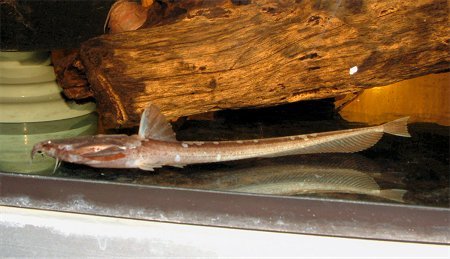
The Banjo Cat is a rugged looking individual with its lumps and bumps and can not be classed as pretty in the sense of the word, but has a charm all of its own in the catfish world. Its head is very broad and flat with very small eyes, 3 pairs of barbels with the maxillary's reaching to about a third of the length of the strong serrated pectoral spine which you can observe in the bottom head shot. As you can also see in the photo the best substrate for them is sand where they can bury themselves for the best part of the daylight hours and only appear at night where they can be seen scurrying across the bottom looking for food. They can propel themselves through the water by taking water into their mouths and then propelling it out of their gills thus causing a burst of speed across the substrate. It is said that they shed their skin periodically but I would surmise that this would coincide with a downturn in water quality in their tank thus causing stress and the shedding of the skin. The Aspredinidae family is divided into two subfamilies, Bunocephalinae, this months subject, and Aspredininae and can be told apart by the longer anal fin of the latter, and also the longer body. Below you can see the differences in the species Platystacus cotylephorus, the "Banded Banjo" from the subfamily Aspredininae, and Bunocephalus coracoideus from the Bunocephalinae subfamily in the top picture.
Platystacus cotylephorus
Determining the sexing out of this species is not easy but a rule of thumb is that the females are larger and fuller in the belly and usually a little darker in colouration. Can be kept in groups and are non aggresive inmates in a shallow tank. The main problem is seeing them as they are a nocturnal species and you may be able to spot them if you feed at lights out in the dusk of a half lit room or fishhouse. To finish off, this is a peaceful catfish which has its own small fan club here in the U.K. especially in the Catfish Study Group, so if you live in the United Kingdom or are visiting, why don't you came along to one of the meetings and find out more about this odd catfish.
|
 his month we concentrate
on a family of fish that are, on the most part, overlooked
by even the most ardent catfish hobbyists. The Aspredinidae
family are what is known in the hobby as " Banjo
Cats" or "Guitarrita" (little guitar)
owing to their long flattened banjo/guitar shape.
They are even cited as "Frying Pan Fish".
You will probably get my drift now on the shape of
this months factsheet individual, namely, Bunocephalus
coracoideus, the "Banjo Catfish".
his month we concentrate
on a family of fish that are, on the most part, overlooked
by even the most ardent catfish hobbyists. The Aspredinidae
family are what is known in the hobby as " Banjo
Cats" or "Guitarrita" (little guitar)
owing to their long flattened banjo/guitar shape.
They are even cited as "Frying Pan Fish".
You will probably get my drift now on the shape of
this months factsheet individual, namely, Bunocephalus
coracoideus, the "Banjo Catfish".
Common Name: |
Banjo Catfish, "Guitarrita" (little guitar) |
Synonyms: |
Bunocephalus bicolor, Dysichthys bicolor, Dysichthys coracoideus, Bunocephalus haggini |
Family: |
Aspredinidae |
Subfamily: |
Bunocephalinae |
Distribution: |
South America: Amazon River basin of Bolivia, Brazil, and Peru. Type locality: Nauta, Peru. |
Size: |
13.0cm. (5ins) |
Temp: |
22-26°c (70-79°f.) |
p.H. |
6.0-8.0. |
Characteristics |
D 1/4; A 1/6-7; P 1/5; V 1/5; Head and anterior part of body very strongly depressed and broad, tapering posteriorly. Caudal peduncle very long and compressed. Pectoral fin-spines very stout and serrated. No adipose fin. 3 pairs of barbels, of which those on the maxillary are the longest and reach to the pectoral fin when laid back. Skin naked; flanks with rows of tubercles. |
Colouration |
Depending on health, uniform dark brown to pale brown with dark bands and blotches. The whole body is strewn with small pale spots. Underside paler, often with brown blotches. Fins translucent brownish with pale brown to black blotches; caudal with a dark edge. |
Aquarium Care & Compatibility |
| No problem to keep in a community tank and they will forage out in the open when food is introduced. Can be kept in groups and are non aggresive inmates in a shallow tank. The main problem is seeing them as they are a nocturnal species and you may be able to spot them if you feed at lights out in the dusk of a half lit room or fishhouse. Provide sand as a substrate as they will dig themselves into this and will smell food as it is introduced. |
Reproduction |
This is one of the few Banjo's that have been spawned in captivity. The eggs which can boast a total of 4,000 are laid in the sand and would probably be better served if they are removed to a smaller tank or container, and when hatched will need to be fed very fine first foods such as brine shrimp and micro worm, after they have used up their yolk sac. They can then be weaned onto small worm foods such as grindel worm and tubifex. |
Sexual differences |
Determining the sexing out of this species is not easy but a rule of thumb is that the females are larger and fuller in the belly and usually a little darker in colouration. |
Diet |
| Adults when settled in their tank are not fussy feeders and can be fed a healthy diet of worm foods such as frozen bloodworm and tubifex and also tablet food at lights out. |
Glossary of Terms |
Caudal fin:
The tail. |
Etymology |
| Bunocephalus:
Buno = mound; cephalus
= head.(with bumps on the head) |
IUCN Red List |
This species is assessed as Least Concern due to its wide distribution, abundance, and the lack of any known major threats (IUCN 2021). |
References |
Burgess,
W.E. 1989 An atlas of freshwater and marine
catfishes. A preliminary survey of the Siluriformes.
T.F.H. Publications, Inc., Neptune City, New Jersey
(USA). 784 p. |
Photo Credits |
| Top & Second: © Johnny
Jensen @ |


|

If you would like to contribute to the monthly factsheets with an article, information or photos, please e-mail me. You will of course be credited for your work.
If you would like to donate any denomination of money to the site just click the above link button. All proceeds will go to running the site and hopefully to keep it going for a few years yet.
ScotCat Sources
 Etymology-genera
Etymology-specific name
Other Sources
 Search
 Fishbase
 Wikipedia
 Catalog
of Fishes
Catalog
of Fishes
 GBIF
GBIF
 Fishnet2
 iNaturalist
 IUCN
IUCN

