SCOTCAT.COM
your internet guide to all things catfish
FACTSHEETS: April 2012 - no. 190
Bunocephalus verrucosus (Walbaum, 1792) |
|
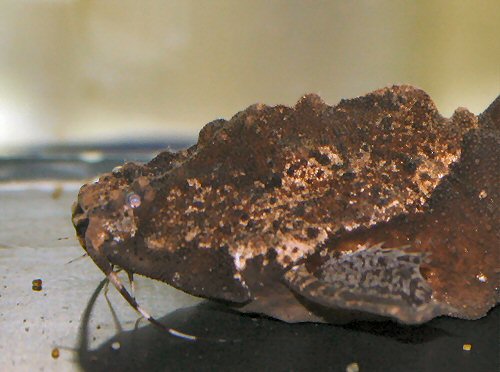
This factsheet is about one of my favourite species of catfish. The Craggy Head Banjo Catfish is an apt common name for these fish. The Craggy Head part obviously is due to the bumpy craggy profile of the head, and the Banjo part is due to the overall fishes shape resembling a banjo. You will sometimes see these fish labelled as Bunocephalus verrucosus scabriceps as well as Bunocephalus verrucosus verrucosus. The subspecies B. v. scabriceps has been synonymised with B. v. verrucosus but is still accepted by some hobbyists. Mees (1988) considered B. v. scabriceps as a valid subspecies due to the range of B. v. scabriceps of Amazonia (the Guianas in B. v. verrucosus), and that in B. v. scabriceps the knobs on the head and predorsal region are more strongly developed. This has not been followed by recent works on the Aspredinidae.
Bunocephalus verrucosus - head view
Regardless of their name(s) these catfish are a charming, peaceful denizen for the community aquarium. Rather than just used as scavengers, I would ask that you regard them as species in their own right. By this I mean you should make sure that you give them a substrate of sand if possible (although they do not burrow like some other Banjos so this is not essential), and that you give them some leaf litter or plants so that they have some cover. Don’t mix them with boisterous or aggressive fish. You should feed them on small catfish pellets, bloodworm, tubifex, and chopped earthworms, making sure that enough food gets to the bottom for them, or better still by feeding sinking food just before you turn the lights out. If they start losing their barbels it could mean that they are being pestered by other fish or that the water conditions are not right. They do better in slightly acidic water. If you see them hanging near the surface they are probably being bullied. They will occasionally shed skin like most Banjos do, but again if you are finding lots of skin and see any lesions on the body, please check your water parameters. This may all sound like they are difficult fish to keep, but in fact they aren’t and they are actually quite resistant to skin infections or diseases. Just please make sure you care for them adequately and you will enjoy watching them for many years getting fat and shuffling around gobbling up food! Who knows, you may even get them to breed!
|
 his our 190th factsheet
since our inception in 1997 has been written this
month by experienced catfish keeper and author Steven
Grant with one of his favourite species and family
with a look at the Craggy Head Banjo Catfish, Bunocephalus
verrucosus.
his our 190th factsheet
since our inception in 1997 has been written this
month by experienced catfish keeper and author Steven
Grant with one of his favourite species and family
with a look at the Craggy Head Banjo Catfish, Bunocephalus
verrucosus.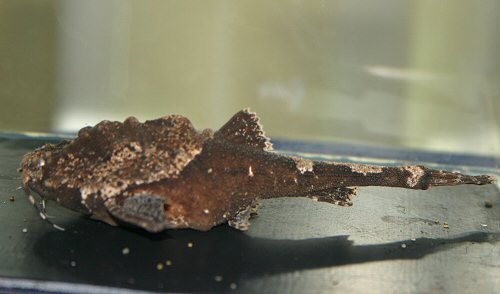
Common Name: |
Craggy Head Banjo Catfish |
Synonyms: |
Aspredo gronovii, Bunocephalichthys gronovii, Agmus lyriformis, Bunocephalus scabriceps, Aspredo verrucosa, Platystacus verrucosus |
Family: |
Aspredinidae |
Subfamily: |
Bunocephalinae |
Distribution: |
South America: Rivers of Guyana and Amazon River basin: Brazil, Ecuador, Guyana, Peru and Suriname. |
Size: |
10.0cm. (4ins) |
Temp: |
23-26°c (72-78°f.) |
p.H. |
5.8-7.6. |
Characteristics |
D 1/5; A 1/5-6; P 1/5; V 1/5. Head depressed but not strongly so, profile of cranium to dorsal fin arches, with varying bumps and notches. Body after dorsal fin thin and elongated. Strong pectoral fin spines and post-coracoid processes. Skin with tubercles. |
Colouration |
Base colour varies from light brown to dark brown, with speckles and patches of cream, grey, or white. The top of the head can sometimes be lighter than the rest of the body, sometimes even being nearly fully cream in colour. |
Aquarium Care & Compatibility |
| An extremely peaceful and lethargic species. May eat fry but other than that will not harm other fish. Should be kept with peaceful tankmates. |
Reproduction |
As yet unknown. |
Sexual differences |
There are no proven external sexual differences, but females appear to be more robust in the body and have proportionately shorter pectoral fin spines. |
Diet |
| Will eat most pellet and live foods. Frozen bloodworm and chopped earthworms are relished. |
Glossary of Terms |
Coracoid:
Middle and lower section of the pectoral girdle. |
Etymology |
| Bunocephalus:
Buno = mound; cephalus
= head.(with bumps on the head) |
References |
Mees,
G. F., 1988. The genera of the subfamily
Bunocephalinae (Pisces, Nematognathi, Aspredinidae).
Proc. K. Ned. Akad. Wet. (Ser. C Biol. Med. Sci.)
v. 91 (no. 1): 85-102. |
Photo Credits |
|
© Chris Ralph |
|

If you would like to contribute to the monthly factsheets with an article, information or photos, please e-mail me. You will of course be credited for your work.
If you would like to donate any denomination of money to the site just click the above link button. All proceeds will go to running the site and hopefully to keep it going for a few years yet.
ScotCat Sources
 Etymology-genera
Etymology-specific name
Other Sources
 Search
 Fishbase
 Catalog
of Fishes
Catalog
of Fishes
 GBIF
GBIF
 Fishnet2
 iNaturalist

