SCOTCAT.COM
your internet guide to all things catfish
FACTSHEETS: September 1998 - no. 027
Chrysichthys nigrodigitatus (Lacepede, 1803) |
Chrysichthys
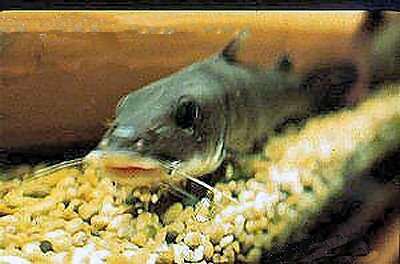
nigrodigitatus I have two 12" specimens housed in a 72" x 18"x 15" with large clay pipes for shelter and apart from a few skirmishes now and again I have had not too many problems with them (apart from growing!). So you should house them with larger community fish and you won't have many problems In the above picture you can see the large eyes (large mouth!) and relatively small barbels on this species which usually relates to the habitat where it resides, being clear water where large barbels for feeling for food is not needed, hence the large eyes for hunting prey. There are 4 pairs of barbels of course in the Claroteidae family I pair: maxillary, 1 pair: outer mandibular, 1 pair: inner mandibular and one pair of nasal barbels.
Chrysichthys nigrodigitatus - head view
The colour is quite drab in this species with a basic grey/silver body colouration and a white underside. It has a quite large dorsal fin and a deeply forked caudal fin. It is basically a food fish in its native African waters where it can grow to excess of 50cm (18") so I know what to do when they get too big :-) ( only joking). Its flesh is reported to be quite good and they are fished out of Lake Togo using all types of capture methods including nets and weirs. The males when fully grown usually have a broader head which they use to dig out their breeding nests in their native habitat.
|
 uite
a mouthful for a name and so would your tetra's be
as well if you housed this African bagrid in a community
tank with smaller characin type fish, as this is a
fish only suitable for a larger tank, as it can get
quite big. The genus Chrysichthys was split
off from Bagridae by Mo in 1991 along with
all of the African Bagrids bar one and is now housed
in the Claroteidae family. You can find out
more in the Ichthyology articles section titled,
uite
a mouthful for a name and so would your tetra's be
as well if you housed this African bagrid in a community
tank with smaller characin type fish, as this is a
fish only suitable for a larger tank, as it can get
quite big. The genus Chrysichthys was split
off from Bagridae by Mo in 1991 along with
all of the African Bagrids bar one and is now housed
in the Claroteidae family. You can find out
more in the Ichthyology articles section titled, 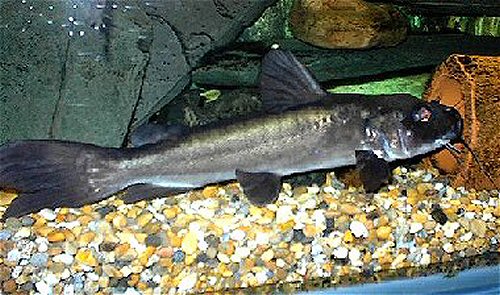
Common Name |
Silver Cat |
Synonyms |
Pimelodus nigrodigitatus, Arius acutivelis, Melanodactylus nigrodigitatus, Chrysichthys acutirostris, Chrysichthys büttkoferi, Chrysichthys ogowensis, Chrysichthys macrops, Chrysichthys coriscanus, Chrysichthys lagoensis. |
Family |
Claroteidae |
Subfamily |
- |
Distribution |
Africa: Senegal to Cabinda, Angola. |
Size |
50.0cm. (18ins) |
Temp |
23-26°C (73-79°F) |
p.H. |
6.0-7.2. |
Characteristics |
Dorsal 11,6; Anal 5-6, 9-10. Adipose fin is round and is not rayed. The head viwed from above is oval and the eye is very large and easily visible from above. The dorsal fin is large and its upper edge round. The caudal fin is deeply forked. |
Colouration |
The colour is grey/blue except for the ventral surface which is white. The fins are greyish-pink, the adipose fin black and the lips and the barbels pink. |
Aquarium Care & Compatibility |
| Peacful as youngsters but not to be trusted as they grow with smaller fish. Should do all right with larger fish such as Cichlids and the larger Barbs such as the 'Tinfoil', Barbonymus schwanenfeldii. |
Reproduction |
They excavate caves in the river banks. The eggs are laid in the caves and guarded by the parents until they hatch. The fry are then guarded until they become free-swimming. |
Diet |
| They are an omnivore and will take a wide variety of food in the aquarium including frozen food, tablets, pellets and prawns. |
Etymology |
| Chrysichthys:
Chrysos = gold; ichthys = fish. |
IUCN Red List |
This species has a wide distribution, with no known major widespread threats. It is therefore listed as Least Concern. (IUCN 2020). |
References |
Lalèyè,
P., Moelants, T., Azeroual, A. & da Costa, L.
2020. Chrysichthys nigrodigitatus. The IUCN Red List
of Threatened Species 2020. |
Photo Credits |
© Allan James
@ |

|

If you would like to contribute to the monthly factsheets with an
article, information or photos, please e-mail
me. You will of course be credited for your work.
If you would like to donate any denomination of money to the site just click the above link button. All proceeds will go to running the site and hopefully to keep it going for a few years yet.
ScotCat Sources
 Etymology-genera
Etymology-specific name
Online Sources
 Search
 Fishbase
 Catalog of Fishes
 GBIF
GBIF
 Fishnet2
 iNaturalist
 IUCN
IUCN

