SCOTCAT.COM
your internet guide to all things catfish
FACTSHEETS: June 2010 - no. 168
Brochis haraldschultzi Knaack, 1962 |
Brochis haraldschultzi is sometimes available amongst aquarium imports from South America, and is well worth looking out for in my opinion. It is suggested that aquarium specimens might grow to 80mm s.l. for males and 85mm s.l. for females. This is a very stunning species to look out for. It is documented that this catfish is confused with Hoplisoma araguaiaense which lacks the orange colouration in the fins, and is said to be similar to two other species, Brochis spectabilis and Brochis isbrueckeri. This catfish is described as being syntopic with Hoplisoma sterbai.
Brochis haraldschultzi
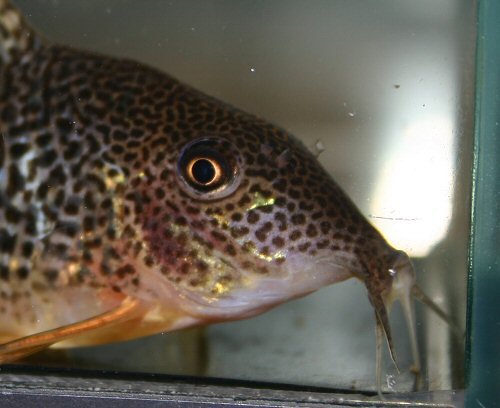
Brochis haraldschultzi - head view
Brochis haraldschultzi prefer to be kept in water which has a pH in the range of 6.0-7.2 and hardness in the range of 2-25ºdGH. This catfish is ideally suited to temperatures in the range of 22-27ºC or 71-8°F. I would suggest a minimum tank size of 24” x 15” X 12” for a small shoal of these fascinating little catfish. I would suggest good quality aquarium sand such as BD Aquarium Sand, or very smooth rounded gravel as the preferred substrate when keeping these catfish. The aquarium should provide some shelter in the form of rocks or bogwood along with some aquatic plants. As with all other species of fish, water quality and general husbandry is very important, and I would recommend that a minimum of 25% water is changed on a weekly to fortnightly basis. This catfish is quite often confused with Hoplisoma sterbai which has a dark basic colour to its body with white spots on its head and snout.
|
 his
month (June 2010) we welcome back regular
contributor, author and aquarist, Chris Ralph. His
subject this month is centered on an old favourite
from the Callichthyidae
family, Brochis
haraldschultzi. I now hand you over to Chris.
his
month (June 2010) we welcome back regular
contributor, author and aquarist, Chris Ralph. His
subject this month is centered on an old favourite
from the Callichthyidae
family, Brochis
haraldschultzi. I now hand you over to Chris.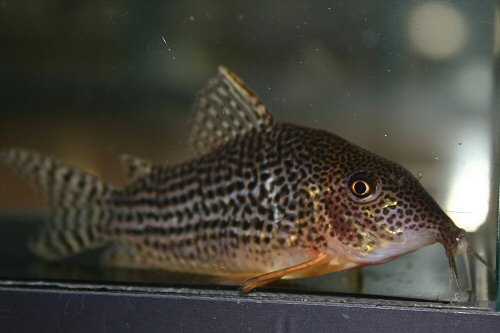
Remarks: Corydoras haraldschultzi is placed in Lineage 8 sub clade 4 which comprises the "intermediate long-snouts" with deeper bodies. It also includes Brochis in sub-clade 1 which was synonymised with Corydoras by Britto in 2003 but in time there will be a revision which will resurrect Brochis (Cope, 1871) to full genera again. As of the latest update Corydoras haraldschultzi has now been placed in Lineage 8 sub clade 4 and has the new genus name of Brochis (Dias 2024).
|
Common Name |
Schultz’s Cory |
Synonyms |
None |
Family |
Callichthyidae |
Subfamily |
Corydoradinae |
Distribution |
South America: Brazil and Bolivia. Type locality: Brasilien, Rio Guaporé. |
Size |
Male: 80mm: Female: 85mm SL. (standard length – this is the measurement of the fish from the tip of the snout to the base of the caudal peduncle). |
Temp |
22-27°C (71-81°F) |
p.H. |
6.0-7.2. |
Characteristics |
The body shape of Brochis haraldschultzi is described as being typical triangular Corydoras shaped with a pointed head and long snout. The body is slightly deeper in comparison to other species of Corydoras. The dorsal fin is described as having 7 to 8 soft rays. |
Colouration |
The base colour of the body and head is described as being light overlaid with 6 to 7 bands of dark coloured markings leading from the front of the dorsal down to the caudal peduncle. There are dark grey reticulated markings on the head which cover the snout and extend towards the leading ray of the dorsal fin. The pectoral and ventral fin spines are described as being orange in colour, whilst the remaining fins are described as being clear with black banding. |
Aquarium Care & Compatibility |
| Wherever possible I would recommend that the aquarist keep these catfish in a community aquarium in small groups of six or more, but as the absolute minimum I would suggest three specimens assuming that they are available in these numbers. In their natural habitat Corydoras haraldschultzi would be found in relatively large shoals. |
Reproduction |
There are no documented records of Brochis haraldschultzi having been spawned in aquaria to date. |
Sexual Differences |
As with most other species of catfish the males tend to be more slender than the females. The females are described as being larger and plumper as they get older. As with most other representatives of the family Corydoradinae, the male is documented as being much smaller than the female. |
Diet |
| Brochis haraldschultzi readily accepts a mixed and varied diet which includes granular foods, frozen bloodworm and a good quality flake. |
Etymology |
| Brochis:
A
sling, (a reference to the structure of the barbels). |
Glossary of Terms |
Adipose is
defined as a second dorsal fin which in the case of
Corydoras consists of fatty tissue with a single
spine supporting a thin membrane. |
References |
Alexandrou,
Markos & Taylor, Martin (2011). Evolution,
ecology and taxonomy of the Corydoradinae revisited. |
Photo Credits |
© Chris Ralph |
|

If you would like to contribute to the monthly factsheets with an
article, information or photos, please e-mail
me. You will of course be credited for your work.
If you would like to donate any denomination of money to the site just click the above link button. All proceeds will go to running the site and hopefully to keep it going for a few years yet.
ScotCat Sources
 Etymology-genera
Etymology-specific name
Online Sources
 Search
 Fishbase
 Wikipedia
 Catalog of Fishes
 GBIF
GBIF
 Fishnet2
 iNaturalist

