SCOTCAT.COM
your internet guide to all things catfish
FACTSHEETS: August 1997- no. 014
Corydoras oiapoquensis Nijssen, 1972 |
|
Corydoras oiapoquensis - Lineage 9
Corydoras oiapoquensis occurs in the wild alongside a long-snouted look-a-like Corydoras condiscipulus. The Latin name of condiscipulus actually means schoolmate pertaining to the fact that they are together much of the time. You can see in the imge below the difference in the length of the snout, and of course this shows in the different lineages of both species. Corydoras oiapoquensis is lineage 9 wheras Corydoras condiscipulus is lineage 8 sub clade 4.
Corydoras condiscipulus
They were imported into the U.K., as far as I know, about 1996. The top picture is the male, I think, as the females don't get very gravid looking or heavy before the spawning cycle, so sometimes you can make a mistake identifying them. I was lucky and picked up 2 males and 1 female from a well known outlet in the north of England in March 98 and housed them in a 17" x 15" x 15" tank. Every time that I appeared in the fishhouse they would scatter about the tank and so I decided to cover the top of the tank to cut down on the light. About 1 month later, with the tank being in darkness most of the time, I did not notice that they had spawned, with about 12 eggs laid on the Java Moss. I had missed the first spawning as the parents must have ate the fry, so I took the eggs out to a separate container. The eggs are a kind of rusty/orange colour and about 2mm in size. There are a few variations of this species where there is no banding in the tail and some that have no black blotch in the dorsal. Below is a small photo gallery of the breeding of Corydoras oiapoquensis, just click on the thumbnail to get a larger image.
Remarks: Corydoras oiapoquensis is placed in Lineage 9, the "short-snouted" species with the designated type species: C. punctatus. A revision in the future would constitute the resurrection of the genus name Hoplosopma (Agassiz, 1846).
|
 his
cory is like a
his
cory is like a 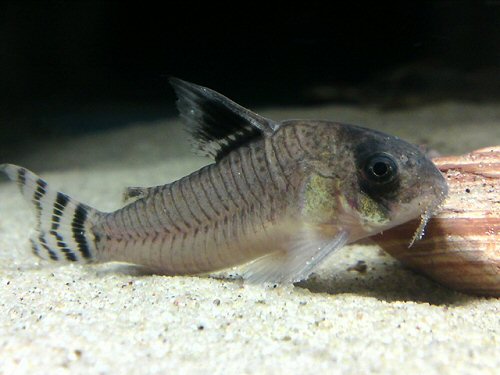


Common Name |
Stripe Tailed Panda |
Synonyms |
None |
Family |
Callichthyidae |
Subfamily |
Corydoradinae |
Distribution |
South America: French Guiana; Cumuri Creek at left bank of Río Oiapoque upstream of first rapids of Grande Roche, southwest of village Oiapoque. |
Size |
Male: 5.0cm (2ins) Female: 5.5cm (2¼ins) |
Temp. |
23-25°C (73-77°F) |
p.H. |
6.0-7.2. |
Characteristics |
Dorsal 1/7; Anal 1/5; Head short and compact. |
Colouration |
Flesh coloured body. Dorsal fin with black blotch to base. Caudal fin with black blotch at the base with dark bands. Black band covering eyes. Adipse fin with a black marking to leading edge. |
Aquarium Care & Compatibility |
| A tank setup would entail a soft substrate such as sand or a small gravel and a nice plant covering around the back and sides of the aquarium. If housed in a community tank a mixture of small South American characins or the smaller varieties of Asian Rasboras would suffice, as larger fishes would intimidate these shy Cory's, and would stop them eating and would be therefore detrimental to their overall health. |
Reproduction |
As stated above, the tank size, but a 18" x 12" x 12" would suffice. When they spawned the tank parameters were a temp.of 77f and a pH of 6.with a GH of 1. As mentioned before they are apt to eating very small fry, so it is advised to take the eggs away and introduce the fry back, if desired, at about 1 month old. They are quite an easy species to spawn and I was surprised that they did when the pH was on the low side. A very shy species and likes to hide in the tank, so give pots etc.for their comfort. |
Diet |
| The usual fare for adult Corydoras, a good quality flake food, tablet food, frozen bloodworm and whiteworm used sparingly.The fry can be fed brine shrimp from a very early age and grow quick in the first month, then they are apt to slow down. |
Etymology |
| Corydoras:
Cory = helmeted; doras =
leathery skin, (helmeted Doras) cuirass. |
References |
| Alexandrou,
Markos & Taylor, Martin. (2011). Evolution,
ecology and taxonomy of the Corydoradinae revisited.
|
Photo Credits |
| Top:
©
Mark Goh |

|

If you would like to contribute to the monthly factsheets with an article, information or photos, please e-mail me. You will of course be credited for your work.
If you would like to donate any denomination of money to the site just click the above link button. All proceeds will go to running the site and hopefully to keep it going for a few years yet.
ScotCat Sources
 Etymology-genera
Etymology-specific name
Online Sources
 Search
 Fishbase
 Catalog of Fishes
 GBIF
GBIF
 Fishnet2
 iNaturalist

