SCOTCAT.COM
your internet guide to all things catfish
FACTSHEETS: August 2002 - no. 074
Corydoras panda Nijssen & Isbrücker, 1971 |
|
Corydoras panda
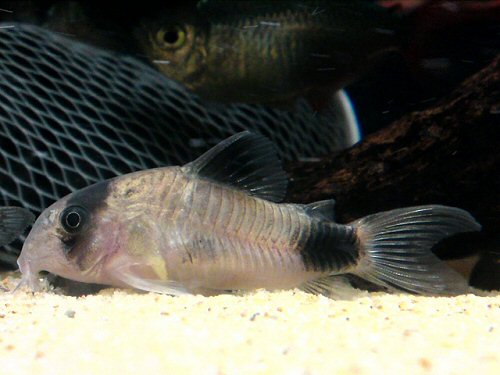
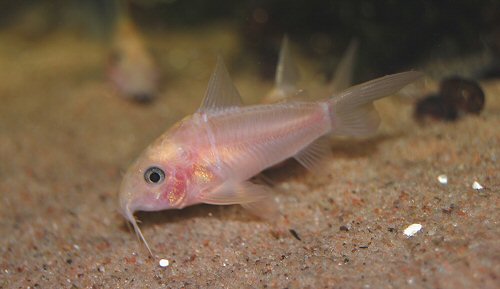
This Corydoras is actually a recent addition, in aquarium terms anyway, to the catfish hobby and was collected by Foersch and Hanrieder in a mountain brook at the side of the Rio Lullapichis (Ucayali/Peru) in 1969. It was not until 1971 that it was named in honour of the Giant Panda of China (Ailuropoda melanoleuca), which its markings resemble, by Nijssen & Isbrücker. The water conditions in this black water river was a pH of 7.7 and 3.1dGH. The temperature of the water ranged from 23.5°C (74.3°F) during the day and dropping down to 22.5°C (72°F) in the evening. The panda cory created a great disturbance in the late 70's early 80's when it started to get a foothold in the hobby due to a breeding project carried out in Germany accumulating with this species arriving in the U.K. around about 1982. My abiding memory was of seeing this Corydoras at the British Aquarist Festival in Manchester of that year, with them priced on a stall at £40 each, needless to say I did not purchase any, I only admired them from afar!. Of course nowadays this is a relatively inexpensive Corydoras to purchase as it has been bred often and proven to be hardy and not too hard to breed in the aquarium. There is a Leucistic specimen that are believed to have been bred in Germany and are not albino but close to being leucistic i.e., pigment in the body with black eyes as seen below.
Corydoras panda - leucistic specimen
There is a clue in the collection data of this species in that it likes the water to be on the cooler side as it was first collected in the foothills of the Andes Mountains and as such the lower temperatures suits this Corydoras ideally, but in saying that the species in your tank has probably been far removed from the wild generation and would be used to temperatures in the high seventies, but I would be inclined to stick to the middle range of between 21°C-24°C (69°F-75°F.) A good pH range would be around the neutral mark (7) as they do not like the water to be too acidic. This is a small inoffensive little Cory which will do better in a shoal, so buy at least six or more individuals. It would also be advisable not to keep rombustous species in with them such as Tiger Barbs and other fin nipping species as they would worry them to death with their constant harassment and would also deprive them of food as they would be inclined not to venture out for feeding, large Cichlids would also be a bad choice. A good community tank for them would house inoffensive tetras such as Neon's and other smaller characins, and if you would like other catfish any of the Ancistrus types would make good partners and of course other Corydoras or Aspidoras species. If you would like to breed Corydoras panda a species tank is the only way to go with a tank size of 18"x 12" x 12" being ideal for a group of six.
Remarks: Corydoras panda is placed in Lineage 9, the "short-snouted" species with the designated type species: C. punctatus. A revision in the future would constitute the resurrection of the genus name Hoplosopma (Agassiz, 1846).
|
 t
has been a few months (October 2001) since my last Corydoras
factsheet and I did not need a second reminder when
I was sent a factsheet request to include this delightful
little Cory in the factsheets archive.
t
has been a few months (October 2001) since my last Corydoras
factsheet and I did not need a second reminder when
I was sent a factsheet request to include this delightful
little Cory in the factsheets archive.
Common Name |
Panda Cory |
Synonyms |
None |
Family |
Callichthyidae |
Subfamily |
Corydoradinae |
Distribution |
South America: Peru; Upper Amazon River basin. Type locality: Peru, Est. Huanuco, Aquas Amarillas, tributary of Río Pachitea, Ucayali river system. |
Size |
Male: 4.5cm (1¾ins) Female: 5.0cm (2ins) |
Temp. |
21-24°C (69-75°F) |
p.H. |
6.0-7.2. |
Characteristics |
Dorsal 1/7; Anal 1/5; Head short and compact. |
Colouration |
Body sandy coloured with black spot/patch on caudal peduncle and dorsal. Black band bridges head and covers both eyes. Gold shimmer to gill covers. Rest of fins hyaline (clear). |
Aquarium Care & Compatibility |
| This is akin to most of this genus, very peaceful, and would be best housed with small to medium tankmates such as Tetras, Rasboras and Danios or in a species tank for breeding purposes. |
Reproduction |
Not too difficult, will breed as per any Corydoras species giving a good diet and water conditions, and water changes of a lower temperature to induce spawning. Two males to one female or one pair. Setup could be a 18"x12"x12" tank with sand or bare bottom with Java moss, Java fern and a sponge filter, adding if you like a power filter for extra aeration and circulation of the water all leading to a hopefully successful spawning. See the breeding section of the ScotCat articles page to read many successful spawning reports of the Corydoras genera. |
Diet |
| Like all Corydoras they like a good quality flake food which will have all the goodness and vitamins that they need and also tablet food. For a breeding project they relish frozen bloodworm, grindal and whiteworm. |
Etymology |
| Corydoras:
Cory = helmeted; doras =
leathery skin, (helmeted Doras) cuirass. |
References |
| Alexandrou,
Markos & Taylor, Martin. (2011). Evolution,
ecology and taxonomy of the Corydoradinae revisited.
|
Photo Credits |
| Top:
©
Mark Goh |
|

If you would like to contribute to the monthly factsheets with an article, information or photos, please e-mail me. You will of course be credited for your work.
If you would like to donate any denomination of money to the site just click the above link button. All proceeds will go to running the site and hopefully to keep it going for a few years yet.
ScotCat Sources
 Art Gallery
 Etymology-genera
Etymology-specific name
Online Sources
 Search
 Fishbase
 Wikipedia
 Catalog of Fishes
 GBIF
GBIF
 Fishnet2
 iNaturalist
 Tankarium

