SCOTCAT.COM
your internet guide to all things catfish
FACTSHEETS: November 2015- no. 233
Glyptothorax trilineatus Blyth, 1860 |
|
Glyptothorax trilineatus
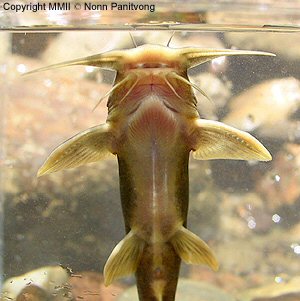
Glyptothorax trilineatus is a pretty looking species being one of the largest in this genera and occurs in the basin-wide tributary of the lower Mekong. The Glyptothorax genus is distinguished from all other sisorid genera by having an adhesive apparatus on the thorax with with grooves parallel or oblique to the longitudinal axis of the body (vs. thoracic adhesive grooves transverse to the longitudinal axis of the body in Pseudecheneis, and thoracic adhesive apparatus absent in all other genera).
Glyptothorax trilineatus - showing the Thorax (Breastplate)
|
 ts the month of November 2015 and we head to Asia
for an interesting group
of fishes that have captivated many catfish
lovers over the years due to
their unusual mode of stability in the mountain streams
where they are adapted to live
by using the adhesive apparatus on the underside to
attach themselves to rocks, and prevent them being
washed away.
ts the month of November 2015 and we head to Asia
for an interesting group
of fishes that have captivated many catfish
lovers over the years due to
their unusual mode of stability in the mountain streams
where they are adapted to live
by using the adhesive apparatus on the underside to
attach themselves to rocks, and prevent them being
washed away.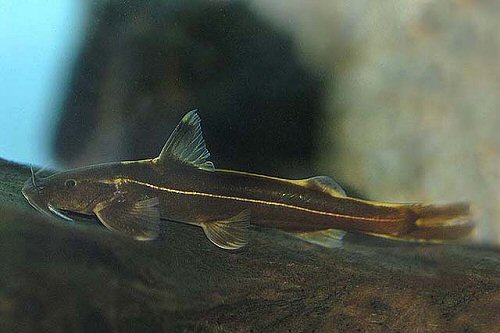
Common Name |
Three-lined catfish |
Synonyms |
Glyptosternum trilineatum |
Family |
Sisoridae |
Subfamily |
Glyptosterninae |
Distribution |
Asia: Irrawaddy, Sittang and Salween drainages, India, Myanmar and China. Type locality: Tenasserim [Sittang drainage], Myanmar, [Burma]. |
Size |
25.0cm. (9¾ins) |
Temp. |
10-20°c (47-67°f.) |
p.H. |
6.0-7.2. |
Characteristics |
Dorsal spines (total): 1 - 1; Dorsal soft rays (total): 6 - 6; Anal soft rays: 13. The eyes are small and dorsally placed. The lips are thick, fleshy, and often papillate. The maxillary barbels have a well-developed membrane and a soft base. The gill openings are wide. The paired fins are plaited and modified to form an adhesive apparatus in some species of Glyptothorax. |
Colouration |
A white mid-dorsal stripe extending from occiput to base of caudal fin, a narrow whitish axial line on sides from shoulder to base of caudal peduncle. |
Aquarium Care & Compatibility |
| This is a cool water species of which most of this genera are. A good water flow is also important with high oxygen levels. Other Asian tank mates such as Rasboras, danios, devario's and Puntius species. |
Reproduction |
No reports |
Sexual Differences |
No reports of sexual differences. Although it is believed that the females are more rotund ventrically than the males when viewed from above. |
Diet |
| Live foods such as white worms, small earthworms and aquatic insect larvae like bloodworms and similar chironomids, should make up the majority of their weekly diet. They will also accept frozen foods such as bloodworm. |
Glossary of Terms |
| Anal
fin: The
median, unpaired, ventrally located fin that lies
behind the anus, usually on the posterior half of
the fish. |
Etymology |
| Glyptothorax:
With a carved breast-plate. |
References |
Froese,
R. and D. Pauly. Editors. 2008. FishBase. World
Wide Web electronic publication. www.fishbase.org, version
(10/2008). |
Photo Credits |
| Top:
© Johnny Jensen @ |

|

If you would like to contribute to the monthly factsheets with an article, information or photos, please e-mail me. You will of course be credited for your work.
If you would like to donate any denomination of money to the site just click the above link button. All proceeds will go to running the site and hopefully to keep it going for a few years yet.
ScotCat Sources
 Etymology-genera
Etymology-specific name
Other Sources
 Search
 Fishbase
 Catalog
of Fishes
Catalog
of Fishes
 GBIF
GBIF
 Fishnet2
 iNaturalist

