SCOTCAT.COM
your internet guide to all things catfish
FACTSHEETS: December 2004 - no. 102
Hemibagrus nemerus (Valenciennes, 1839) |
Hemibagrus
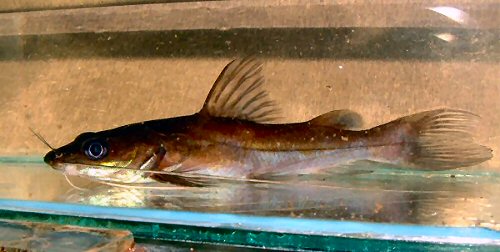
nemerus This can become a pretty nasty character in your fish tanks and if housed with other fish can be lethal. Cichlids such as the Pikes from the Crenichla genus that can look after themselves would be the best bet for other tankmates. I have housed them with Synodontis and they can make a lot of damage to their fins and can kill smaller specimens by charging them midriff and causing internal injuries. The reason for this factsheet this month is that there are a lot for sale around the U.K. at present going under various names with such as Mystus gulio and there seems to be quite an influx of asian imports at the present (Nov.2004). They look quite nice at about 10cm (4inch) and you could be fooled into thinking that "they would make a nice addition to my community tank"!.
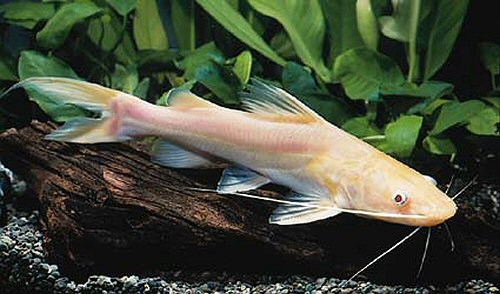
Hemibagrus nemerus - albino
There are a few identification checks to make between H. nemerus and H. wyckioides. H. nemerus has a smaller adipose fin and a identifying black mark on this fin which can even be seen on the farm bred albino variety above. It also possess a filament extension to the top caudal lobe and there are a few specimens that do not even have the pinkish/orange colour to the caudal but have the same colouration as the body.
Hemibagrus nemerus - juvenile
Tying in with the factsheet of two months ago, Hemibagrus wyckioides, there is also a link to last months factshheet for the Helicopter catfish Wallagoni leerii, in that this enormous catfish from the Siluridae family actually predates on H. nemerus in its native habitat so there is always something else higher up in the food chain!. Your tank set-up should be at least a 4ft long for juveniles with either gravel or a sand base with rockwork and also plants if you so prefer. H.nemerus will rearrange the substrate to suit itself anyway with the gravel bed being shifted and usually banked up the side of the aquarium walls. External filtration is a better bet with weekly water changes carried out, although this catfish is very hardy and can take most tank parameters. In its native habitat they are caught by seines, hook and line, gill nets, cast nets and traps and then taken to the local markets to be sold fresh.
|
 e
continue our look at another "Wolf in sheep's
clothing" continuing the theme from our 100th
factsheet two months ago in spotlighting the Asian
Red Tailed catfish,
e
continue our look at another "Wolf in sheep's
clothing" continuing the theme from our 100th
factsheet two months ago in spotlighting the Asian
Red Tailed catfish, 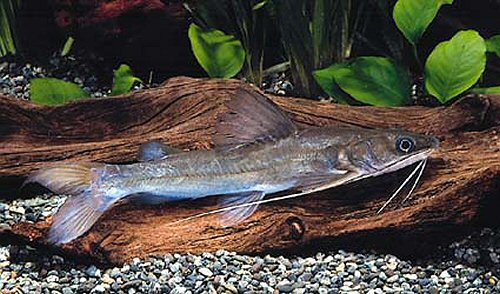
Common Name |
False Asian Red Tailed Catfish |
Synonyms |
Bagrus nemurus, Mystus nemurus, Macrones nemurus, Hemibagrus hoevenii, Bagrus hoevenii |
Family |
Bagridae |
Subfamily |
Bagrinae |
Distribution |
Asia: Cambodia, Indonesia, Laos, Malaysia, Singapore, Thailand, Viet Nam. |
Size |
65.0cm (26ins) |
Temp. |
22-25°C (71-77°F) |
p.H. |
7.0-8.2. |
Characteristics |
The dorsal fin has 2 spines with 7 soft rays. The anal fin has 10-13 soft rays. Base of adipose fin shorter than that of dorsal fin and about equal to that of anal fin. Barbels four pairs; nasal barbels extending to or beyond eyes, maxillary ones in anal fin, mandibulary ones beyond base of pectoral fins, mental ones 2/3 - 3/4 the distance between their base and insertion of pectoral fins. Head flattened rather than conical; rugose skull roof; depressed dorsal fin not reaching adipose fin; pectoral fin smooth in front. |
Colouration |
Body colour brown often with greenish sheen. Fins grey with violet tint. Caudal fin sometimes shows a pinkish/orange colouration. Dark pigmentation to adipose fin. |
Aquarium Care & Compatibility |
| Not to be trusted with other fish. If kept with other fish they will have to be able to look after themselves as mentioned above. |
Reproduction |
There are no known reported aquarium spawning's of this catfish, most likely due to the eventual size that these fish attain and their aggressive nature! The males are said to possess a genital papilla just in front of the anal fin. Breeds in the summer months in its natural habitat. Moves into the flooded forest to spawn and the youngsters are usually seen in August. Returns to the larger Rivers at the end of the year. |
Diet |
| Whilst this catfish is best described as a predator/carnivore in its natural habitat feedings of fish, insects, shrimps and other crustaceans, in captivity this catfish will feed on mussels, prawns, pieces of fish, earthworms and will even take prepared foods such as catfish pellets. |
Etymology |
| Hemi-
half; bagrus - From 'bagre',
a South American name for a catfish, but is only used
for African and Asian species. |
References |
Froese,
R. and D. Pauly.
Editors. 2004. FishBase. World Wide Web electronic
publication. www.fishbase.org, version (11/2004).
|
Photo Credits |
Top:
& Middle © Bottom:
© Allan James @
|


|

If you would like to contribute to the monthly factsheets with an
article, information or photos, please e-mail
me. You will of course be credited for your work.
If you would like to donate any denomination of money to the site just click the above link button. All proceeds will go to running the site and hopefully to keep it going for a few years yet.
ScotCat Sources
 Etymology-genera
Etymology-specific name
Online Sources
 Search
 Fishbase
 Catalog of Fishes
 GBIF
GBIF
 Fishnet2
 iNaturalist

