SCOTCAT.COM
your internet guide to all things catfish
FACTSHEETS: January 2007 - no. 127
Horabagrus nigricollaris Pethiyagoda & Kottelat, 1994 |
Horabagrus
nigricollaris
I have kept plenty of catfish that like to hide away for weeks and even months on end and this species certainly fits in with the latter. It is kept in the fishhouse so maybe you may see it more in a tank situated in your living room. There are now three species in this genus (see updates below), the other species that is alike is Horabagrus brachysoma, and the differences between the two apart from colouration (see image below) is that H. nigricollaris has the spot behind the gills extending over the head to meet the corresponding spot on the other side whereas H. brachysoma has only the spot on both sides (a good identification guide). There are also slight differences with the caudal and dorsal fins. Colour in the tank can vary from light to very dark depending on lighting and substrate.
Horabagrus brachysoma - similar apart from colouration
The Horabagrus genus has had a checkered history with H. brachysoma named in 1864 by Günther as Pseudobagrus brachysoma and placed in the Bagridae family. In 1955, Day, while studying this family, created a new genus Horabagrus and placed this only species (at that time) into it. In 1964, Tilak in studying the osteology and weberian apparatus of the Schilbidae family doubted the inclusion of Horabagrus in the Bagridae family. Mo (1991) then suggested that this genus should be placed in the Schilbidae family and a few authors have actually taken this as they feel that there are a few similarities that place them in this family. At the moment we at ScotCat have it in Bagridae but I am sure that in the future there will be more work done on this genus and a final destination for these two species. The Horabagrus genera including H. brachysoma and H. nigricollaris were originally placed in the Bagridae family but work carried out by JAYARAM suggested that the Horabagrus were more closely related to the Schilbidae family but could be given their own family, Horabagridae, with some species taken out of the Schilbidae that are phylogenetically different. As bagrids go this is quite a pretty species and along with its near cousin, H. brachsoma, should make an interesting addition to your catfish collection.
UPDATE: Horabagrus nigricollaris has of course now been moved into a new family, Horabagridae, alongside H. brachysoma,and as of 2024 there are now 3 species in this genera with Horabagrus obscurus now being added.
|
 he first factsheet of 2007 centers
on a relatively new member and a new family, the Horabagridae,
and to me one of the most secretive, the "Black
Collared Catfish", Horabagrus nigricollaris.
he first factsheet of 2007 centers
on a relatively new member and a new family, the Horabagridae,
and to me one of the most secretive, the "Black
Collared Catfish", Horabagrus nigricollaris.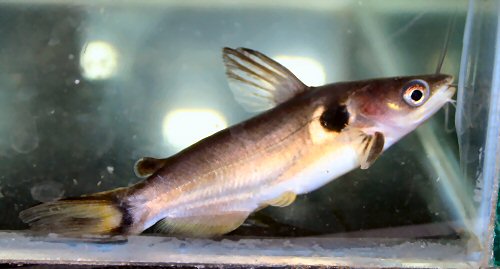
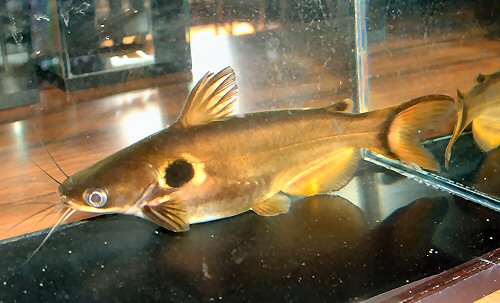
Common Name |
Black Collared Catfish. |
Synonyms |
None |
Family |
Horabagridae |
Subfamily |
Horabagrinae |
Distribution |
Asia: India, Kerala, Chalakudy River, 26 km upstream of Chalakudy town, near Vettilappara. |
Size |
30.0cm. (12ins) |
Temp. |
23-25°C (73-77°F) |
p.H. |
6.5-7.2 |
Characteristics |
D. 1, 5; P. 1,8; V. i, 5; A. iii, 23-26; C. 8+9=17. Median longitudinal groove on head in a single oval fontanel anteriorly narrow not extending posteriorly beyond orbit. Occipital process distinct, extending to basal bone of dorsal fin. Four pairs of barbels; maxillary extending well beyond base of pectoral fin, nasals almost to base of occipital process, outer mandibular to base of pectoral fin, inner pair much shorter not reaching pectoral fin base. Branchiostegal rays 10. Rayed dorsal fin inserted above anterior half of pectoral fin, spine sharp, with 12-16 serrations along the posterior margin. Adipose dorsal fin short, well separated from caudal fin. Pectoral fin not reaching pelvics, spine with 9 to 11 serrations along outer edge and 13-17 along inner edge. Pelvic fin reaching anal fin origin. Anal fin long not reaching caudal fin base. Least height of caudal peduncle 1.0 in its length. Caudal fin forked, lobes rounded and sub-equal. |
Colouration |
Head and body grey/brown, darker dorsally. Belly white. A black saddle shaped band edged in white extends from the humeral region of each side over the back. Caudal fin light yellow edged in black. Caudal base black. Pectoral and ventral fins light grey. Dorsal hyaline, dark at base. Anal and caudal fin edged in black. |
Aquarium Care & Compatibility |
| This species along with H. nigricollaris are extremaly nocturnal and would do better if the aquarium is not too brightly lit, and you may see them if you feed at night. Will do well in a larger community tank with other bagrids such as Pseudomystus siamensis but will be predatory on smaller fishes that are even at the 2 inch (5cm) mark as they will charge into them at night and stun them, then they will consume the injured fish, so house with larger barbs and Characins such as Congo Tetra's that are over this size. |
Reproduction |
Not reported. |
Sexual Differences |
Not reported but females would probably be more rotund especially in the breeding season. |
Diet |
| Will feed mostly at darkness but if plenty of cover is provided they will dart out and feed quickly. Worm and tablet foods will all be taken greedily. |
Glossary of Terms |
Branchiostegal:
Slender bones which support the gill membranes. |
Etymology |
| Horabagrus:
Taken from Mr. S.L.Hora,
director of Zoological Survey of India + Greek, pagros
= a fish, Dentex sp. |
References |
Jayaram; K.C., Catfishes of India, Narendera Publishing House 2006, p 144-145. |
Photo Credits |
Top image: © Chris
Ralph |

|

If you would like to contribute to the monthly factsheets with an
article, information or photos, please e-mail
me. You will of course be credited for your work.
If you would like to donate any denomination of money to the site just click the above link button. All proceeds will go to running the site and hopefully to keep it going for a few years yet.
ScotCat Sources
 Etymology-genera
Etymology-specific name
Online Sources
 Search
 Fishbase
 Wikipedia
 Catalog of Fishes
 GBIF
GBIF
 iNaturalist

